When it comes to ensuring the safety and well-being of your elderly loved ones at home, smart elder care sensors can make a significant difference. These devices offer real-time alerts and tailored monitoring solutions, giving you peace of mind without compromising privacy. With various options available, like fall detection systems and caregiver pagers, you’ll find the perfect fit for your needs. But which ones stand out as the best choices? Let’s explore the top ten options.
Medical Alert System with Fall Detection for Seniors
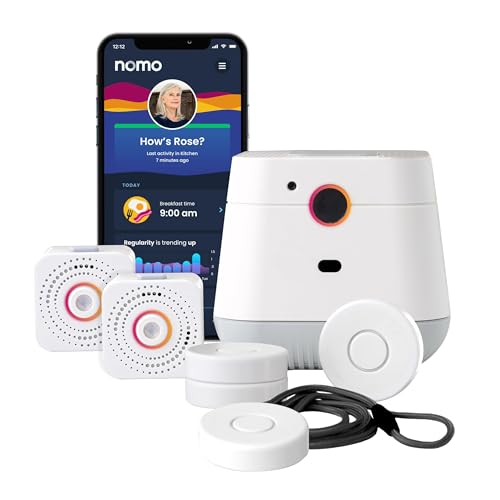
If you’re looking for a reliable way to guarantee the safety of your elderly loved ones at home, the Nomo Smart Care Essential Kit is an excellent choice. This medical alert system features fall detection, ensuring peace of mind for you and your family. With its Smart Hub, motion-sensing Satellites, and movement-capturing Tags, it provides real-time alerts via secure WiFi—no landline needed. Installation is quick and hassle-free, requiring just a plug-and-play setup. Plus, the two-way voice communication allows immediate contact during emergencies. With 24/7 monitoring and adjustable alert sensitivity, it’s a smart, modern solution for seniors aging in place.
Best For: Seniors who want a reliable and modern solution for in-home safety and emergency alerts.
Pros:
- Quick and easy installation with plug-and-play setup, requiring no special wiring or technician visits.
- Two-way voice communication for immediate contact during emergencies enhances safety for seniors.
- 24/7 monitoring with adjustable alert sensitivity, providing comprehensive support for seniors and their families.
Cons:
- Monthly subscription fee of $19.99 after the 30-day trial may not be ideal for all budgets.
- Dependence on WiFi means that service could be disrupted during internet outages.
- Tags may need to be worn or placed carefully to ensure effective fall detection and movement monitoring.
Caregiver Pager WiFi Door Alarm for Dementia Patients

The Caregiver Pager WiFi Door Alarm is an essential tool for families caring for dementia patients, providing peace of mind through its real-time alerts. This system includes two sensors and a gateway, connecting to your smartphone via a free app. You’ll receive instant notifications when doors or windows open, no matter where you are. With 32 ringtones and five volume levels, it accommodates different needs, including a built-in LED indicator for the hearing impaired. Plus, you can share alerts with multiple users and expand the system with additional sensors. Extensive support guarantees you’ll have assistance whenever needed.
Best For: Families caring for dementia patients who need reliable and real-time alerts for door and window openings.
Pros:
- Provides instant notifications via a smartphone app, ensuring caregivers are always informed.
- Features customizable alerts with 32 ringtones and adjustable volume levels, catering to various needs.
- Expandable system allows for adding more sensors and sharing alerts with multiple users.
Cons:
- Requires a stable WiFi connection for optimal functionality, which may not be available in all locations.
- Initial setup may be challenging for individuals who are not tech-savvy.
- Limited to alerting only for door and window openings, lacking additional security features.
Upgraded Bed Sensor Alarm for Elderly and Dementia Care
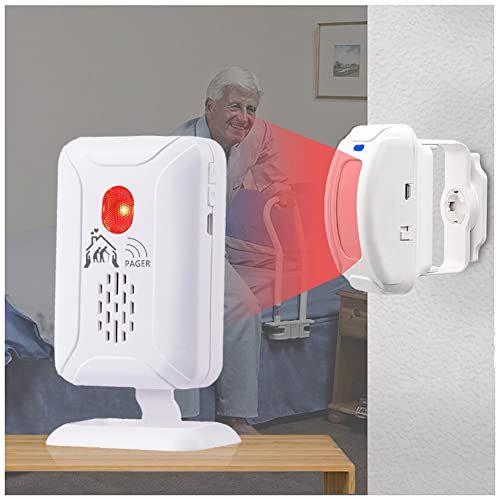
For caregivers seeking peace of mind, the upgraded bed sensor alarm stands out as an ideal choice for elderly and dementia patients. This advanced system features wireless motion sensors that trigger an alarm when a patient’s foot touches the ground, ensuring you’re alerted when they start to get up. It includes a caregiver pager with five volume levels, allowing you to monitor your loved one from afar. The alarm is designed not to startle patients, minimizing the risk of falls. With easy installation and reliable functionality, this bed sensor alarm enhances safety and simplifies monitoring for caregivers like you.
Best For: Caregivers of elderly and dementia patients who need a reliable alert system for monitoring mobility.
Pros:
- Wireless technology allows for easy installation and placement of motion sensors.
- Five volume levels on the caregiver pager enable customizable alert settings.
- Safety feature prevents startling patients, reducing the risk of falls.
Cons:
- Initial testing required to ensure proper sensing range and direction before permanent installation.
- Limited operational range of 918ft may not be suitable for larger homes or facilities.
- Battery dependency may require regular monitoring and replacement of AA and AAA batteries.
Lunderg Early Alert Bed Alarm for Elderly Adults

Designed specifically for elderly adults and those with dementia, the Lunderg Early Alert Bed Alarm stands out as an essential tool for fall prevention. This wireless sensor pad and pager alerts you before your loved one fully gets out of bed, giving caregivers time to intervene. With patented Pre-Alert Smart Technology, it minimizes false alarms while providing reliable notifications. The user-friendly design makes setup a breeze, and the lightweight pager fits easily in your pocket. With a pad lifespan of 15 months, you can trust this system for long-term safety, ensuring peace of mind for both you and your loved ones.
Best For: The Lunderg Early Alert Bed Alarm is best for elderly adults and dementia patients who require fall prevention support while providing caregivers with timely alerts.
Pros:
- Pre-Alert Smart Technology minimizes false alarms and allows for timely intervention.
- User-friendly design with easy setup and a pressure pad that is resistant to incontinence.
- Long pad lifespan of 15 months, offering more reliability than many competitors.
Cons:
- Proper placement of the pad is crucial to prevent false alarms, which may require additional adjustments.
- The device may not be suitable for individuals who are very active or frequently shift positions in bed.
- Some users may find the pager’s volume settings insufficient for noisy environments.
WiFi Smart Bed Sensor Alarm for Elderly and Seniors

Offering peace of mind for caregivers, the WiFi Smart Bed Sensor Alarm is perfect for elderly individuals, seniors, and those with dementia. When motion is detected, the hub rings and sends an alert to your smartphone, no matter where you are. The sensor works within a 330ft range outdoors and 30-150ft indoors, easily placed under the bed or on the doorframe. You can share alerts through the Smart Life app with multiple users, ensuring everyone stays informed. Plus, you can expand the system by adding more hubs or transmitters, tailoring it to your needs for ultimate safety and convenience.
Best For: The WiFi Smart Bed Sensor Alarm is best for elderly individuals, seniors, and those with dementia who require monitoring for safety and quick caregiver alerts.
Pros:
- Provides real-time alerts via smartphone notifications when motion is detected.
- Offers a wide range of operation, up to 330ft outdoors and 150ft indoors, for flexible placement.
- Expandable system allows for additional hubs and transmitters to enhance monitoring capabilities.
Cons:
- Only supports 2.4GHz WiFi, which may limit connectivity options for some users.
- Requires installation and setup that may be complex for some caregivers or elderly users.
- Only one phone can connect directly to the hub, which may limit immediate access for multiple caregivers.
Smart Caregiver Floor Mat Alarm and Pager System

The Smart Caregiver Floor Mat Alarm and Pager System is an ideal solution for caregivers of seniors, particularly those with dementia. This system features a durable 24in x 48in floor mat sensor that alerts you via a wireless pager when someone steps on it. With a range of up to 300 feet, you’ll receive sound or vibrate notifications without disturbing your loved one. You can place the mat near the bed to prevent nighttime falls or by an exit door for wandering alerts. Plus, it easily pairs with other Smart Caregiver products, enhancing overall safety and monitoring capabilities.
Best For: Caregivers of seniors, especially those with dementia, who need an effective way to monitor movements and prevent falls or wandering.
Pros:
- Wireless pager allows caregivers to be alerted up to 300 feet away without disturbing the patient.
- Durable floor mat sensor effectively detects movement, providing peace of mind for caregivers.
- Compatible with other Smart Caregiver products, enhancing the overall safety and monitoring system.
Cons:
- Requires 2 AA batteries for the pager, which are not included with the system.
- Limited to the range of 300 feet, which may not be sufficient in larger homes.
- Initial setup may require some adjustments to find the best placement for the floor mat.
Smart Caregiver Bed Exit Alarm with Wireless Pager for Fall Prevention

For families caring for seniors at home, the Smart Caregiver Bed Exit Alarm with Wireless Pager stands out as an essential tool for fall prevention. This system features a weight-sensing bed pad that alerts you when your loved one gets out of bed, allowing you to manage daily tasks with peace of mind. The advanced pager offers both vibrate and sound alerts, ensuring you won’t miss any notifications. Plus, it supports up to six sensors, providing extensive monitoring for beds, chairs, and doorways. With its reliable design and responsive customer support, you can trust this system to enhance safety at home.
Best For: Families caring for seniors or elderly individuals who require assistance in fall prevention at home.
Pros:
- Advanced weight-sensing bed pad provides timely alerts when the patient leaves the bed.
- Multiple alert options (vibrate and sound) ensure caregivers can respond quickly and effectively.
- Supports up to six sensors for comprehensive monitoring across various areas, enhancing overall safety.
Cons:
- Initial setup may require some technical knowledge for optimal use.
- Limited to wireless range, which may affect performance in larger homes.
- Some users may experience occasional false alarms despite the design aimed at minimizing them.
Smart Caregiver Central Monitoring Unit for Elderly Care (Model 433-CMU)

Ideal for caregivers in assisted living facilities or private homes, the Smart Caregiver Central Monitoring Unit (Model 433-CMU) provides seamless monitoring of up to 40 wireless sensors. You’ll appreciate the large display that shows which sensor is alerting, allowing for quick responses. With immediate audible and visual alerts, you can guarantee your loved ones receive timely assistance, enhancing their safety. The unit supports a range of up to 300 feet, making it perfect for larger spaces. Plus, it’s user-friendly and cost-effective, with no monthly fees, and can be easily set up for multiple residents.
Best For: Caregivers in assisted living facilities or private homes who need a reliable and efficient monitoring system for elderly care.
Pros:
- Provides immediate audible and visual alerts for timely caregiver responses.
- Supports up to 40 wireless sensors, ideal for monitoring multiple residents.
- No monthly fees or subscriptions, making it a cost-effective solution.
Cons:
- Limited range of 300 feet may not be sufficient for very large properties.
- Requires batteries or an AC adapter for operation, which may add to maintenance.
- Initial setup may require some time to assign individual numbers to sensors.
Bed Alarms for Elderly Dementia Patients – Digital Sensor with Caregiver Pager

Designed specifically for elderly dementia patients, the bed alarms equipped with a digital sensor and caregiver pager offer an essential solution for enhancing safety at home. With a wireless range of 1,000 feet, you can easily monitor movements without worrying about monthly fees. The innovative infrared sensors detect footstep motion, minimizing false alarms caused by shifting or incontinence. When triggered, the caregiver pager displays the exact sensor ID, enabling you to respond 50% faster to emergencies. Plus, with 100% privacy protection and an expandable system, you’ll guarantee all-encompassing monitoring while respecting your loved one’s dignity.
Best For: Elderly dementia patients and their caregivers seeking a reliable and non-intrusive monitoring solution at home.
Pros:
- Innovative sensor technology reduces false alarms by detecting footstep motion instead of relying on pressure pads.
- Quick response capability with caregiver pager displaying exact sensor ID, allowing for faster intervention during emergencies.
- Privacy protection ensures that monitoring is conducted without audio or video recording, respecting the dignity of the patient.
Cons:
- Requires battery replacements for the motion sensors, which may be inconvenient for some caregivers.
- Initial setup may require some technical understanding for optimal installation and configuration.
- Limited to a maximum of 20 sensors, which may not be sufficient for larger homes or facilities.
Upgrade Professional Bed Sensor Alarm and Fall Prevention for Elderly
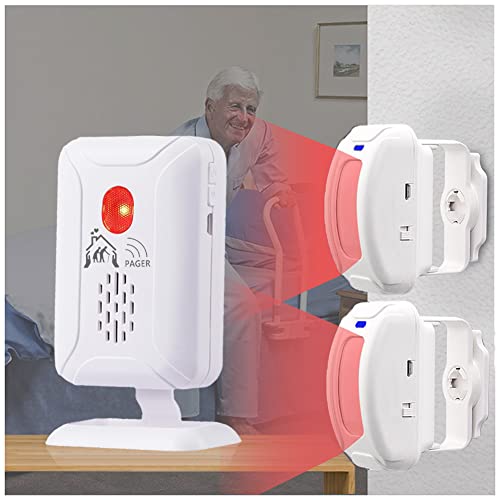
If you’re caring for an elderly loved one, the Upgrade Professional Bed Sensor Alarm is an essential tool for ensuring their safety at home. This long-range wireless motion sensor alerts you when they get out of bed or leave a room, transmitting signals up to 918 feet. It’s easy to set up—just load the batteries, and the system will self-test before going live. With four alert modes, including a loud 113dB alarm, you can adjust the volume and brightness to suit your needs. Plus, power options include battery or MICRO USB, making it convenient for any setup.
Best For: Caregivers and families of elderly individuals who require assistance and fall prevention at home.
Pros:
- Long-range wireless transmission allows monitoring from a significant distance (up to 918 feet).
- Multiple alert modes provide customizable options for notifications, including a loud alarm for immediate attention.
- Flexible power options (battery or MICRO USB) make it easy to set up in various locations without needing wall sockets.
Cons:
- Battery dependency may require regular replacements or recharging, potentially causing interruptions.
- Self-test feature may be confusing for some users who are unfamiliar with the initial setup process.
- Sensitivity settings might not be adjustable enough for all environments, leading to false alarms in some cases.
Factors to Consider When Choosing Smart Elder Care Sensors for Home
When choosing smart elder care sensors for home, you need to take into account several key factors. Safety features, installation ease, and monitoring range are essential for ensuring your loved one’s well-being. Additionally, you’ll want to explore alert mechanisms and compatibility with other devices to create a seamless experience.
Safety Features Importance
While choosing smart elder care sensors for home, prioritizing safety features is essential to guarantee the well-being of seniors. Look for sensors with fall detection and alert systems, as these can prevent injuries and provide timely assistance. Effective safety systems should offer multiple alert mechanisms—like sound, vibration, and visual notifications—so caregivers can respond quickly to emergencies. Advanced motion sensors with adjustable sensitivity help minimize false alarms from everyday movements, enhancing reliability. Wireless connectivity allows alerts to be sent directly to caregivers’ smartphones, providing real-time notifications for immediate intervention. Finally, prioritize user privacy by selecting systems that utilize motion detection without audio or video recording, respecting the dignity of elderly individuals while keeping them safe.
Easy Installation Process
Choosing smart elder care sensors involves not only prioritizing safety features but also considering how easy they are to install. Many sensors offer a plug-and-play installation process, allowing you to connect devices quickly without the need for special wiring or technician visits. With wireless technology, you can place sensors in desired locations without the hassle of running cables. User-friendly designs typically come with easy-to-follow instructions and pre-paired components, so you don’t need technical expertise. During installation, you can often adjust sensitivity settings to minimize false alarms. Finally, performing quick tests after setup guarantees the sensors function properly and are ideally placed in your home, providing peace of mind for you and your loved ones.
Monitoring Range Capabilities
Effective monitoring range capabilities are essential for ensuring that smart elder care sensors provide extensive coverage throughout your home. Monitoring ranges can vary widely, from 30 feet indoors to over 1,000 feet outdoors. Be mindful of how walls and obstacles can reduce wireless signal effectiveness, especially indoors. Many sensors operate well within a range of about 300 feet, making them suitable for larger homes or multi-room facilities. Additionally, consider systems that allow you to expand coverage with extra sensors or receivers. This flexibility can enhance safety in different areas of your home. When you’re choosing a smart elder care sensor, make sure the range aligns with your living space’s layout for ideal monitoring and response capabilities.
Alert Mechanism Options
When selecting smart elder care sensors for your home, you’ll encounter various alert mechanism options that cater to different needs. Many sensors provide sound, vibration, and visual indicators, letting you pick what works best in your environment. Some systems come with caregiver pagers, offering clear audible and visual alerts for immediate notifications when a sensor is triggered. Wireless motion sensors can also be programmed to send different alerts depending on the time of day, giving you flexibility during nighttime or quiet hours. Furthermore, advanced technologies may include pre-alert notifications, warning you before a patient fully leaves their bed. With adjustable volume levels and alert modes, you can customize settings to minimize startling your loved one while ensuring their safety.
Expandability and Compatibility
As you explore smart elder care sensors for your home, consider their expandability and compatibility to confirm you’re making a sound investment. Look for systems that allow you to add additional sensors, guaranteeing thorough monitoring across multiple areas. If you have a larger home or an assisted living facility, some systems can accommodate up to 40 sensors simultaneously, enhancing your coverage. Compatibility with your existing devices can improve functionality, allowing for seamless integration and a better user experience. It’s also important to find systems that enable multiple caregivers to receive alerts, fostering shared responsibility. Finally, confirm the sensors connect with smartphone apps for remote monitoring and notifications, adding flexibility and effectiveness to your elder care solutions.
Privacy Protection Measures
While expandability and compatibility are key factors in choosing smart elder care sensors, privacy protection measures shouldn’t be overlooked. Many devices prioritize your privacy by using camera-free designs, ensuring no audio or video recordings occur during monitoring. Look for sensors that utilize local alert systems, which don’t connect to the cloud, meaning your personal data isn’t transmitted or stored online. Features that limit notifications to caregivers only can further protect sensitive information about the patient’s movements. Additionally, some sensors detect motion without capturing personal data, alerting caregivers only when necessary. A growing number of systems offer 100% privacy protection through motion detection technology, reducing false alarms compared to traditional monitoring methods like pressure pads.