Fresh bread is easier to fit into a busy routine when a machine handles mixing, kneading, rising, and baking for you. The best bread machines for home bakers combine dependable results with settings that match the recipes you actually make.
We compare 10 options across loaf size, program variety, specialty features, controls, and cleanup considerations so you can choose a model with the right balance of convenience and control.
Best 10 Bread Machines for Home Bakers Picks for 2026
Most Customizable
KITCHENARM 29-in-1 Bread Machine
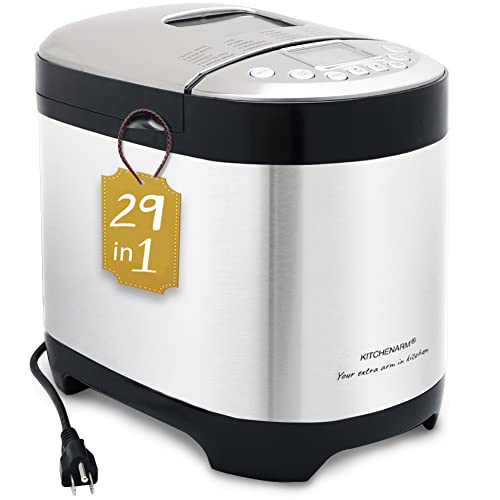
- 29 automatic programs plus four custom menus
- Supports gluten-free, keto, sourdough, and specialty breads
- Three loaf sizes and 15-hour delay timer
Best For: Home bakers who want maximum recipe and cycle flexibility
Best for Sourdough Starters

- Maintains starter from 41 to 122°F
- Supports daily or weekly feeding schedules
- Compact chamber fits one 1-quart jar
Best For: Sourdough bakers seeking more consistent starter activity
Best for Even Browning
Zojirushi Virtuoso Plus Breadmaker

- Dual heaters support even baking and browning
- Double blades thoroughly knead dough
- Rapid white and whole wheat courses take about 2 hours 25 minutes
Best For: Frequent bakers who want consistent 2-pound loaves
Best Large-Capacity Value

- Bakes loaves up to 2.2 pounds
- Automatic dispenser handles nuts and other mix-ins
- Ceramic pan, convection heating, and 17 programs
Best For: Families wanting larger loaves and hands-off specialty baking
Best Beginner Value
Elite Gourmet 2 Lb Bread Maker

- 19 one-touch programs, including gluten-free and dough settings
- Three loaf sizes from 1 to 2 pounds
- 15-hour delay timer and compact 550-watt design
Best For: Beginners and small kitchens seeking flexible everyday baking
Best for Larger Loaves

- 2.2-pound capacity for larger household batches
- Automatic fruit-and-nut dispenser for hands-off mix-ins
- Dual heaters, 15 programs, and three crust colors
Best For: Families and frequent fruit- or nut-filled loaves
Best Compact Stainless Steel Pick

- 12 programs with bread, cake, and pizza options
- Three loaf sizes and three crust colors
- LCD display, 13-hour delay start, and compact vertical design
Best For: Everyday bakers wanting simple controls and a space-conscious machine
Versatile Ceramic-Pan Pick
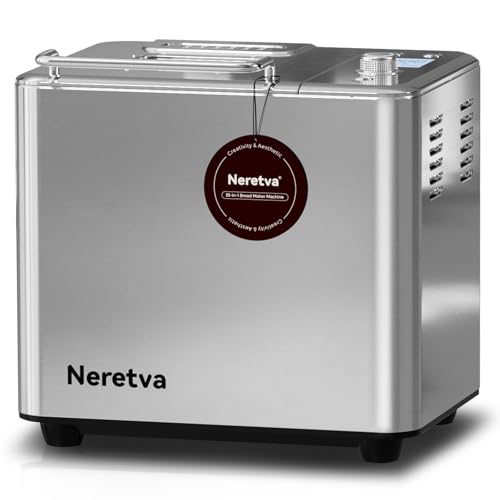
- 20 programs cover bread, dough, desserts, yogurt, and more
- 2-pound capacity with three crust settings
- Ceramic pan, dual heaters, and 15-hour timer
Best For: Home bakers who want maximum program flexibility and quieter operation
Beginner-Friendly Value
2LB Automatic Stainless Steel Bread Maker

- 17 automatic programs for bread, dough, desserts, and more
- Three loaf sizes and three crust settings
- 15-hour timer, keep-warm mode, and nonstick pan
Best For: Beginners and families wanting simple, flexible bread making
Large-Loaf Specialist
West Bend Hi-Rise 3-Lb Bread Maker

- Makes 2-, 2.5-, or 3-pound horizontal loaves
- Dual knead blades support thorough dough mixing
- 12 programs with gluten-free and three crust settings
Best For: Families wanting larger, traditionally shaped loaves
Most Customizable – KITCHENARM 29-in-1 Bread Machine
For home bakers seeking versatile bread machines for home bakers, the KITCHENARM offers an unusually broad selection of automatic and customizable programs. It supports three loaf sizes, multiple crust colors, specialty breads, and non-bread recipes.
Best For: New bakers and experienced users who want extensive recipe options and programmable control.
Pros:
- 29 programs include gluten-free, whole wheat, sourdough, keto, cake, jam, and yogurt settings.
- Custom HOME MADE menu allows cycle-by-cycle adjustments and up to four personalized menus.
- Offers 1-, 1.5-, and 2-pound loaves, a 15-hour delay timer, and power-interruption recovery.
- Includes 77 recipes plus access to the KitchenArm Recipe Cloud.
Cons:
- The extensive programming may feel overwhelming for users who prefer simple controls.
- Hand washing is specified for product care.
- The 2-pound capacity is smaller than some larger-capacity models.
The KITCHENARM is a strong choice when customization matters as much as convenience. Its specialty settings and programmable cycles make it particularly adaptable to evolving baking routines.
Best for Sourdough Starters – Brod & Taylor Sourdough Home
The Brod & Taylor Sourdough Home is a specialized companion for bread machines for home bakers and traditional sourdough enthusiasts. Rather than baking a loaf, it manages starter temperature to make feeding and fermentation more predictable.
Best For: Sourdough bakers who want to maintain a starter on a daily or weekly schedule.
Pros:
- Heats and cools from 41 to 122°F to regulate starter activity year-round.
- Can support daily baking or slow starter maintenance with weekly feedings.
- Sealed door helps maintain stable internal temperatures.
- Compact design fits one 1-quart or 1-liter jar.
Cons:
- It does not bake bread and is not a standalone bread machine.
- The glass starter jar is sold separately.
- Its single-jar capacity is intended for starter maintenance rather than larger batch preparation.
For bakers committed to sourdough, this appliance addresses one of the process’s most variable factors: temperature. It is best viewed as a focused fermentation tool to pair with a separate oven or bread maker.
Best for Even Browning – Zojirushi Virtuoso Plus Breadmaker
The Zojirushi Virtuoso Plus is a substantial 2-pound option among bread machines for home bakers, with dual heaters designed to promote even baking and browning. Its focused set of courses includes everyday and specialty options, along with a rapid cycle.
Best For: Families and frequent bakers who prioritize consistent 2-pound loaves and straightforward specialty programs.
Pros:
- Dual heaters in the lid and bottom promote even baking and browning.
- Double kneading blades thoroughly work dough.
- Rapid white and whole wheat courses finish in about 2 hours and 25 minutes.
- Includes multigrain, gluten-free, vegan, salt-free, and sugar-free settings.
Cons:
- At 24 pounds, it is considerably heavier than the other listed bread machines.
- It offers seven programs, fewer than several highly programmable competitors.
- The one-year manufacturer warranty is shorter than some alternatives’ stated coverage.
The Virtuoso Plus emphasizes baking performance over a long menu of programs. Its dual-heater design and rapid courses make it appealing for reliable family-size loaves, especially when even browning is important.
Best Large-Capacity Value – KBS Pro 17-in-1 Bread Maker
The KBS Pro combines a 2.2-pound maximum capacity with automatic ingredient dispensing and a ceramic pan, making it a feature-rich contender among bread machines for home bakers. Its convection heating and custom setting add flexibility beyond basic automated baking.
Best For: Households that want larger loaves, hands-off mix-ins, and a broad selection of bread and non-bread programs.
Pros:
- Supports 1-, 1.5-, and 2.2-pound loaf sizes.
- Automatic stainless-steel dispenser adds ingredients during the cycle.
- Ceramic pan and paddle are described as non-toxic and naturally nonstick.
- Offers 17 programs, custom baking, convection heating, and 53 recipes.
Cons:
- The larger feature set may require more setup and experimentation.
- Hand washing is specified for product care.
- The notes do not specify the exact time or temperature range available in the custom setting.
The KBS Pro is a practical match for families and adventurous bakers. Its larger capacity and automatic dispenser reduce hands-on work, while the custom program leaves room to fine-tune recipes.
Best Beginner Value – Elite Gourmet 2 Lb Bread Maker
For home bakers who want straightforward automation, the Elite Gourmet is a practical choice among bread machines for home bakers. It handles kneading, rising, and baking automatically, while three loaf sizes and 19 presets make it easy to adjust recipes for different needs.
Best For: Beginners, small kitchens, and households wanting flexible loaf sizes and broad program selection.
Pros:
- Offers 19 one-touch programs, including gluten-free, wheat, rye, pizza dough, cake, and jam.
- Supports 1-, 1.5-, and 2-pound loaves.
- Includes a 15-hour delay timer and 60-minute keep-warm function.
- Compact design uses 550 watts and avoids heating the entire oven.
Cons:
- Its maximum loaf size is 2 pounds, smaller than the 2.2-pound Neretva.
- Only a 60-minute keep-warm period is specified.
The Elite Gourmet stands out for accessible controls and an unusually broad preset list at this size. It is a strong fit when convenience, compactness, and recipe variety matter more than advanced dispensing features.
Best for Larger Loaves – Neretva 2.2LB Bread Machine
The Neretva is designed for home bakers who need a little more capacity and hands-off ingredient additions. Among bread machines for home bakers, its 2.2-pound maximum loaf, automatic fruit-and-nut dispenser, and dual-heater design make it appealing for family-size baking.
Best For: Families, larger batches, and bakers who regularly add fruit or nuts to dough.
Pros:
- Bakes loaves up to 2.2 pounds, with capacity listed for serving up to six or seven people.
- Includes 15 programs, three crust colors, and settings such as gluten-free, yogurt, jam, and homemade.
- Automatically dispenses fruit and nuts at the intended time.
- Uses dual heaters, a viewing window, and a 15-hour delay timer.
Cons:
- At 15.8 pounds, it is notably heavier than a compact entry-level machine.
- The ceramic pan is specified for wiping with a damp cloth rather than dishwasher cleaning.
- It offers 15 programs, fewer than the Elite Gourmet’s 19.
With its larger capacity and automatic add-in dispenser, the Neretva is the most feature-focused option here for family loaves and mix-ins. Its heavier build and manual-cleaning guidance are trade-offs for those capabilities.
Best Compact Stainless Steel Pick – Cuisinart 2 Lb Bread Maker
The Cuisinart Bread Maker keeps the controls focused while still covering everyday baking needs. For shoppers comparing bread machines for home bakers, it offers three loaf sizes, three crust colors, automatic kneading and baking, and a compact vertical design with an LCD display.
Best For: Home bakers who want a compact, recognizable machine with simple controls and customizable loaf settings.
Pros:
- Provides 12 menu programs for bread, cake, pizza, and other baked goods.
- Offers 1-, 1.5-, and 2-pound loaf sizes plus light, medium, and dark crust options.
- Includes an LCD display, audible reminders, 13-hour delay start, and 60-minute keep-warm cycle.
- Has a counter-friendly footprint and a removable nonstick vertical pan.
Cons:
- Its 12 programs provide less preset variety than the Elite Gourmet or Neretva.
- The pan is listed as hand-wash only.
- It does not list an automatic fruit-and-nut dispenser.
The Cuisinart is a balanced choice for routine loaves when display feedback and compact counter storage are priorities. Its smaller menu is less suited to shoppers seeking the widest selection of specialty programs.
Versatile Ceramic-Pan Pick – Neretva 20-in-1 Bread Maker
For home bakers seeking flexible bread machines for home bakers, the Neretva combines 20 automatic programs with a 2-pound capacity. Its ceramic nonstick pan, dual heaters, delay timer, and low-noise operation make it suited to regular family baking and more than just standard loaves.
Best For: Home bakers who want extensive program choices, quieter operation, and a ceramic-coated pan.
Pros:
- Offers 20 programs, including gluten-free, whole-wheat, cake, yogurt, jam, pizza dough, and bake settings.
- Supports 1.65- and 2-pound loaves with light, medium, and dark crust options.
- Dual heaters and 550W power are designed for more even, faster baking.
- Includes a 15-hour delay timer, one-hour keep-warm function, and 15-minute power-interruption recovery.
Cons:
- Its broad feature set may be more than beginners need for simple loaves.
- The supplied dimensions and capacity may require checking available counter space before purchase.
The Neretva stands out when versatility is the priority. The ceramic pan and quieter motor add everyday convenience, while the wide menu supports experimentation beyond basic bread.
Beginner-Friendly Value – 2LB Automatic Stainless Steel Bread Maker
This 2-pound machine is a straightforward option for people comparing bread machines for home bakers and prioritizing simple controls. Add ingredients, select one of 17 programs, and let the machine knead and bake while the timer and keep-warm functions handle scheduling.
Best For: Beginners and families who want adjustable loaf sizes, easy controls, and uncomplicated cleanup.
Pros:
- Beginner-oriented operation automates kneading through baking.
- Provides 17 programs, including basic, whole-wheat, gluten-free, cake, jam, and yogurt options.
- Offers 1-, 1.5-, and 2-pound loaf sizes plus light, medium, and dark crust settings.
- Includes a 15-hour delay timer, one-hour keep-warm feature, nonstick pan, and overheat protection.
Cons:
- At up to 50 decibels, it is described as quiet but not silent.
- The supplied basic-cycle times run about 3 hours 35 minutes to 3 hours 45 minutes, so it is not an instant-bread solution.
- Overheat protection may pause operation for roughly 20 to 30 minutes after extended use or excess heat.
Its strongest appeal is ease of use: useful settings without requiring much baking experience. The adjustable capacity also lets households choose a smaller loaf when a full 2-pound bake is unnecessary.
Large-Loaf Specialist – West Bend Hi-Rise 3-Lb Bread Maker
For households that regularly bake larger loaves, the West Bend Hi-Rise offers a 3-pound capacity and a horizontal pan designed for traditionally shaped bread. Among bread machines for home bakers, it emphasizes larger batches, dual knead blades, and practical recipe guidance.
Best For: Families and experienced home bakers who prefer horizontal, larger-format loaves.
Pros:
- Bakes 2-, 2.5-, or 3-pound loaves in a horizontal bread pan.
- Dual knead blades are designed to knead dough thoroughly and support a higher rise.
- Includes 12 digital settings, gluten-free and wheat options, and three crust colors.
- Offers a 13-hour delayed-start cycle and recipes for bread, bagel dough, pasta dough, low-carb, and gluten-free baking.
Cons:
- It has fewer programs and a shorter delay timer than the supplied Neretva and 17-program models.
- The pan and accessories are specified for hand washing rather than dishwasher cleaning.
- Its 15.5-inch width and 13.5-inch height may require substantial counter or storage space.
The West Bend is a practical choice when loaf size and shape matter more than having the largest program menu. Its dual-blade design and recipe range make it especially useful for larger household batches and dough projects.
How We Picked the Best Bread Machines for Home Bakers
We focused on the features that most affect everyday baking: loaf capacity, bread and dough programs, crust control, gluten-free options, specialty cycles, automatic ingredient dispensers, and manual customization. We also considered whether each machine suits beginners, frequent bakers, or households that need more flexibility than a basic preset appliance provides.
Because the selection includes both conventional bread makers and a dedicated sourdough appliance, we judged each product according to its intended use rather than treating every model as interchangeable. Always check the included manual for exact ingredient limits, cycle times, and compatible recipes.
Quick Comparison
| What matters | Look for | Best suited to |
|---|---|---|
| Loaf size | 1-, 1.5-, 2-, or 2.2-pound capacity | Individuals, couples, or families |
| Program variety | Basic, dough, jam, cake, gluten-free, or custom cycles | Bakers who want recipe flexibility |
| Ingredient handling | Nut and fruit dispenser or manual additions | Recipes with mix-ins |
| Specialty baking | Sourdough-focused controls or homemade cycles | Experienced or experimental bakers |
| Convenience | Delay timer, viewing window, removable pan, and simple controls | Hands-off daily baking |
Key Buying Factors for Bread Machines for Home Bakers
Capacity and Loaf Shape
A 2-pound machine is a practical choice for many households, while 2.2-pound models can provide extra servings. Smaller settings are useful when you want to reduce waste or bake more frequently. Check the finished loaf shape as well as capacity, since some machines produce taller loaves that may not fit your preferred toaster.
Programs and Customization
Preset counts can be useful, but the specific cycles matter more than the number. Prioritize gluten-free, whole wheat, dough-only, rapid, or jam settings if you will use them. A homemade or manual cycle is especially valuable for adjusting kneading and rise times.
Ease of Use and Cleanup
Look for clearly labeled controls, a delay timer, a readable display, and a removable nonstick pan. A viewing window can help monitor progress, but it does not replace reliable temperature control. If you bake with nuts or dried fruit, an automatic dispenser can reduce timing errors.
Noise, Storage, and Accessories
These appliances need counter space during operation and storage space afterward. Consider overall footprint, cord placement, paddle removal, measuring accessories, and how easy it is to clean flour from the lid and vents.
Who Should Buy Which Bread Machines for Home Bakers?
Choose a straightforward programmable model if you mainly want dependable sandwich bread with minimal setup. Families or frequent bakers should consider a larger-capacity machine with multiple loaf sizes. Bakers exploring gluten-free recipes should select a model with a dedicated gluten-free cycle, while mix-in enthusiasts will benefit from an automatic dispenser.
If you want to experiment with long fermentation, custom timing, or sourdough-specific preparation, prioritize specialized controls rather than simply choosing the machine with the most presets. Finally, compare warranty coverage, replacement-pan availability, and recipe support before buying; those details can matter as much as headline wattage or program count.