Choosing a high efficiency energy recovery ventilator can improve indoor air quality without wasting as much heated or cooled air. The right unit helps bring in fresh air, manage humidity, and support a more comfortable home.
Below, we focus on ERV and HRV options that balance airflow, filtration, efficiency, and installation style so you can quickly narrow down the best fit for your space.
Best 10 High Efficiency Energy Recovery Ventilator Picks for 2026
Premium Whole-Home Balancing
Panasonic Intelli-Balance Elite Plus+ 120 CFM ERV

- SmartFlow ECM motors auto-adjust for airflow stability.
- 30–120 CFM supports balanced, positive, or negative pressure.
- Dual MERV 13 filters are included.
Best For: Homes needing flexible whole-home ventilation and high-efficiency filtration
Compact Fresh-Air Performer

- Delivers up to 160 CFM of fresh air.
- Counterflow core supports energy-efficient heat recovery.
- Top-mounted ducts and front access simplify service.
Best For: Compact ventilation installs that need easy access and solid airflow
Smart Single-Room Ventilation
Pioneer ECOasis 150 Ductless ERV
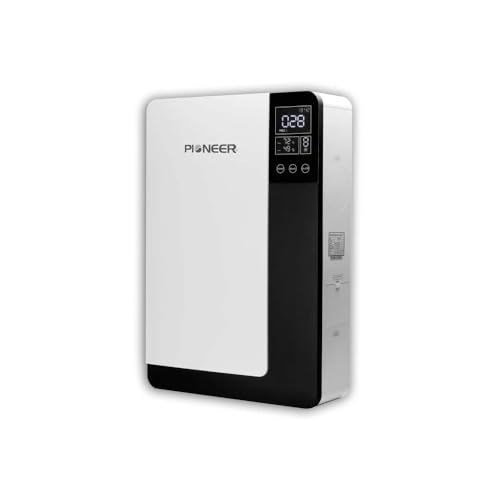
- 82% efficient heat exchanger helps reduce energy loss.
- PM2.5 and CO2 sensors auto-adjust the 8-speed fan.
- HEPA H10 and activated charcoal filtration add air cleaning.
Best For: Single-room spaces needing smart, ductless ventilation and filtration
Balanced Mid-Size Choice
Panasonic Intelli-Balance Elite 110 CFM ERV
- SmartFlow ECM motors adapt to pressure changes.
- 30–110 CFM supports multiple ventilation setups.
- Dual MERV 13 filters are included.
Best For: Mid-size homes wanting flexible mounting and balanced ventilation
Compact Smart ERV
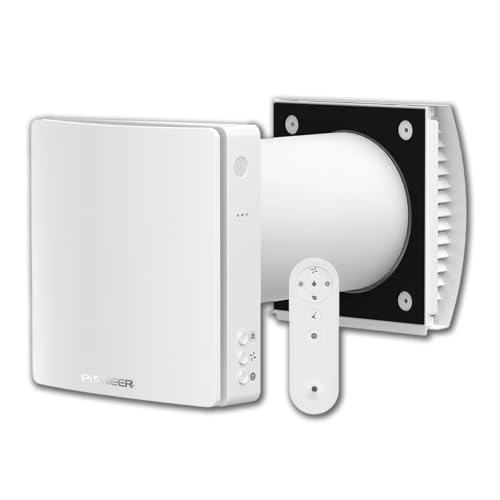
- Up to 97% heat recovery
- Uses just 6 to 8W
- Wi‑Fi app and CO2 sensor
Best For: Single-room smart ventilation with very low power use
Whole-House Balanced Ventilation

- Up to 162 CFM airflow
- Freeze protection for cold climates
- Transfers heat and moisture
Best For: Whole-house ventilation with strong cold-weather performance
Attic ERV with Controls
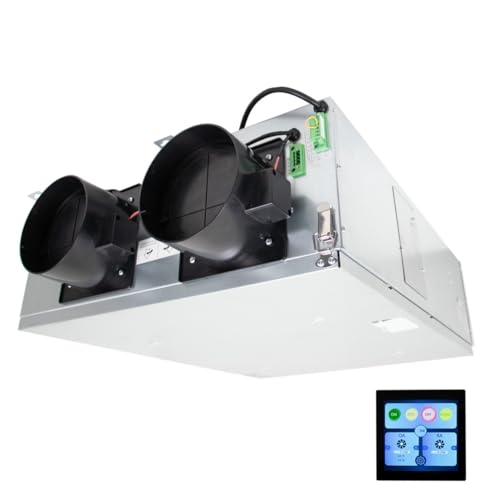
- 40 to 100 CFM variable airflow
- Touchscreen with humidity sensor
- Washable filters and EC motors
Best For: Attic setups needing adjustable airflow and humidity control
Plug-and-Play Wall Ventilation

- 5W EC motor for low-energy operation
- Reversible remote for intake or exhaust
- Plug-in wall mount with washable ceramic core
Best For: Bedrooms, attics, garages, and small rooms
Attic ERV With Adjustable Output
6-Inch HVI-Certified ERV System

- Up to 100 CFM with adjustable intake and exhaust
- Humidity sensor plus washable filter included
- Two EC motors for continuous attic operation
Best For: Attics and larger homes needing balanced ventilation
Ductless Room ERV
TwinFresh Comfo 30 CFM Ventilator

- Up to 88% heat or cooling recovery
- Very quiet reversible DC motor uses as little as 4.5W
- Ductless through-wall design with humidity sensor
Best For: Bedrooms, basements, and retrofit rooms
Premium Whole-Home Balancing – Panasonic Intelli-Balance Elite Plus+ 120 CFM ERV
If you’re shopping for a high efficiency energy recovery ventilator, this Panasonic Intelli-Balance Elite Plus+ is built for flexible whole-home ventilation with strong filtration and balanced airflow control. Its SmartFlow ECM motors automatically adjust to pressure changes, while the hygroscopic core helps transfer heat and moisture to support more comfortable incoming air.
Best For: Homes that need adjustable ventilation, higher-end filtration, and flexible install options.
Pros:
- Dual SmartFlow ECM motors help maintain airflow and quiet operation under changing static pressure.
- 30–120 CFM range supports balanced, positive, or negative pressure setups.
- Dual MERV 13 filters are included for high-efficiency air cleaning.
- Ceiling, wall, or floor mounting adds installation flexibility.
Cons:
- May be more system than you need if you only want basic single-room ventilation.
- Wi-Fi module and some control options are compatible, but not necessarily included as the core setup.
This model stands out if you want an ERV that combines airflow tuning, moisture transfer, and strong filtration in one package. It’s a practical fit for more demanding ventilation projects where customization matters.
Compact Fresh-Air Performer – Fantech HERO150H 160 CFM HRV
Fantech HERO150H 6" Top Duct Connection Fresh Air Appliance HRV, 160 Cfm, 120 A
Check Price On AmazonThe Fantech HERO150H is a compact high efficiency energy recovery ventilator alternative for buyers who want straightforward fresh-air exchange with an energy-efficient counterflow core. Its 160 CFM capacity and integrated MERV 8 filter make it a practical option for adding ventilation while keeping maintenance and complexity relatively low.
Best For: Fresh-air ventilation projects that prioritize compact size and simple access.
Pros:
- Up to 160 CFM of fresh air for robust ventilation capacity.
- Energy-efficient counterflow core supports heat recovery.
- Integrated MERV 8 filter adds basic incoming-air filtration.
- Top-mounted 6″ duct connections and front access help simplify installation and service.
Cons:
- MERV 8 filtration is less aggressive than MERV 13 options.
- No smart-home compatibility is listed.
This unit is appealing if you want a compact HRV-style solution that focuses on airflow, heat recovery, and practical serviceability. It’s especially useful when you want dependable ventilation without a lot of extra bells and whistles.
Smart Single-Room Ventilation – Pioneer ECOasis 150 Ductless ERV
If you want a high efficiency energy recovery ventilator for a single room, the Pioneer ECOasis 150 is designed around air cleaning, smart monitoring, and efficient heat recovery. It uses a built-in PM2.5 sensor and CO2 monitor to automatically adjust its 8-speed fan, while the heat exchanger recovers energy from outgoing air to reduce conditioning loss.
Best For: Bedrooms, living rooms, or small spaces up to 500 sq. ft. that need smart, ductless ventilation.
Pros:
- 82% efficient heat exchanger helps recover energy from outgoing air.
- Built-in PM2.5 sensor and CO2 monitor automatically track indoor air quality.
- 4-stage filtration includes HEPA H10 and activated charcoal filtration.
- Wi-Fi app, touch panel, and remote control offer flexible operation.
Cons:
- Designed for single-room use rather than whole-home ventilation.
- Wall-mounted ductless setup may not suit every layout.
This model makes sense if you want smart controls plus strong filtration in a room-by-room format. It balances comfort, convenience, and efficiency without requiring a traditional ducted ERV setup.
Balanced Mid-Size Choice – Panasonic Intelli-Balance Elite 110 CFM ERV
The Panasonic Intelli-Balance Elite is a high efficiency energy recovery ventilator for users who want balanced airflow, moisture transfer, and strong filtration in a mid-capacity unit. Its SmartFlow ECM motors adjust automatically for changing pressure conditions, and the hygroscopic transfer core helps balance heat and moisture for more comfortable indoor air.
Best For: Mid-size homes or rooms that need flexible mounting and dependable balanced ventilation.
Pros:
- SmartFlow ECM motors help maintain airflow and quiet operation under varying pressure.
- 30–110 CFM airflow range supports balanced, positive, or negative pressure setups.
- Dual MERV 13 filters are included for high-efficiency filtration.
- Ceiling, wall, or floor mounting gives you installation flexibility.
Cons:
- 110 CFM maximum is lower than the 120 CFM sibling in this lineup.
- At 45 decibels, it may not be the quietest option in all settings.
This is a solid all-around ERV if you want Panasonic’s airflow control and filtration features in a slightly smaller capacity. It’s a sensible choice when versatility matters more than maximum output.
Compact Smart ERV – Wi-Fi-Enabled Pioneer 50
If you want a high efficiency energy recovery ventilator for a single room, this wall-mounted ductless model focuses on fresh air with very low power draw. It offers up to 97% heat recovery, Wi‑Fi app control, and a built-in CO2 sensor for automated air quality management, making it a practical fit for bedrooms, offices, or other enclosed spaces.
Best For: Single-room use where smart controls, quiet operation, and low energy use matter most.
Pros:
- Up to 97% heat recovery with only 6 to 8W input power
- Wi‑Fi control plus handheld remote and onboard interface
- Built-in CO2 sensor for automated breathing-air management
- Quiet operation rated up to 32.7 dB(A) with washable prefilters and F7 filter
Cons:
- Designed for a single room rather than whole-house ventilation
- Best results are noted when using two units for full seasonal heat-transfer benefits
- Requires wall mounting and an in-wall channel sized to the installation
This is a strong pick if you want efficient room-by-room ventilation with modern controls and filtration. Its low wattage and high recovery rate make it especially appealing where continuous operation is important.
Whole-House Balanced Ventilation – VENTS-US Frigate ERV 120s
This high efficiency energy recovery ventilator is built for whole-house fresh air exchange, with balanced supply and exhaust airflow and up to 162 CFM of output. It also includes freeze protection, dual washable MERV 6 filters, and an enthalpy core that transfers both heat and moisture to help stabilize indoor comfort in colder climates.
Best For: Whole-house ventilation where freeze protection, higher airflow, and humidity recovery are priorities.
Pros:
- Up to 162 CFM for whole-house air exchange
- Electronic anti-frost protection for cold-weather operation
- Enthalpy core recovers both heat and moisture
- Washable MERV 6 filters and corrosion-resistant steel casing
Cons:
- Ceiling-mounted installation may be less convenient than smaller room units
- Standard 5-inch duct connections may require compatible home ducting
- Larger, heavier system than single-room ERV options
For buyers who need a more complete ventilation solution, this model stands out for its airflow capacity and cold-climate protection. It is a more involved install, but the performance targets a full-home application rather than just one room.
Attic ERV with Controls – Awoco 6d Vent ERV System
For shoppers comparing a high efficiency energy recovery ventilator with integrated controls, this attic-mounted Awoco unit offers balanced airflow, washable filters, and touch-screen operation. It supports variable speeds from 40 to 100 CFM, includes humidity sensing, and is designed for continuous run with two enclosed EC motors.
Best For: Attic installations that need adjustable airflow, humidity control, and a built-in control panel.
Pros:
- Adjustable airflow from 40 to 100 CFM on both OA and RA
- Touch screen control panel plus timer and humidity sensor
- Two enclosed EC motors for continuous operation
- Washable filters, built-in dampers, and included mounting brackets
Cons:
- Rated at 50 dB, so it is not the quietest option in the group
- Requires 6-inch insulated ducting and a suitable attic install
- Lower max airflow than larger whole-house units
This model makes sense if you want an attic-based ERV with more direct control over runtime and humidity. It offers solid flexibility, though buyers prioritizing the highest airflow or the quietest operation may want to compare alternatives.
Plug-and-Play Wall Ventilation – 4-inch EC Motor Wall Vent Fan
If you want a compact high efficiency energy recovery ventilator for a single room, this 4-inch wall unit keeps installation simple while still offering reversible airflow. It plugs into a standard outlet, uses a 5W EC motor, and is built for basic room-by-room ventilation without needing an electrician.
Best For: Bedrooms, attics, garages, and small spaces that need simple wall-mounted fresh air exchange.
Pros:
- Reversible remote lets you switch between intake and exhaust quickly.
- 5W EC motor is designed for energy efficiency and near-silent operation.
- Plug-in setup avoids hardwiring and makes installation more approachable.
- Washable ceramic core and stainless steel rain hood add low-maintenance durability.
Cons:
- Requires drilling and stable wall mounting, so it is not a no-tools install.
- Single-room design is better for targeted ventilation than whole-home use.
- 4-inch size may be limiting for larger airflow needs.
Overall, this is a practical choice if you want an easy-to-use wall ventilator with energy-saving operation and basic heat-recovery features. It makes the most sense when convenience and low power use matter more than high airflow volume.
Attic ERV With Adjustable Output – 6-Inch HVI-Certified ERV System
This high efficiency energy recovery ventilator is aimed at larger installs where balanced airflow matters. It moves up to 100 CFM, uses two enclosed EC motors, and adds humidity control plus washable filtration to support better indoor air quality in an attic-mounted setup.
Best For: Attics and larger homes that need a balanced, continuously running ERV with adjustable airflow.
Pros:
- Adjustable OA and RA knobs let you tune airflow from 40 CFM to 100 CFM.
- Two enclosed EC motors are rated for continuous run and low-temperature protection.
- Built-in humidity sensor and washable filter help manage comfort and air quality.
- HVI, ETL, cETL, and CSA standard certification adds confidence for buyers.
Cons:
- 60-watt power draw is higher than smaller single-room ERV units.
- Requires 6-inch insulated ducts, so installation is more involved.
- Designed for attic mounting, which may not suit every layout.
For buyers who need a more traditional ERV system with tunable airflow and certification support, this model offers a solid mix of performance and control. It is best viewed as a ventilation solution for spaces that can accommodate ducting and attic installation.
Ductless Room ERV – TwinFresh Comfo 30 CFM Ventilator
For room-by-room ventilation, this high efficiency energy recovery ventilator stands out because it does not require traditional ductwork. It delivers up to 30 CFM, recovers up to 88% of heat or cooling, and uses a high-efficiency reversible DC motor that is built for quiet continuous operation.
Best For: Bedrooms, basements, home offices, and retrofit projects where ductwork is not practical.
Pros:
- Recovers up to 88% of heat or cooling to help reduce HVAC load.
- Ductless through-the-wall design simplifies installation in tight spaces.
- Reversible DC motor runs as quietly as 0.2 sones while using as little as 4.5 watts.
- Humidity sensor, MERV 5 filters, and remote control improve everyday usability.
Cons:
- 30 CFM is modest compared with larger ERV systems.
- Best suited to single rooms rather than broad whole-home ventilation.
- Through-wall install still requires the right wall thickness and placement.
This is a strong option if you want efficient fresh-air exchange without the complexity of ducts or a mechanical room. Its low power draw, quiet operation, and room-specific approach make it especially appealing for retrofit and small-space applications.
How We Picked the Best High Efficiency Energy Recovery Ventilator Options
We focused on products that offer practical fresh-air performance for real homes, apartments, and single rooms. Key considerations included airflow capacity, energy recovery design, filtration quality, control features, and whether the unit is suited to whole-house or ductless use. We also looked for models with useful certifications, smart controls, freeze protection, and easier maintenance.
Quick Comparison: Whole-House Vs Single-Room
A whole-house High Efficiency Energy Recovery Ventilator is the better choice when you want balanced ventilation across multiple rooms, especially in tighter homes. Single-room ductless units are more flexible for apartments, additions, offices, basements, or bedrooms where full ductwork is not practical. HRVs are often favored in colder climates, while ERVs are commonly preferred where humidity control matters more.
Key Buying Factors for a High Efficiency Energy Recovery Ventilator
Airflow and Room Size
Match CFM output to the space you want to ventilate. Higher airflow is useful for larger homes or multiple occupants, while lower-output units are often enough for one room or a smaller zone. Oversizing can be wasteful, while undersizing may leave stale air behind.
Energy Recovery Type
ERVs transfer both heat and moisture, which can help maintain comfort in mixed or humid climates. HRVs transfer heat but not moisture, making them a strong fit for cold-weather applications where indoor humidity is less of a concern.
Filtration and Indoor Air Quality
Look for models with strong filtration if allergies, dust, or pollen are concerns. Some units include MERV 13 filters or dual filtration, which can improve supply-air quality and reduce buildup inside the system.
Controls, Noise, and Maintenance
Wi-Fi, remote control, and adjustable fan speeds make operation easier day to day. Also consider service access, filter replacement, and how often the core or filters need cleaning. Quieter units are usually better for bedrooms and living areas.
Who Should Buy Which High Efficiency Energy Recovery Ventilator?
Choose a whole-house system if you want consistent ventilation throughout an entire home and already have, or plan to add, ducting. Pick a ductless or single-room High Efficiency Energy Recovery Ventilator if you need targeted ventilation for one area, want simpler installation, or live in a space where running ducts is not realistic.
If indoor humidity is a major issue, prioritize an ERV. If your priority is cold-climate heat recovery, a properly sized HRV may be the better match. In every case, the best option is the one that fits your climate, space, and installation limits while delivering enough fresh air for everyday comfort.