The best nonstick Dutch ovens make one-pot cooking easier by combining generous capacity with simpler food release and cleanup. They can be useful for everything from simmering soup and chili to braising meat and baking bread.
This roundup includes ceramic-coated, hard-anodized, hybrid, and enameled cast-iron options in several sizes and price ranges. Use the guide below to compare materials, stovetop compatibility, oven limits, maintenance needs, and the best fit for your kitchen.
Best 10 Nonstick Dutch Ovens Picks for 2026
Best Everyday Value
Cooks Standard 7-Quart Hard Anodized Dutch Oven

- 7-quart heavy-gauge aluminum body
- Hard-anodized nonstick cooking surface
- Works on gas, electric, ceramic, and glass cooktops
Best For: Large-batch cooking on non-induction stovetops
Best for Searing
HexClad 5-Quart Hybrid Nonstick Dutch Oven

- Hybrid stainless-steel and ceramic-coated surface
- Induction ready and compatible with all cooktops
- Oven safe up to 900°F with steel lid
Best For: Searing, braising, and high-heat oven cooking
Best PFAS-Free Pick
GreenPan Lima 5.2-Quart Ceramic Stock Pot

- PFAS-, PFOA-, lead-, and cadmium-free ceramic coating
- Hard-anodized body with glass lid
- Oven and broiler safe up to 425°F
Best For: Health-conscious everyday cooking on non-induction cooktops
Best for Bread Baking
Mueller DuraCast 6-Quart Enameled Dutch Oven

- 500°F oven-safe cast iron for bread baking
- PFOA- and PTFE-free porcelain enamel interior
- Compatible with induction and other major cooktops
Best For: Sourdough, braising, and heat-retentive cooking
Best Flexible Induction Pick
BEZIA 6-Quart Nonstick Stock Pot

- PFOS- and PFOA-free granite-style nonstick coating
- Works on induction and other common stovetops
- Oven safe to 450°F; lid stays out of the oven
Best For: Everyday soups, pasta, sauces, and family-size meals
Best Heat-Retaining Dutch Oven
Umite Chef 5-Quart Enameled Cast Iron

- Heavy-duty cast iron retains heat for slow cooking
- Tight lid helps circulate condensation
- Oven safe to 500°F and induction compatible
Best For: Braising, stews, roasting, and bread baking
Best Budget Everyday Option
Cook N Home 6-Quart Nonstick Stock Pot

- Hard-anodized aluminum heats quickly and evenly
- Glass lid has a steam vent for easier monitoring
- Oven safe to 400°F; not induction compatible
Best For: Everyday soups, pasta, seafood boils, and family cooking
Best Enamelled Cast Iron Pick

- 6.4-quart enamelled cast iron construction
- Oven-safe to 500°F without seasoning
- Designed for stews, roasting, and bread baking
Best For: Home cooks wanting heat retention and a colorful, low-maintenance pot
Best Large-Capacity Value
6-Quart Enameled Cast Iron Dutch Oven
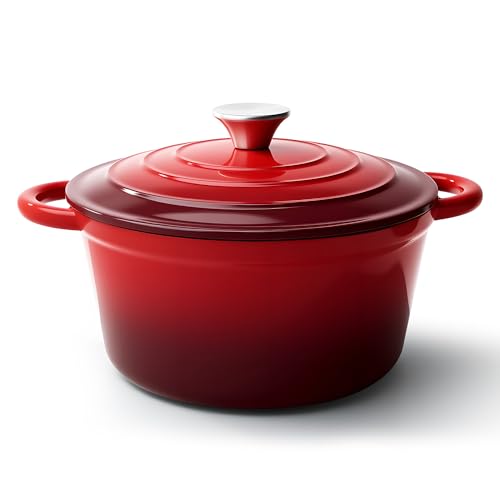
- 6-quart capacity for larger meals
- Compatible with induction and other major cooktops
- Oven-safe to 500°F with steam-circulating lid
Best For: Families and batch cooks making stews, roasts, and bread
Best Everyday Value – Cooks Standard 7-Quart Hard Anodized Dutch Oven
For shoppers comparing nonstick Dutch ovens for everyday cooking, the Cooks Standard 7-quart model offers a roomy aluminum body, even heat distribution, and a hard-anodized nonstick surface. It includes a vented glass lid and works on gas, electric, ceramic, and glass cooktops, but not induction.
Best For: Large-batch boiling, frying, stewing, and general cooking on non-induction stovetops.
Pros:
- Heavy-gauge aluminum heats quickly and evenly.
- Hard-anodized nonstick surface is designed for improved wear resistance and easy food release.
- Vented tempered-glass lid lets you monitor cooking, and the pot is oven safe up to 500°F.
- Wide, riveted stainless steel handles provide a secure grip.
Cons:
- Not compatible with induction cooktops.
- The glass lid is oven safe only up to 350°F.
This is a practical choice when capacity and straightforward nonstick cooking matter more than induction compatibility. Verify your cooktop before buying, especially if you use induction.
Best for Searing – HexClad 5-Quart Hybrid Nonstick Dutch Oven
The HexClad Hybrid 5-quart braiser is a versatile pick among nonstick Dutch ovens, combining a laser-etched stainless-steel and ceramic-coated surface with tri-ply construction. It is induction ready, dishwasher friendly, metal-utensil safe, and suitable for high-heat oven cooking.
Best For: Searing proteins, braising, simmering, stews, soups, and breads across any home cooktop.
Pros:
- Hybrid surface is designed to support searing while allowing easier cleanup.
- Aluminum-core tri-ply construction promotes quicker, even heating.
- Compatible with all cooktops, including induction.
- Oven safe up to 900°F with the included steel lid, and backed by a lifetime warranty against manufacturer defects.
Cons:
- At 5 quarts, it offers less capacity than larger stock pots.
- The supplied dimensions describe a relatively low-profile braiser shape rather than a tall stockpot.
If you want one nonstick vessel for stovetop searing and oven braising, this HexClad model is especially flexible. Its induction compatibility and high oven rating broaden its use, while the 5-quart size suits moderate portions.
Best PFAS-Free Pick – GreenPan Lima 5.2-Quart Ceramic Stock Pot
For cooks seeking nonstick Dutch ovens with a ceramic coating, the GreenPan Lima provides a PFAS-, PFOA-, lead-, and cadmium-free Thermolon cooking surface. Its hard-anodized body is designed for durability, while the included glass lid and 5.2-quart capacity suit everyday stock making and general cooking.
Best For: Health-conscious cooking, low-fat meal preparation, and everyday use on non-induction cooktops.
Pros:
- Thermolon ceramic nonstick coating is free of PFAS, PFOA, lead, and cadmium.
- Hard-anodized construction is designed to resist scratches and support regular use.
- Oven and broiler safe up to 425°F.
- Riveted stainless steel handle offers a contoured, secure grip.
Cons:
- Not compatible with induction cooktops.
- Hand washing is recommended to help preserve the nonstick surface.
This GreenPan is a sensible option when a ceramic, PFAS-free nonstick surface is a priority. Its moderate capacity works well for routine meals, though induction users will need a different model.
Best for Bread Baking – Mueller DuraCast 6-Quart Enameled Dutch Oven
The Mueller DuraCast takes a different approach to nonstick Dutch ovens, using a high-gloss porcelain enamel interior rather than synthetic nonstick coatings. Its cast-iron construction retains heat for bread baking and braising, while the self-basting lid helps return moisture to roasts, stews, and sourdough loaves.
Best For: Sourdough and artisan bread baking, slow braising, stews, and cooks who need induction compatibility.
Pros:
- 500°F oven-safe cast iron is designed for sustained heat and bread baking.
- Porcelain enamel interior contains no PFOA, PTFE, or synthetic coatings and requires no seasoning.
- Works on gas, electric, ceramic, halogen, and induction cooktops.
- Raised condensation nodes on the lid continuously recirculate moisture during cooking.
Cons:
- At 12.5 pounds, it is substantially heavier than aluminum or hybrid alternatives.
- Hand washing is recommended.
This is the strongest fit for cooks who value cast-iron heat retention, sourdough baking, and induction versatility. Choose it over a lighter nonstick pot when oven performance and moisture-retaining braises are the priority.
Best Flexible Induction Pick – BEZIA 6-Quart Nonstick Stock Pot
For shoppers comparing nonstick dutch ovens and versatile stock pots, the BEZIA 6-quart model offers a lightweight aluminum body, granite-style nonstick coating, and compatibility with induction and other common stovetops. Its glass lid and oven-safe design make it practical for everyday soups, pasta, sauces, vegetables, and chili.
Best For: Cooks who want a roomy, easy-clean pot that works across multiple stovetop types, including induction.
Pros:
- PFOS- and PFOA-free granite coating is designed to simplify food release and cleanup.
- Compatible with gas, electric, halogen, ceramic, and induction cookers.
- Oven safe up to 450°F; the tempered-glass lid should remain out of the oven.
- Perforated lid helps release excess steam while allowing food to remain visible.
Cons:
- The lid is not oven safe.
- Aluminum construction may not provide the heat retention of cast iron.
- High-heat handling requires oven gloves to avoid burns.
The BEZIA is a sensible everyday choice when stovetop flexibility and quick cleanup matter more than traditional Dutch-oven heat retention. Its 6-quart capacity suits family-size cooking, while the induction compatibility broadens its usefulness.
Best Heat-Retaining Dutch Oven – Umite Chef 5-Quart Enameled Cast Iron
The Umite Chef is a traditional enameled cast-iron option among nonstick dutch ovens, built for steady heat, moisture retention, and one-pot cooking. Its 5-quart capacity, tight lid, and 500°F oven rating suit braises, stews, roasts, casseroles, and bread baking.
Best For: Families and home cooks who prioritize heat retention, slow cooking, and oven-to-table versatility.
Pros:
- Heavy-duty enameled cast iron provides even heat distribution and strong heat retention.
- Tight-fitting lid with raised interior nodes helps return condensation to the food.
- Works on induction, gas, electric, and ceramic cooktops and is oven safe up to 500°F.
- Includes wide stainless-steel handles and a pair of cotton potholders.
Cons:
- Heavy cast iron can be less convenient to lift and move.
- Enamel may crack from thermal shock, so the pot should cool naturally before cleaning.
- Preheating and careful temperature management are recommended for best results.
This model is the strongest choice here for slow braising and heat-intensive oven cooking. The enamel surface is easier to clean than bare cast iron, but its weight and need for gradual cooling make it less carefree than lightweight nonstick cookware.
Best Budget Everyday Option – Cook N Home 6-Quart Nonstick Stock Pot
The Cook N Home 6-quart stock pot is a practical pick for shoppers seeking nonstick dutch ovens for routine stovetop meals. Its hard-anodized aluminum body heats evenly, while the nonstick interior, tempered-glass lid, and stay-cool riveted handles support convenient cooking and cleanup.
Best For: Cooks who need an affordable 6-quart pot for pasta, seafood boils, soups, and family meals on non-induction stovetops.
Pros:
- Hard-anodized aluminum construction is designed for even heating and corrosion resistance.
- Nonstick surface supports easy food release and simpler cleanup.
- Tempered-glass lid includes a steam vent for monitoring and pressure release.
- Oven safe to 400°F, with the lid rated to 350°F.
Cons:
- Not compatible with induction cooktops.
- Lower oven-temperature limits than the enameled cast-iron option.
- Its nonstick aluminum construction may retain less heat than cast iron.
If you cook primarily on gas, electric, glass, ceramic, or halogen stoves, this Cook N Home pot covers everyday needs without the weight of cast iron. The main limitation is its lack of induction compatibility, so verify your stovetop before buying.
Best Enamelled Cast Iron Pick – Nuovva 6.4-Quart Dutch Oven
For shoppers comparing nonstick dutch ovens, the Nuovva combines enamelled cast iron with a roomy 6.4-quart capacity. Its smooth enamel finish avoids seasoning, while the pot supports stovetop browning, oven cooking, and serving at the table.
Best For: Home cooks who want a colorful, low-maintenance pot for stews, braises, roasting, and bread baking.
Pros:
- Enamel coating requires no seasoning and supports easier cleanup.
- Retains heat well for browning, slow stewing, and roasting.
- Oven-safe to 500°F with a matching cast iron lid and sturdy handles.
- Available in several colors, including dark blue, red, grey, and green.
Cons:
- At 6.46 kg, it is considerably heavier than aluminum alternatives.
- The enamel finish should be cleaned without abrasive tools.
This is a practical traditional-style choice when heat retention and presentation matter more than low weight. The generous capacity suits batch cooking, though its cast iron construction may feel cumbersome for frequent lifting.
Best Lightweight Nonstick Option – Calphalon Ceramic 5-Quart Dutch Oven
Among nonstick dutch ovens, the Calphalon Ceramic model emphasizes quick cleanup and easier handling. Its ceramic-coated aluminum body heats evenly, while the 5-quart capacity works well for everyday soups, stews, and braises.
Best For: Cooks who prioritize a lighter pot, ceramic nonstick performance, and convenient stovetop-to-oven cooking.
Pros:
- Lightweight 4.2-pound aluminum construction is easier to handle.
- PFAS-free ceramic coating is scratch-resistant and metal-utensil-safe.
- Dishwasher-safe and designed for quick cleanup, with hand washing recommended to preserve the finish.
- Works on gas, electric, and glass cooktops and is oven-safe to 450°F.
Cons:
- Its 5-quart capacity is smaller than the 6-quart-plus cast iron options.
- The tempered glass lid and aluminum body have a lower oven rating than the enamelled cast iron alternatives.
The Calphalon is the most convenient everyday option in this group, especially if lifting a heavy cast iron pot is a concern. Its lower oven rating and smaller capacity make it less suited to very large batches or higher-heat baking.
Best Large-Capacity Value – 6-Quart Enameled Cast Iron Dutch Oven
This 6-quart model is a strong contender for shoppers seeking nonstick dutch ovens with traditional cast iron heat retention. Its enamelled surface is designed for easier cleaning, and the special lid design helps circulate steam during cooking.
Best For: Families and batch cooks preparing bread, braises, roasts, and stews across multiple cooktops.
Pros:
- 6-quart capacity accommodates larger meals and baking projects.
- Enamelled cast iron retains heat and is compatible with gas, electric, ceramic, and induction stoves.
- Oven-safe to 500°F for baking, roasting, and slow cooking.
- Circular lid design promotes steam circulation and heat preservation.
Cons:
- Its 6.02 kg cast iron construction is heavy to move.
- Although dishwasher-safe, hand washing with a soft sponge is recommended to protect the finish.
This pot offers the capacity and versatility expected from an enamelled cast iron Dutch oven, with broad cooktop compatibility. It is best suited to cooks comfortable handling substantial cookware and using gentler cleaning methods.
How We Picked These Nonstick Dutch Ovens
We focused on cookware that offers the practical benefits shoppers typically want from Nonstick Dutch Ovens: dependable food release, useful capacity, broad cooktop compatibility, sturdy construction, and manageable cleanup. The selection includes lighter aluminum and ceramic models, hybrid designs, and heavier enameled cast-iron pots.
We also considered features that affect everyday use, including lid design, stay-cool handles, oven safety, induction compatibility, coating claims, and whether the pot is better suited to quick weeknight meals or slow, heat-retaining cooking.
Quick Comparison
- Best for lightweight daily cooking: Hard-anodized and ceramic models are generally easier to lift and maneuver.
- Best for browning and heat retention: Enameled cast iron holds heat well for braises, stews, and bread baking.
- Best for flexible stovetop use: Look for induction-ready construction if you may change cooktops or already use induction.
- Best for easy cleanup: Smooth nonstick or ceramic interiors typically need less scrubbing, though care instructions vary.
Key Buying Factors for Nonstick Dutch Ovens
Material and Coating
Hard-anodized aluminum is relatively light and responsive, while ceramic nonstick surfaces are often selected by shoppers seeking PFAS-free coating claims. Hybrid cookware may offer a compromise between nonstick convenience and searing performance. Enameled cast iron is not always “nonstick” in the same way as coated aluminum, but its smooth enamel surface resists sticking better than bare cast iron and is highly versatile.
Capacity and Weight
A 5- to 6-quart pot suits most households and handles soup, pasta sauce, stew, or a small roast. A 7-quart model is better for batch cooking and entertaining but may be heavier when full. Remember to account for both the listed capacity and the space available on your cooktop and in your cabinets.
Cooktop and Oven Compatibility
Confirm that the pot works with your stove, especially if you use induction. Check the maximum oven temperature for the pot, lid, handles, and any included accessories separately. Glass lids may have lower heat limits than the body, and some nonstick coatings are not intended for broiling.
Care Requirements
Use the manufacturer’s instructions rather than assuming a pot is dishwasher-safe or metal-utensil-safe. Gentle utensils, moderate heat, and avoiding sudden temperature changes can help preserve coated surfaces and enamel. Cast iron is also substantially heavier and may require more careful handling around sinks and glass cooktops.
Who Should Buy Which Nonstick Dutch Ovens?
Choose a lightweight hard-anodized or ceramic option if you want a practical everyday pot that is easier to lift and clean. A hybrid model is worth considering if you prioritize searing and versatility alongside food release. Choose enameled cast iron if heat retention, oven cooking, braising, or bread baking matters more than low weight.
For couples or smaller households, a 5-quart pot is often sufficient. Families, meal preppers, and hosts may prefer 6- or 7-quart capacity. Finally, prioritize a secure lid, comfortable handles, and confirmed induction or oven compatibility over marketing claims alone; those details have the greatest effect on how useful the pot will be in your kitchen.