Looking for a portable power station with remote monitoring? The right pick makes it easier to track battery status, power use, and charging from wherever you are.
Below, we’ve narrowed down 10 strong options for different needs, from compact camping units to higher-capacity backup models.
Best 10 Portable Power Station with Remote Monitoring Picks for 2026
Ultra-fast backup power

- 2,000W output with 3,000W peak
- 49-minute recharge with HyperFlash
- Anker app with TOU Mode control
Best For: Home backup, RVs, and app-managed power control
Budget-friendly backup box
GRECELL 500W Portable Power Station

- 519Wh capacity for small essentials
- USB-C PD 60W plus 10 total outlets
- Pure sine wave inverter with BMS
Best For: Basic backup for phones, laptops, and small appliances
Expandable smart backup

- Bluetooth app control for monitoring
- 0-80% charge in 36 minutes
- Expandable to 5,120Wh with add-on batteries
Best For: App-controlled backup with expansion potential
Solar-ready monitored kit
Anker SOLIX C1000 Gen 2 with 200W Panel

- App-based monitoring and scheduling
- Includes 200W bifacial solar panel
- 2,000W output with 3,000W peak
Best For: Smart solar-ready backup in one bundle
Home Backup / Remote Work Power

- 1800W output with 3600W surge for essential appliances
- App control enables real-time monitoring and charging changes
- 1024Wh LiFePO4 battery with 4000+ cycles and 5-year warranty
Best For: Home backup, remote work, and app-monitored power management
Budget Compact Backup

- 6.5 lb portable design with 296Wh capacity
- Pure sine wave AC outlets help protect sensitive devices
- Solar, wall, and car charging plus eight output ports
Best For: Budget emergency kits, travel, and light camping power
Compact Backup Pick
BLUETTI Elite 30 V2 288Wh Power Station

- 9.4 lb portable design
- 600W output, 1500W lifting mode
- 0-80% charge in 45 minutes
Best For: lightweight emergency backup and travel power
Budget Camping Pick
MARBERO M823 300W Portable Power Station

- 237Wh capacity in a 4.6 lb body
- AC, USB-A, USB-C, and DC outputs
- Built-in lantern and SOS light modes
Best For: lightweight camping and basic emergency charging
Long-Life Value Pick
ALLWEI 300W 256Wh LiFePO4 Power Station
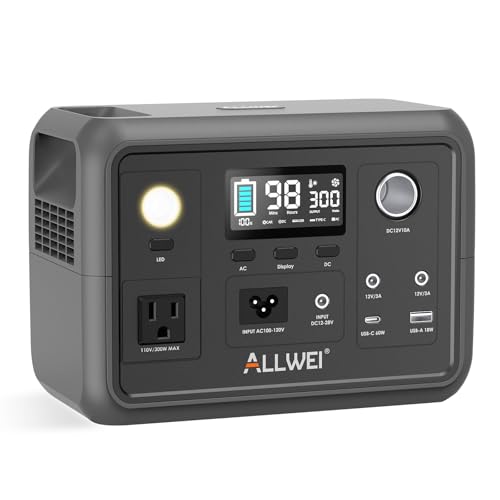
- LiFePO4 battery with 3,000 cycles
- Pass-through charging support
- Six output ports for mixed devices
Best For: durable everyday backup and travel charging
Ultra-fast backup power – Anker SOLIX C1000 Gen 2
If you want a portable power station with remote monitoring features, the Anker SOLIX C1000 Gen 2 is built around app-based control, fast charging, and serious output. It delivers 2,000W across 10 ports, supports under-10 ms UPS backup, and can be managed in the Anker app for smart power control and TOU scheduling.
Best For: Home backup, remote work setups, RV use, and outage prep where app control matters.
Pros:
- 49-minute full recharge with upgraded HyperFlash tech at 1,600W.
- 2,000W output with 3,000W peak and 1,024Wh capacity.
- Anker app support for power management and TOU Mode.
- Under 10 ms UPS switchover for sensitive devices like CPAP machines and laptops.
Cons:
- Solar input is capped at 600W, so off-grid recharge still depends on panel setup.
- At 11.3 kg, it is portable but not ultralight.
This is a strong fit if you want fast recharging plus app-based management in a compact, high-output unit. It balances emergency backup and everyday portability well, especially for users who value monitored power control.
Budget-friendly backup box – GRECELL 500W Portable Power Station
The GRECELL 500W is a straightforward portable power station with remote monitoring features absent, so it is better viewed as a simple backup option than a smart connected one. It offers 519Wh of capacity, pure sine wave AC output, and enough ports to run multiple small essentials for camping, outages, or a home emergency kit.
Best For: Users who need a basic, multi-device backup power source for small electronics and light appliances.
Pros:
- 519Wh capacity with 500W rated output for essentials like phones, laptops, routers, and CPAP machines.
- Multiple outputs, including 2 AC outlets, USB-C PD 60W, USB-A QC 3.0, DC ports, car port, and wireless charging.
- Pure sine wave inverter and built-in BMS for safer use with sensitive electronics.
- Three recharge options: wall, car, or solar.
Cons:
- No app or remote monitoring features listed.
- Limited to devices under 500W rated power.
- Solar panel is not included.
This model makes sense if you want a practical, no-frills portable backup rather than smart app control. It covers the basics well, but buyers needing remote monitoring should look at more connected alternatives.
Expandable smart backup – OUPES Mega 1
The OUPES Mega 1 is a portable power station with remote monitoring features built into its Bluetooth app control, making it a strong choice for users who want to track and manage power from a distance. It pairs that smart control with fast charging, high output, and the ability to expand capacity for more demanding backup or off-grid setups.
Best For: Professional users, home backup, and off-grid setups that benefit from app-based monitoring and expandability.
Pros:
- Bluetooth app control for remote monitoring and output management.
- 0-80% charging in 36 minutes via AC, or 26 minutes with AC plus solar.
- Expandable from 1,024Wh to 5,120Wh with extra batteries.
- <20 ms UPS transfer time for protecting sensitive equipment.
Cons:
- Only 4 AC outlets, so port count is lower than some rivals.
- Expansion requires compatible extra batteries, increasing total cost.
If remote monitoring is a priority, this is one of the more capable options in the group thanks to Bluetooth app control and detailed power management. It stands out for users who want fast recharge, UPS protection, and room to scale capacity later.
Solar-ready monitored kit – Anker SOLIX C1000 Gen 2 with 200W Panel
This Anker bundle is a practical portable power station with remote monitoring features through the Anker app, plus a 200W solar panel for easier off-grid charging. It keeps the same high-output C1000 Gen 2 platform, including 2,000W output, UPS backup, and TOU scheduling, while adding solar hardware for longer trips and backup planning.
Best For: Buyers who want app-based power management and a solar panel bundled with a compact backup station.
Pros:
- Anker app support for monitoring, control, and scheduling power use.
- 2,000W output with 3,000W peak and 1,024Wh capacity.
- Includes a 200W bifacial solar panel for off-grid recharging support.
- 49-minute full recharge with HyperFlash when enabled in the app.
Cons:
- Ships in two packages, which may arrive separately.
- Solar charging still depends on panel conditions and sunlight.
This bundle is a good pick if you want the station and solar panel together without piecing the system out separately. It is especially appealing for users who want smart app control plus a ready-made solar charging setup.
Home Backup / Remote Work Power – ALLPOWERS P1800 1024Wh 1800W
If you want a portable power station with remote monitoring for backup power, the ALLPOWERS P1800 stands out for its 1024Wh LiFePO4 battery, 1800W AC output, and app control. It is built to handle practical loads like refrigerators, computers, power tools, lights, and other essential devices, while still staying portable enough for home use, camping, or an off-grid cabin.
Best For: Home backup, remote work setups, and users who want app-based charging control and status monitoring.
Pros:
- 1800W rated output with 3600W surge for running more demanding essentials.
- Smart app support for real-time monitoring, charging mode changes, and shutdown scheduling.
- 1024Wh LiFePO4 battery rated for 4000+ cycles and backed by a 5-year warranty.
- Multiple charging options include solar, wall outlet, and car charging.
Cons:
- At 28.7 lbs, it is portable but not ultra-light.
- Solar input is capped at 650W max, so recharge speed depends on your setup.
- The feature set may be more than casual users need for simple phone charging.
This is a strong pick if you need a capable backup unit with app-based oversight and enough output for home essentials. It is less about pocket-sized convenience and more about dependable power management for real-world outage and off-grid use.
Compact Travel Pick – Anker SOLIX C300 288Wh
The Anker SOLIX C300 is a compact portable power station with remote-friendly convenience in a small package, especially if you value quick charging and simple monitoring through a modern travel setup. With 300W output, 288Wh capacity, and a lightweight design, it suits short trips, camping, and backup use for smaller devices like phones, laptops, cameras, and drones.
Best For: Travelers and campers who want a small, quiet power station for essential electronics.
Pros:
- Very compact and 15% smaller than similar designs.
- Fast 140W two-way USB-C charging and 80% recharge in 50 minutes via wall outlet.
- Eight output ports for flexible charging of small devices.
- Quiet operation at 25dB and a LiFePO4 battery rated for 3,000 cycles.
Cons:
- 300W total output limits what larger appliances it can run.
- Solar charging depends on compatible Anker solar panels.
- Shoulder strap is sold separately.
The C300 is a good fit when portability matters more than sheer capacity. It is best viewed as a compact power source for electronics and light-duty backup rather than a whole-home or heavy-appliance solution.
Budget Compact Backup – EnginStar R300 296Wh
The EnginStar R300 is a compact portable power station that covers basic emergency and travel needs with a 296Wh battery and 300W pure sine wave output. It is a practical choice if you want a portable power station with remote monitoring alternatives in the sense of simple, easy-to-read status through its digital display, without paying for a larger high-output unit.
Best For: Budget-minded users who need a small backup unit for phones, laptops, CPAPs, and light camping use.
Pros:
- Lightweight 6.5 lb design is easy to carry.
- Pure sine wave AC outlets are better for sensitive electronics.
- Three charging methods: solar, wall, and car.
- Eight output ports and a built-in digital display add flexibility and visibility.
Cons:
- 300W output is limited for larger appliances.
- Battery cycle life is listed at more than 1000 charges, which is lower than LiFePO4 models.
- Solar panel is not included.
The R300 is a sensible small-capacity option for emergency kits and weekend trips. It focuses on portability and essential-device support instead of high-capacity backup or advanced smart features.
Compact Backup Pick – BLUETTI Elite 30 V2 288Wh Power Station
If you want a portable power station with remote monitoring-ready convenience in a small, easy-to-carry form, the BLUETTI Elite 30 V2 is built for everyday carry, road trips, and emergency backup. Its 288Wh capacity, 600W continuous output, and fast charging make it a practical fit for users who need reliable power without moving up to a heavier unit.
Best For: Travelers, campers, and home users who want a lightweight backup unit for phones, laptops, CPAP machines, and small appliances.
Pros:
- Only 9.4 lbs, so it is easy to carry for camping, storms, or road trips.
- 600W continuous output with 1500W Power Lifting Mode for higher-demand essentials.
- Fast AC charging, reaching 0-80% in 45 minutes and 0-100% in 70 minutes.
- 10ms UPS switching helps keep critical devices running during outages.
Cons:
- 288Wh capacity is better for short-term backup than extended whole-day use.
- The remote monitoring feature is not listed in the supplied notes.
Overall, this is a compact, efficient choice if your priority is portability, quick recharging, and dependable backup for smaller electronics. It stands out most as a grab-and-go power solution rather than a high-capacity home battery.
Budget Camping Pick – MARBERO M823 300W Portable Power Station
The MARBERO M823 is a practical portable power station with remote monitoring-style convenience for campers and emergency users who care more about size and simplicity than high capacity. With 237Wh of storage, 300W output, and a very compact 4.6 lb design, it is easy to pack for weekends away or keep on hand for blackout backup.
Best For: Campers, road-trippers, and budget buyers who need a lightweight power source for phones, tablets, laptops, lights, and CPAP devices.
Pros:
- Very lightweight at 4.6 lbs, with a compact size that fits easily in a backpack.
- Multiple outputs, including AC, USB-A, USB-C, and DC for different devices.
- Built-in LED lanterns with brightness levels, steady mode, twinkling, and SOS.
- Supports wall, car, and solar charging for flexible recharging.
Cons:
- 300W output is suited to smaller electronics, not larger appliances.
- Solar panel is not included.
- Remote monitoring features are not mentioned in the supplied notes.
As a compact entry-level option, the M823 focuses on portability, essential device support, and simple emergency usefulness. It is a sensible pick if you want a small backup unit that is easy to carry and straightforward to recharge.
Long-Life Value Pick – ALLWEI 300W 256Wh LiFePO4 Power Station
For buyers comparing a portable power station with remote monitoring possibilities, the ALLWEI 300W stands out for long battery life and flexible charging rather than app-based extras. Its 256Wh LiFePO4 battery, 300W output, and pass-through charging make it a dependable all-around choice for camping, home backup, and off-grid use.
Best For: Users who want a durable small power station for routine backup, travel, and charging sensitive electronics.
Pros:
- LiFePO4 battery chemistry with a claimed 3,000 charge-discharge cycles.
- Pass-through charging lets you recharge the unit while powering devices.
- Six output ports, including AC, USB-A, USB-C PD 60W, DC, and car outlet.
- Flexible recharging with AC, car, solar, or dual charging options.
Cons:
- 300W output limits use to smaller appliances and electronics.
- Remote monitoring features are not listed in the supplied notes.
- Solar panel is sold separately.
This model is strongest as a long-life utility battery for people who want dependable everyday performance and broad device support. If you value cycle life and charging flexibility over advanced smart features, it is an easy model to shortlist.
How We Picked the Best Portable Power Station with Remote Monitoring
We focused on models that offer the best mix of capacity, output, battery chemistry, portability, and smart monitoring value. For a Portable Power Station with Remote Monitoring, the most important factors are accurate app or wireless status tracking, dependable output for your devices, and enough charging flexibility to fit real-world use.
We also prioritized brands and models that balance useful features with practical sizing, since monitoring is only valuable if the unit itself fits your travel, emergency, or home backup routine.
Quick Comparison
In this lineup, compact units are better suited to phone charging, laptops, and short camping trips, while larger-capacity models are better for CPAP machines, mini fridges, tools, and longer outages. If you want the most versatile all-around option, look for a mid-to-high capacity unit with strong AC output, LiFePO4 batteries, and clear remote status updates.
Lower-wattage models can still be excellent if portability matters more than runtime, while higher-wattage options make more sense when you need to power multiple appliances or heavier loads.
Key Buying Factors for a Portable Power Station with Remote Monitoring
Monitoring Features
Check whether monitoring is handled through an app, Bluetooth, Wi-Fi, or a dedicated display. Good remote monitoring should show battery percentage, input/output wattage, remaining runtime, and charging progress without guesswork.
Capacity and Output
Match watt-hours to how long you need power and AC watts to what you want to run. A larger battery does not help if the inverter cannot support your device’s startup draw.
Battery Type
LiFePO4 batteries are usually the better long-term choice because they tend to last longer and handle frequent cycling well. That matters if you plan to monitor and use the unit regularly.
Ports and Charging
Look for a useful mix of AC outlets, USB-C, USB-A, and car ports. Fast AC charging, solar input, and pass-through support can make the station much more practical day to day.
Who Should Buy Which Portable Power Station with Remote Monitoring?
Choose a compact model if you want an easy-to-carry option for day trips, tailgates, or light emergency charging. Choose a mid-size model if you need a balanced mix of portability and backup runtime for laptops, routers, and small appliances.
Choose a high-capacity unit if your priority is home outage backup, longer off-grid stays, or running demanding devices. If remote visibility is important to you, a Portable Power Station with Remote Monitoring is especially useful when the unit is stored in another room, tent, RV compartment, or garage.