Choosing a professional home weather station can make everyday forecasting more useful, whether you want real-time wind readings, rain totals, or app-based alerts before a storm moves in.
This roundup focuses on connected models that balance accuracy, sensor range, smart features, and ease of installation for serious homeowners.
Best 10 Professional Home Weather Station Picks for 2026
Wi-Fi Forecasting with Rain and Wind Tracking
La Crosse Smart Wi-Fi Weather Station
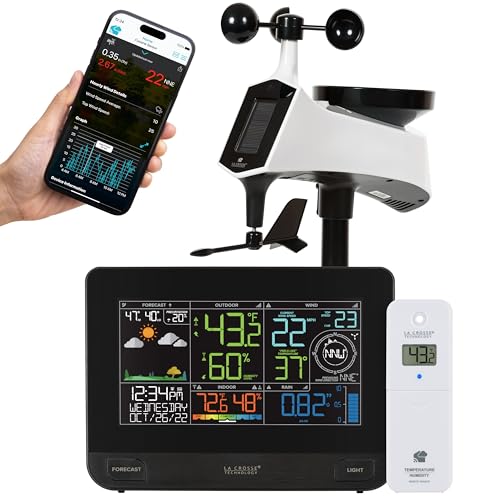
- Wind, rain, temp, humidity, and forecast display
- Wi-Fi adds app monitoring and extended weather data
- 400-foot range with custom alerts and hi/lo records
Best For: homeowners who want a feature-rich display station with app support
Hyper-Local Data with Smart Home Control
Ambient Weather WS-2902 WiFi Station
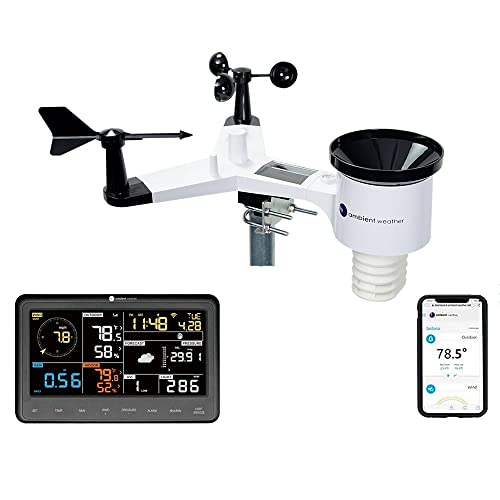
- Tracks wind, rain, UV, solar radiation, and climate data
- Remote monitoring with Wi-Fi and optional network sharing
- Smart-home and automation support via IFTTT, Alexa, and Google Home
Best For: buyers who want connected backyard data and automation support
Low-Maintenance All-in-One Sensing
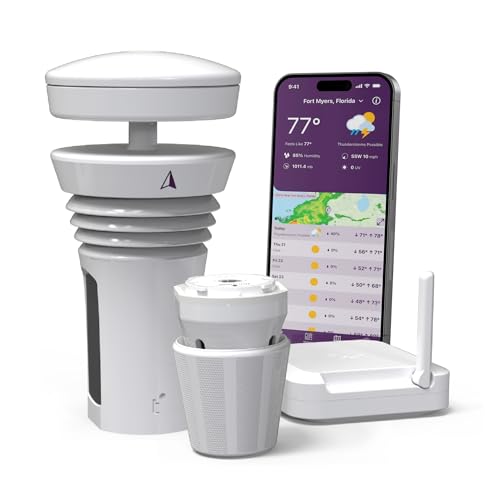
- All-in-one sensor tracks wind, rain, lightning, UV, and more
- No moving parts and solar power reduce maintenance
- Fast 3-second updates with Alexa and smart-home integration
Best For: buyers who want a low-maintenance smart weather station
Color Console with Remote Alerts
Ambient Weather WS-2000 Smart Station
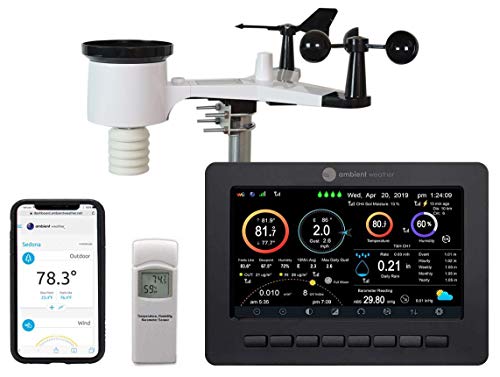
- TFT color display with remote weather monitoring
- Tracks wind, rain, UV, solar radiation, and climate data
- Calibration support and selectable imperial/metric units
Best For: buyers who want a colorful console with remote monitoring
Midrange All-in-One Monitoring
AcuRite Iris 5-in-1 Weather Station
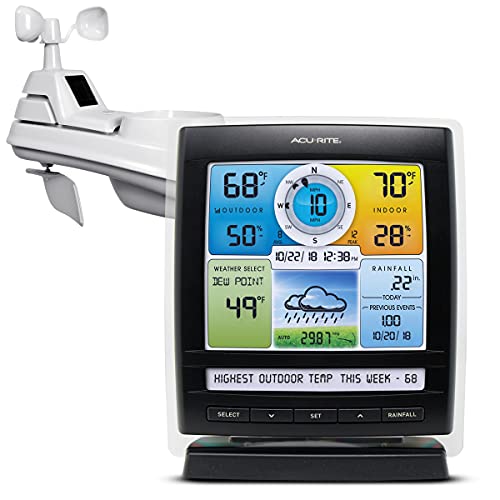
- Over 55 weather data points
- Wind, rain, temperature, and humidity
- Large color display with forecast
Best For: Homeowners wanting a detailed, easy-to-read station
Wi-Fi Backyard Monitor
La Crosse 328-69357-INT Weather Station

- Wi-Fi with La Crosse View app
- Tracks wind, rain, pressure, and temp
- Historical data and custom alerts
Best For: Connected monitoring with remote app access
Storm-Tracking Upgrade
AcuRite Iris with Lightning Detection
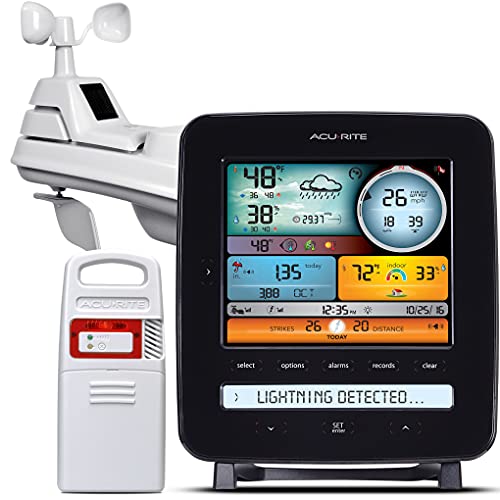
- Lightning distance and strike counter
- 50+ weather data points
- Illuminated display with alerts
Best For: Homes that want added storm and lightning awareness
LoRa Long-Range Smart Pick
4900FT WiFi Smart Weather Station with 7-in-1 Sensor

- LoRa signal reaches up to 4900 ft in open areas.
- 7-in-1 sensor tracks weather, UV, and light.
- Expandable console supports extra sensors and app monitoring.
Best For: Large homes and properties needing long-range, expandable weather monitoring.
Readable No-WiFi Monitor
Sainlogic 12-in-1 Weather Station SA6

- Large 6.5-inch color display with oversized fonts.
- Rain gauge is rated for precise hourly, daily, and total tracking.
- No Wi-Fi design keeps setup simple and local.
Best For: People who want a simple, readable weather station without Wi‑Fi.
Wi-Fi Forecasting with Rain and Wind Tracking – La Crosse Smart Wi-Fi Weather Station
If you want a professional home weather station that covers the basics and goes further when connected to Wi-Fi, this La Crosse model is built for practical backyard monitoring. It combines an easy-to-read color display with wind, rain, indoor/outdoor temperature, humidity, and forecast views, plus app-based remote access for added context.
Best For: Homeowners who want a feature-rich display station with strong forecast detail, wind/rain tracking, and Wi-Fi app monitoring.
Pros:
- Shows wind speed and direction, rainfall history, and indoor/outdoor temperature and humidity.
- Wi-Fi unlocks extended forecast data, 7-day outlooks, and extra weather info through the app.
- Custom alerts, hi/lo records, and an indoor comfort meter add day-to-day usefulness.
- 400-foot transmission range helps place sensors farther from the console.
Cons:
- Some of the richer forecast and environmental data require Wi-Fi connection.
- Outdoor sensors need separate batteries, which are not included.
- It is a display-first station, so it relies on the included sensors for all measurements.
For buyers who want a balanced professional home weather station with a clear screen and deeper cloud-connected forecasting, this La Crosse setup is a strong all-around pick.
Hyper-Local Data with Smart Home Control – Ambient Weather WS-2902 WiFi Station
Ambient Weather WS-2902 Wi-Fi Smart Weather Station | With Wi-Fi Remote Monitoring and Alerts
Check Price On AmazonThe Ambient Weather WS-2902 is a practical professional home weather station if you want hyper-local readings from a wireless sensor array and a bright LCD console. It tracks the core conditions most buyers care about, then layers in Wi-Fi sharing and smart-home features for more advanced use.
Best For: Buyers who want a connected weather station with strong backyard data, smart-home compatibility, and customizable alerts.
Pros:
- Measures wind speed/direction, temperature, humidity, rainfall, UV, and solar radiation.
- Wi-Fi lets you access data remotely and optionally share it with Ambient Weather Network.
- Works with IFTTT, Google Home, Alexa, and other smart-home setups for automation.
- Supports imperial and metric units, with calibration available.
Cons:
- AAA batteries for the sensor array are not included.
- Smart home compatibility is listed in the features, but the product details also note it is not smart-home compatible.
- The station is more feature-packed than simple stand-alone displays, so setup may take more effort.
If you want a connected weather station focused on accurate backyard readings and broad ecosystem support, the WS-2902 is an easy one to shortlist.
Low-Maintenance All-in-One Sensing – Tempest Smart Weather Station
The Tempest Weather Station is a standout choice for a professional home weather station if you prefer a sleek, low-maintenance design with no moving parts. Its single outdoor sensor measures a wide range of conditions and sends fast real-time updates, while app and Alexa support make it easy to use with modern smart-home setups.
Best For: Buyers who want a maintenance-light, all-in-one weather station with smart-home integration and fast reporting.
Pros:
- Measures temperature, humidity, barometric pressure, wind, rain, dew point, UV, solar radiation, and lightning.
- Solar-powered sensor transmits wirelessly up to 1,000+ feet and updates every 3 seconds.
- No moving parts means near-zero maintenance compared with traditional mechanical stations.
- Integrates with Alexa, Rachio, IFTTT, and other smart-home platforms.
Cons:
- There is no built-in display, so you rely on the app or connected devices for viewing data.
- The advanced feature set is concentrated in the sensor and software, not a console unit.
- It may be more than casual buyers need if they only want basic temperature and forecast readings.
For users who want broad sensing, strong wireless range, and minimal upkeep, Tempest offers a very modern take on home weather monitoring.
Color Console with Remote Alerts – Ambient Weather WS-2000 Smart Station
Ambient Weather WS-2000 Smart Weather Station | With Wi-Fi Remote Monitoring and Alerts
Check Price On AmazonIf you want a professional home weather station with a bigger, more detailed console experience, the Ambient Weather WS-2000 is designed around a TFT color display and an integrated sensor array. It covers the key outdoor measurements for backyard tracking and adds Wi-Fi remote monitoring for users who want access beyond the console.
Best For: Buyers who want a colorful console station with remote alerts and full backyard weather monitoring.
Pros:
- TFT color display provides an easy-to-read console experience.
- Measures wind speed/direction, temperature, humidity, rainfall, UV, and solar radiation.
- Wi-Fi support enables remote monitoring and optional transmission to a large weather network.
- Supports calibration and both imperial and metric units.
Cons:
- Sensor array batteries are not included.
- Temperature accuracy is listed at ±2°F, which is less precise than some competing stations.
- The product notes show some inconsistent smart-home details, so buyers should verify compatibility needs before choosing it.
The WS-2000 is a solid fit if you want a feature-forward display and connected monitoring without stepping into a more minimalist sensor-only design.
Midrange All-in-One Monitoring – AcuRite Iris 5-in-1 Weather Station
If you want a professional home weather station that covers the essentials without getting overly complex, the AcuRite Iris 5-in-1 is a strong all-around choice. It tracks indoor and outdoor temperature, humidity, wind speed and direction, rainfall, barometric pressure, and more, while the color display keeps current conditions easy to read at a glance.
Best For: Homeowners who want broad, local weather data with an easy setup and clear display.
Pros:
- Tracks more than 55 data points, including heat index, dew point, feels-like temperature, and pressure trends
- Wireless outdoor sensor with built-in anemometer, wind vane, barometer, hygrometer, rain gauge, and thermometer
- Large color LCD with time, date, adjustable dimmer, and a personalized 12-hour forecast
- Simple setup with included mounting bracket and battery-powered sensor installation
Cons:
- No batteries are included
- Requires multiple AA batteries for operation
- Does not offer Wi-Fi app monitoring
For buyers who care most about dependable, hyperlocal readings and easy day-to-day viewing, this model offers a practical balance of detail and usability. It’s a solid pick if you want more than a basic indoor/outdoor station but do not need app-based remote access.
Wi-Fi Backyard Monitor – La Crosse 328-69357-INT Weather Station
The La Crosse Technology 328-69357-INT is a professional home weather station built for users who want both local readings and app access. It measures indoor and outdoor temperature, humidity, wind speed, wind direction, rainfall, and barometric pressure, then adds Wi-Fi connectivity through the La Crosse View app for remote monitoring and alerts.
Best For: Users who want a connected weather station with app monitoring and customizable alerts.
Pros:
- Wi-Fi support with free La Crosse View app for remote tracking
- Measures wind, rain, pressure, temperature, and humidity
- Historical wind data from 1 hour up to 1 year
- Illuminated color display with adjustable intensity and auto-dimming
Cons:
- Temperature accuracy is listed at +/- 2 degrees Celsius
- Battery powered, so ongoing battery management is required
- Additional components are optional but may add setup complexity
This station stands out if you want modern connectivity alongside traditional weather instrumentation. It fits well for users who like checking conditions from anywhere and value alerts, history, and expandability in one system.
Storm-Tracking Upgrade – AcuRite Iris with Lightning Detection
AcuRite Iris (5-in-1) Professional Weather Station with LCD Display and Lightning Detection (01022M)
Check Price On AmazonFor shoppers looking for a professional home weather station with stronger storm awareness, this AcuRite Iris model adds lightning detection to the usual core readings. It reports indoor and outdoor temperature and humidity, wind speed and direction, rainfall, barometric pressure, and lightning activity on an illuminated color display.
Best For: Households that want lightning alerts and broader storm monitoring in a single station.
Pros:
- Includes lightning detection with estimated storm distance and strike counter
- Tracks 50+ data points, including pressure trends, heat index, and dew point
- Illuminated color display with auto-dimming and programmable notifications
- Self-calibrating technology provides a hyperlocal 12-hour forecast
Cons:
- No batteries are included
- Requires 6 AA batteries
- Does not include smart home compatibility
This is the most storm-focused option in the group, especially if lightning tracking matters as much as everyday weather data. It makes the most sense for buyers who want a more alert-driven station that still covers the standard home-weather essentials.
LoRa Long-Range Smart Pick – 4900FT WiFi Smart Weather Station with 7-in-1 Sensor
If you want a professional home weather station that can cover a large property without signal headaches, this model stands out for its LoRa-based long-range connection and Wi‑Fi/app access. It combines a 7-in-1 outdoor sensor, a bright HD console, and expandable monitoring features, making it practical for backyards, greenhouses, barns, and detached spaces.
Best For: Homes and properties that need long-range wireless coverage, app monitoring, and expandable sensor support.
Pros:
- LoRa transmission reaches up to 4900 ft in open areas for strong outdoor sensor connectivity.
- 7-in-1 outdoor sensor tracks temperature, humidity, rain, wind, UV, and light in one unit.
- Solar-assisted sensor design helps reduce battery maintenance, with adjustable panel positioning.
- Expandable console supports add-on sensors for temperature/humidity, air quality, and water leaks.
Cons:
- Uses multiple power sources and requires 5 AA batteries, which are not included.
- Feature set may be more than needed if you only want basic weather readings.
This is the most feature-rich option in the group, especially if you want broader coverage and the ability to grow into a larger smart home monitoring setup. The included bonus temperature/humidity sensor adds extra value for secondary spaces like a basement or garage.
Readable No-WiFi Monitor – Sainlogic 12-in-1 Weather Station SA6
This professional home weather station focuses on clear local readings and dependable wireless monitoring without Wi‑Fi complexity. The large 6.5-inch color LCD, precise rainfall tracking, and broad weather data display make it a strong fit for users who want a straightforward, highly readable setup.
Best For: Users who want a no-WiFi weather station with a large, easy-to-read display and accurate rainfall monitoring.
Pros:
- 6.5-inch HD color display uses oversized fonts and adjustable backlight for easy reading.
- Professional-grade rain gauge offers ±1 mm accuracy under 15 mm and ±7% across the full range.
- Displays many metrics including temperature, humidity, pressure, wind, rain, dew point, and moon phase.
- Wireless setup is simple and suited to gardens, farms, orchards, and other large outdoor areas.
Cons:
- No Wi‑Fi or app connectivity, so remote access is not part of the experience.
- Requires 3 AA batteries, which are not included.
If you prefer a local display over app features, this model keeps things practical and easy to live with. Its combination of readability and rainfall precision makes it especially appealing for hands-on weather tracking.
Simple Precision Choice – Sainlogic 12-in-1 Home Weather Station
For buyers comparing a professional home weather station with an emphasis on easy reading and accurate rainfall data, this Sainlogic model is a practical pick. It offers a large 6.5-inch display, manual calibration, and wireless outdoor monitoring for homes, yards, farms, and orchards.
Best For: Readers who want an easy-to-use weather station with precise rainfall monitoring and simple setup.
Pros:
- Large 6.5-inch display uses bold, high-contrast text and three-level backlighting.
- Rainfall monitor supports manual calibration and precise measurement across light and heavy rain ranges.
- Shows core data such as indoor/outdoor temperature, humidity, pressure, wind, dew point, and perceived temperature.
- Wireless transmission is suited to larger outdoor areas and avoids wiring hassles.
Cons:
- Batteries are not included for backup operation.
- No Wi‑Fi means you won’t get remote app-based monitoring.
This version is a good fit if you value straightforward operation and a clear screen more than smart-home extras. The manual calibration feature is especially useful if you want to fine-tune readings to local conditions.
How We Picked the Best Professional Home Weather Station
We focused on stations that deliver the most value for a Professional Home Weather Station setup: reliable sensor data, strong wireless connectivity, useful mobile or console features, and clear expansion support. We also prioritized models that are practical for real homes, not just hobbyist dashboards.
Quick Comparison
At a high level, the main differences come down to sensor depth, smart-home compatibility, and how much weather you can track at once. Some models emphasize simple, dependable backyard monitoring, while others add advanced forecasting, lightning detection, or broader multi-sensor data for more serious weather watching.
Key Buying Factors for a Professional Home Weather Station
Sensor Suite and Accuracy
Look for the readings you actually need: indoor/outdoor temperature, humidity, wind speed, wind direction, rainfall, barometric pressure, and lightning if severe weather matters in your area. More sensors can help, but only if the station reports them consistently and clearly.
Wireless Range and Placement
Range matters if your outdoor sensor must sit far from the display or router. Check the rated transmission distance, then account for walls, trees, and metal siding, which can reduce real-world performance. A strong range is especially important for a Professional Home Weather Station installed across a large yard.
Connectivity and Alerts
Wi-Fi app access, smart notifications, and cloud history make it easier to monitor trends over time. If you travel often or want storm warnings away from home, prioritize systems with dependable alerts and easy remote viewing.
Power and Maintenance
Solar-assisted sensors, battery life, and overall upkeep affect long-term convenience. A station that is easy to clean, calibrate, and service will usually stay useful longer than one that needs frequent troubleshooting.
Who Should Buy Which Professional Home Weather Station?
If you want the simplest connected experience, choose a model with straightforward app monitoring and the core weather metrics. If you live in a storm-prone area, a weather station with rain, wind, and lightning tracking is the better fit. For buyers who want the most capable Professional Home Weather Station setup, look for a system with strong remote monitoring, a broad sensor package, and stable Wi-Fi performance.
Budget-minded shoppers can still get solid basics from streamlined stations, while enthusiasts and data-focused users should pay more for better forecasting, more sensors, and stronger expansion options.