When it comes to smart home automation, choosing the right hardware can make all the difference in connectivity and control. You’ll want to take into account factors like compatibility, ease of use, and the features each device offers. With a variety of options available, from versatile hubs to dedicated controllers, finding the perfect fit for your needs is essential. Let’s explore some top contenders that promise to streamline your smart home experience.
Aqara Smart Home Hub M3 for Advanced Automation

If you’re looking for a versatile solution to streamline your smart home, the Aqara Smart Home Hub M3 is an excellent choice. This multi-protocol hub supports both Aqara Zigbee and Thread devices, seamlessly integrating third-party devices into the Aqara Home app. It prioritizes local control and automation, allowing for efficient operation without constant internet reliance. With dual-band Wi-Fi, a 360° IR blaster, and advanced security features, it enhances your smart home experience. Plus, you can easily migrate your older Zigbee devices, making it a future-proof option for advanced automation tailored to your needs.
Best For: Those seeking a reliable and versatile hub to enhance their smart home automation with a focus on local control and compatibility across multiple ecosystems.
Pros:
- Supports a wide range of devices, including Aqara Zigbee and Thread, and integrates third-party devices into the Aqara Home app.
- Prioritizes local control and automation, reducing reliance on internet connectivity for efficient operation.
- Features advanced security with dual-band Wi-Fi and end-to-end encrypted local storage for privacy.
Cons:
- Some cloud-based notifications may still require an internet connection.
- Limited to one AC device exposed to Matter, which may restrict functionality for users with multiple AC units.
- Requires repeaters for optimal performance with up to 127 Thread devices, which may add complexity to setup.
Home Assistant Connect ZBT-2 for Zigbee, Thread, or Matter Devices

Home Assistant Connect ZBT-2 is an ideal choice for smart home enthusiasts who want seamless integration of Zigbee, Thread, or Matter devices. This adapter boosts performance with a 4× speed improvement and an optimized antenna for superior connectivity. Its plug-and-play design makes setup a breeze, while the built-in wizard enables easy migration of existing networks. The liberated, open-source design invites tinkering, allowing you to customize your experience. With broad compatibility through ZHA, Zigbee2MQTT, and OpenThread Border Router, and reliable updates from the Home Assistant team, you’ll reduce hub clutter while enjoying robust connectivity.
Best For: Smart home enthusiasts looking for seamless integration and control of Zigbee, Thread, or Matter devices with enhanced performance.
Pros:
- 4× speed improvement enhances device responsiveness and connectivity.
- Plug-and-play design allows for quick and easy setup of new networks.
- Open-source design encourages tinkering and customization for advanced users.
Cons:
- Requires a Home Assistant system for functionality, limiting standalone use.
- Potential learning curve for users unfamiliar with Zigbee or Thread networks.
- Limited to supported protocols, which may exclude certain devices not compatible with ZHA, Zigbee2MQTT, or OpenThread.
Home Assistant Connect ZWA-2 for Z-Wave Devices

The Home Assistant Connect ZWA-2 is an ideal choice for anyone looking to seamlessly integrate Z-Wave devices into their smart home ecosystem. It uses the latest 800-series Z-Wave chipset, ensuring compatibility with all Z-Wave devices while minimizing interference from Zigbee, WiFi, and Bluetooth. You’ll benefit from reliable connections, even through thick walls. Setting it up is a breeze, thanks to a user-friendly startup wizard and one-click firmware updates. Plus, its sleek design blends effortlessly into your decor, resembling a candle with added lighting features. You’ll enjoy enhanced range, reliability, and battery life with this powerful adapter.
Best For: Homeowners and smart home enthusiasts looking to easily integrate Z-Wave devices into their existing systems with minimal setup.
Pros:
- Reliable connections through thick walls and busy areas due to minimized interference from other wireless technologies.
- User-friendly setup with an intuitive startup wizard and one-click firmware updates for hassle-free operation.
- Sleek design that blends well with home decor, featuring lighting elements that resemble a candle.
Cons:
- Requires Home Assistant system for operation, limiting its use to those already invested in that ecosystem.
- Potential compatibility issues with older Z-Wave devices not supported by the latest chipset.
- Limited to Z-Wave devices only, which may not suit users looking for broader smart home integration options.
Aqara Smart Hub M2 for Home Automation

For anyone looking to streamline their smart home experience, the Aqara Smart Hub M2 stands out with its ability to connect up to 128 Aqara Zigbee devices. It requires a 2.4 GHz Wi-Fi connection and supports devices like the Smart Plug and Wall Switch. You can control IR devices such as TVs and air conditioners with 360° infrared control, plus enjoy alerts through its built-in speaker. With Ethernet support for stable connections and compatibility with ecosystems like Apple HomeKit and Google Assistant, you’ll create a seamless automation experience. Just remember to keep the hub updated for peak performance.
Best For: Users looking to enhance their smart home setup with reliable connectivity and extensive compatibility with Aqara Zigbee devices.
Pros:
- Supports up to 128 Aqara Zigbee devices, allowing for a comprehensive smart home automation system.
- 360° infrared control for existing IR devices, enabling voice and automation control of appliances like TVs and air conditioners.
- Compatible with major smart home ecosystems such as Apple HomeKit, Google Assistant, and Alexa, ensuring ease of integration.
Cons:
- Limited to Aqara Zigbee devices, excluding compatibility with other Zigbee brands or Aqara thread devices.
- Only supports 2.4 GHz Wi-Fi, which may limit connectivity options for some users.
- Indoor use only for infrared control, restricting the placement and functionality of IR-controlled devices.
Aqara Smart Hub M100 for Home Automation
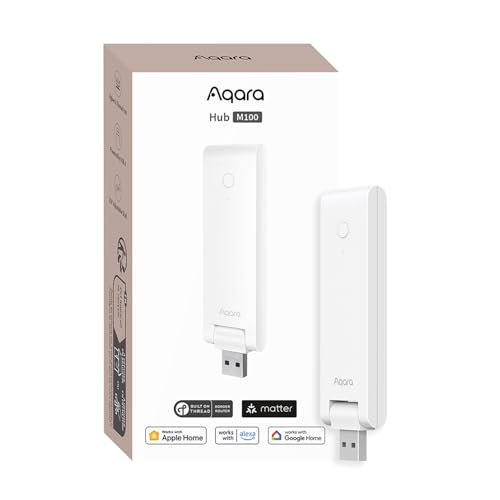
If you’re looking to streamline your smart home experience, the Aqara Smart Hub M100 is an excellent choice. This multi-protocol hub acts as a Matter controller and Thread border router, supporting up to 20 Aqara Zigbee and Thread devices. You can easily integrate it with ecosystems like Apple Home and Amazon Alexa. Its advanced features, including local automation execution and facial recognition, guarantee reliable performance. With a compact design and adjustable pivoting shaft, you can place it flexibly. Just remember to connect it to a 5V adapter for continuous operation, and enjoy seamless control over your smart devices!
Best For: Users seeking a versatile smart hub that integrates seamlessly with multiple ecosystems and supports a variety of smart devices.
Pros:
- Supports up to 20 Aqara Zigbee and Thread devices, allowing for extensive smart home setups.
- Advanced features like local automation execution and facial recognition enhance functionality and reliability.
- Compact design with an adjustable pivoting shaft for flexible placement in various environments.
Cons:
- Only compatible with Aqara Zigbee devices, limiting third-party device integration.
- Requires a separate 5V power adapter for continuous operation, which is not included.
- Optimal placement requires proximity to the router, limiting placement options.
Hubitat Elevation Home Automation Hub (Model C-8 Pro)

Designed with power users in mind, the Hubitat Elevation Home Automation Hub (Model C-8 Pro) excels in providing a fast, reliable, and private smart home experience. It supports over 1000 devices from 100+ brands, ensuring compatibility with popular products like Aqara, Philips Hue, and Nest. With built-in Z-Wave, Zigbee, and Matter protocols, you can enjoy seamless connectivity across your smart home devices. Integration with Apple HomeKit, Amazon Alexa, and Google Home enhances your control options. Plus, powerful external antennas improve signal strength, making it a great fit for larger homes. You’ll appreciate the rich automation features for effortless management.
Best For: Power users seeking a fast, reliable, and private smart home hub that supports a wide range of devices and protocols.
Pros:
- Wide Compatibility: Supports over 1000 devices from popular brands, ensuring extensive integration options.
- Multiple Protocol Support: Built-in Z-Wave, Zigbee, and Matter compatibility for seamless connectivity across devices.
- Robust Automation Features: Allows for detailed automation rules and scene creation directly from the hub.
Cons:
- Initial Setup Complexity: May require multiple updates and restarts during the initial setup process.
- Limited User Interface: Some users may find the interface less intuitive compared to other smart home hubs.
- Potential Signal Range Issues: While external antennas improve range, users in very large homes may still face connectivity challenges.
Tapo Smart Home Central Hub for Smart Devices (Tapo H500)

The Tapo Smart Home Central Hub (Tapo H500) stands out as the ideal choice for tech-savvy homeowners looking to centralize their smart device management. You can connect and control up to 16 Tapo cameras and 64 Sub-G sensors, ensuring seamless security monitoring. With built-in 16GB storage and offline mode, you access recordings without extra subscriptions. Its advanced WPA3 encryption keeps your footage safe, while the 110dB alarm alerts you to potential intruders. Plus, the hub’s facial recognition technology minimizes unnecessary alerts. Enjoy two-way audio communication and flexible networking options to enhance your smart home experience effortlessly.
Best For: Tech-savvy homeowners seeking a centralized solution for managing multiple smart security devices.
Pros:
- Supports connection and control of a large number of Tapo cameras and sensors for comprehensive home security.
- Built-in storage and offline mode eliminate the need for additional subscriptions or microSDs, ensuring easy access to recordings.
- Advanced security features, including WPA3 encryption and facial recognition technology, enhance privacy and reduce false notifications.
Cons:
- Requires additional purchases for expandable storage options (2.5 SATA HDD/SSD).
- Limited to Tapo devices, which may restrict compatibility with other brands of smart home products.
- Some users may find the setup and configuration process challenging if they are not tech-savvy.
Tapo Smart Hub with Built-in Chime (H100)

For anyone looking to streamline their smart home experience, the Tapo Smart Hub with Built-in Chime (H100) stands out as an excellent choice. This hub connects up to 64 smart devices over a reliable sub-1G wireless protocol, ensuring fewer signal interferences and a range of up to 30 meters. It extends the battery life of your connected devices by up to 10 times. You can set smart actions based on sensor detections or button presses, while home security features like motion and door/window sensors enhance your safety, activating a high-decibel siren for alerts when needed.
Best For: Those seeking an efficient and scalable solution to manage multiple smart devices in their home.
Pros:
- Connects up to 64 smart devices, allowing for extensive smart home integration.
- Extends battery life of connected devices by up to 10 times, reducing maintenance needs.
- High-decibel siren for alerts enhances home security and deterrence against intruders.
Cons:
- Cannot directly connect to smart plugs or lighting, limiting some functionalities.
- Requires 2.4GHz Wi-Fi, which may not be ideal for homes with only 5GHz networks.
- Range limited to 30 meters, which may not cover larger properties without additional hubs.
Amazon Echo Hub, 8” Smart Home Control Panel with Alexa

With its 8-inch touch screen and Alexa integration, the Amazon Echo Hub is perfect for anyone looking to streamline their smart home experience. You can control lights, smart plugs, and camera feeds effortlessly through voice commands or touch. The Hub works with thousands of Alexa-compatible devices, including locks and thermostats, ensuring seamless connectivity via WiFi, Bluetooth, Zigbee, and more. You can also arm and disarm security systems and monitor your home remotely using the Alexa app. Plus, it features multiple privacy controls and is made from 27% recycled materials, making it a smart choice for eco-conscious users.
Best For: Anyone looking to simplify their smart home management with a user-friendly interface and voice control capabilities.
Pros:
- Compatible with thousands of Alexa-compatible devices for extensive smart home integration.
- Easy installation options, including wall mounting and cable concealment.
- Designed with privacy controls and made from recycled materials, appealing to eco-conscious consumers.
Cons:
- Additional accessories, like table-top stands and power-over-Ethernet adapters, are sold separately.
- May require a stable internet connection for optimal performance of voice commands and remote monitoring.
- The reliance on Alexa may limit functionality for users who prefer other smart home ecosystems.
Lutron Caseta Smart Lighting Hub (L-BDG2-WH)
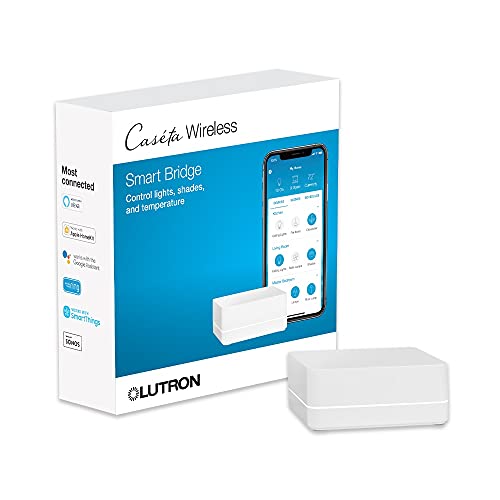
Ideal for homeowners seeking seamless smart lighting control, the Lutron Caseta Smart Lighting Hub (L-BDG2-WH) excels in integrating with popular smart home brands like Amazon Alexa and Apple HomeKit. This hub supports up to 75 devices, allowing you to personalize your lighting experience. With Clear Connect Technology, it won’t interfere with your Wi-Fi, ensuring smooth operation. Setup is a breeze—just plug it in and connect via the Lutron App. You can easily dim lights or switch them on and off using voice commands with Alexa, enhancing convenience and comfort throughout your home. Expand your smart lighting at your own pace!
Best For: Homeowners looking for a user-friendly smart lighting solution that integrates seamlessly with popular smart home systems.
Pros:
- Supports up to 75 devices, allowing for extensive customization and scalability in smart lighting.
- Easy installation with simple setup instructions via the Lutron App, making it accessible for all users.
- Compatible with major smart home platforms like Amazon Alexa and Apple HomeKit, enabling voice control for added convenience.
Cons:
- Limited to Lutron Caséta devices, which may restrict options for users with existing smart lighting systems from other brands.
- Requires a Wi-Fi connection for full functionality, potentially limiting use in areas with poor internet service.
- Initial cost may be higher compared to basic smart lighting solutions, which could be a consideration for budget-conscious consumers.
Factors to Consider When Choosing Smart Home Automation Platform Hardware
When choosing smart home automation platform hardware, you need to take into account several key factors. Think about device compatibility and the ecosystem it supports, as well as the communication protocols that work best for your needs. Don’t forget to evaluate local control capabilities, the setup process, and future upgrade potential to guarantee a seamless experience.
Device Compatibility and Ecosystem
Choosing the right smart home automation hardware hinges on its compatibility with various devices and ecosystems. You’ll want to verify it supports protocols like Zigbee, Z-Wave, and Thread to connect a broader range of smart devices. Look for platforms that easily integrate with popular ecosystems such as Apple HomeKit, Amazon Alexa, Google Assistant, and IFTTT for seamless operation. Also, check the maximum capacity for connected devices; some hubs can handle up to 127 devices. Consider whether the hardware can act as a Matter bridge, promoting interoperability across brands. Finally, evaluate the option to migrate existing devices from older systems, simplifying your setup and eliminating the hassle of starting from scratch.
Communication Protocols Supported
Device compatibility is just the beginning; the communication protocols supported by your smart home automation platform play a pivotal role in how well your devices work together. Different platforms support various protocols, like Zigbee, Z-Wave, Thread, and Matter, which impact device interoperability. Zigbee and Thread are favored for their low power consumption and mesh network capabilities, enhancing reliability in larger homes. Z-Wave operates on its own frequency, minimizing interference from Wi-Fi and Bluetooth, making it ideal for crowded areas. Matter, a newer protocol, streamlines integration across multiple ecosystems. Your choice of protocol can greatly affect how many devices you can connect, as some platforms support hundreds, while others may limit your options. Choose wisely!
Local Control Capabilities
Although cloud-based automation can offer convenience, local control capabilities are essential for ensuring your smart home operates smoothly and reliably. By enabling your devices to execute commands without relying on cloud services, you’ll experience enhanced speed and reliability. Local processing of device data also boosts privacy and security, as it minimizes data transmission over the internet. When your platform functions as an edge hub, devices can communicate and operate independently, ensuring continuous operation even during internet outages. You’ll enjoy markedly reduced response times, providing near-instantaneous feedback and actions for connected devices. Plus, platforms prioritizing local control often support seamless device integration and allow easy upgrades and expansions from older systems, making your smart home future-proof.
User-Friendly Setup Process
When setting up a smart home automation platform, a user-friendly setup process can make all the difference in your experience. Look for plug-and-play designs that allow for quick installation without complex configurations. Many smart home hubs feature built-in wizards to help you seamlessly migrate from your existing network, reducing setup time and effort. Intuitive startup wizards can guide you through connecting devices and configuring settings, ensuring a smooth experience. If you enjoy customization, consider platforms with open-source designs that allow for easy tinkering. Finally, centralized apps for managing devices and automations simplify the process by providing a single interface for all your connected devices, making it easier to control your smart home.
Future Upgrade Potential
As you explore smart home automation platforms, it’s important to evaluate their future upgrade potential. Check if the hardware supports the latest protocols like Matter, guaranteeing compatibility with upcoming devices. Look for hubs that make it easy to migrate existing devices and automations, as this simplifies upgrades. Assess the hub’s capacity to handle additional devices; options that can grow with your needs will keep your system relevant longer. Prioritize hardware with local control features, enhancing reliability and performance even during internet outages. Finally, consider platforms offering open-source or customizable options, allowing you to adapt to future innovations and personal preferences. Investing in these factors guarantees your smart home remains cutting-edge for years to come.