As you consider your smart home setup for 2026, the choice of a central automation hub can make a significant difference. These hubs not only streamline device integration but also enhance your home’s security and energy efficiency. With various options available, each offering unique features and compatibility, you’ll want to know what stands out. Let’s explore the top contenders that might just simplify your life and elevate your smart home experience.
Tapo Smart Home Central Hub for Smart Devices (Tapo H500)

If you’re looking for a centralized solution to manage your smart home devices, the Tapo Smart Home Central Hub (Tapo H500) stands out with its ability to connect and control up to 16 Tapo cameras and 64 Tapo Sub-G sensors. You’ll appreciate the built-in 16GB storage, expandable via HDD/SSD, allowing easy access to recordings without extra subscriptions. The advanced WPA3 encryption guarantees your footage stays secure, while the built-in alarm alerts you to intruders. Plus, with two-way audio and facial recognition, communication and security become seamless. Monitor live feeds and enjoy peace of mind, all through the intuitive Tapo App.
Best For: Those seeking a comprehensive and user-friendly solution to manage multiple Tapo smart devices with enhanced security features.
Pros:
- Centralized control allows seamless management of up to 16 cameras and 64 sensors.
- Built-in storage eliminates the need for subscriptions and extra microSDs, making access to recordings convenient.
- Advanced security features like facial recognition and WPA3 encryption ensure both safety and privacy.
Cons:
- Limited to Tapo devices, which may restrict compatibility with other smart home brands.
- Requires additional purchase of HDD/SSD for expanded storage.
- Continuous recording is limited to only 4 cameras at a time.
Aqara Smart Home Hub M3 for Advanced Automation

The Aqara Smart Home Hub M3 is perfect for tech-savvy users looking to create a seamless and advanced home automation system. This multi-protocol hub supports both Aqara Zigbee and Thread devices, integrating third-party options into the Aqara Home app. With Matter bridge functionality, you can connect effortlessly to ecosystems like Home Assistant. It prioritizes local control, ensuring speed and reliability. Plus, its 360° IR blaster connects air conditioners, transforming your space into a smart haven. Dual-band Wi-Fi and robust security keep your network safe, while 8GB of encrypted storage protects your automation data. Enjoy advanced automation with privacy in mind!
Best For: Tech-savvy users looking to create a seamless and advanced home automation system with a focus on local control and privacy.
Pros:
- Supports both Aqara Zigbee and Thread devices for versatile automation options.
- Prioritizes local control and speed, ensuring reliable performance without dependence on cloud services.
- Enhanced privacy features with end-to-end encrypted local storage and no microphones or cameras included.
Cons:
- Limited to one air conditioning unit connected to Matter at a time, which may restrict multi-AC setups.
- Some cloud-based notifications may still require internet connectivity, potentially limiting full offline functionality.
- Requires additional repeaters for optimal performance with up to 127 Thread devices.
Philips Hue Bridge Smart Lighting Hub
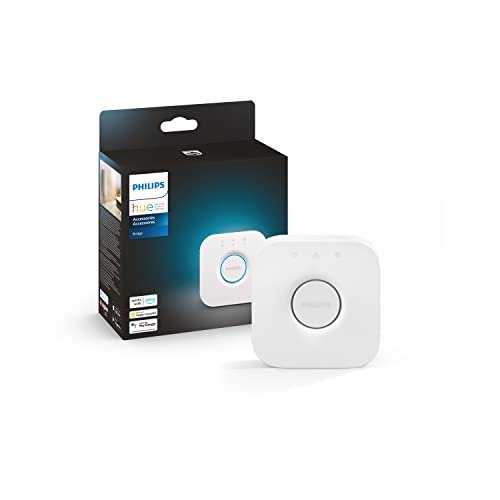
For anyone looking to elevate their smart home experience, the Philips Hue Bridge Smart Lighting Hub is a game-changer. This hub lets you control up to 50 lights and accessories, ensuring seamless management of your indoor and outdoor lighting. With Zigbee technology, you enjoy a secure connection that won’t bog down your Wi-Fi. You can control your lights from anywhere using the Hue app, even if your internet’s down. Plus, it integrates with Matter, enhancing your smart home setup. With features for automation, customization, and automatic updates, the Philips Hue Bridge keeps your lighting system future-ready and versatile.
Best For: Those seeking a comprehensive and customizable smart lighting solution for their home.
Pros:
- Seamless control of up to 50 lights and accessories, enhancing your indoor and outdoor lighting experience.
- Utilizes Zigbee technology, providing a secure connection without affecting Wi-Fi performance.
- Compatible with Matter, allowing integration with other smart home devices for improved automation.
Cons:
- Requires a Hue Bridge for full functionality, which may be an additional expense for some users.
- Limited to Philips Hue products, restricting users to a specific brand for expansion.
- May require a learning curve for users unfamiliar with smart home technology and app navigation.
Amazon Echo Hub, 8” Smart Home Control Panel with Alexa

Looking for a smart home control panel that simplifies your life? The Amazon Echo Hub features an 8” screen and Alexa integration, letting you control thousands of compatible devices effortlessly. With simple voice commands or touch, you can manage lights, smart plugs, and even camera feeds. This hub supports WiFi, Bluetooth, Zigbee, Matter, Sidewalk, and Thread for smooth connections. You can also enhance your home security by arming or disarming systems remotely. Installation is a breeze with wall-mount options and cable concealment. Plus, enjoy peace of mind with privacy controls and eco-friendly materials.
Best For: Individuals seeking an intuitive and versatile smart home control panel to manage various devices and enhance home security.
Pros:
- Seamless integration with thousands of Alexa-compatible devices, providing extensive control over smart home features.
- Easy installation options, including wall mounting and cable concealment for a clean look.
- Robust privacy controls and eco-friendly materials, ensuring user security and sustainability.
Cons:
- Additional costs for table-top stands and power-over-Ethernet adapters may be required for optimal setup.
- Limited functionality may occur if not all devices are compatible with Alexa.
- The 8” screen size may be too small for some users who prefer larger displays for monitoring.
Hubitat Elevation Home Automation Hub (Model C-8 Pro)

Designed for tech-savvy homeowners, the Hubitat Elevation Home Automation Hub (Model C-8 Pro) offers unparalleled control and flexibility over your smart devices. It supports over 1000 devices from 100+ brands, using protocols like Zigbee, Z-Wave, and Matter for seamless integration. With built-in Z-Wave and Zigbee chips, it enhances security and connectivity. You can easily automate tasks and manage devices directly from the hub without relying on external services. Plus, it integrates with major smart assistants like Apple HomeKit, Amazon Alexa, and Google Home. Enjoy improved signal strength with external antennas, making it perfect for larger homes.
Best For: Tech-savvy homeowners looking for comprehensive control and automation of their smart home devices.
Pros:
- Supports over 1000 devices from 100+ brands, ensuring compatibility with a wide range of smart home products.
- Offers local processing for enhanced speed, reliability, and privacy, reducing dependency on cloud services.
- Integrates seamlessly with major smart assistants like Apple HomeKit, Amazon Alexa, and Google Home for a cohesive smart home experience.
Cons:
- Initial setup may require several updates and restarts, which could be cumbersome for some users.
- The complexity of advanced automation features may be overwhelming for those new to smart home technology.
- Limited support for devices that do not use the supported communication protocols (Zigbee, Z-Wave, Matter).
Aeotec Smart Home Hub2 – V4, Works with SmartThings and Compatible with Alexa and Google Assistant
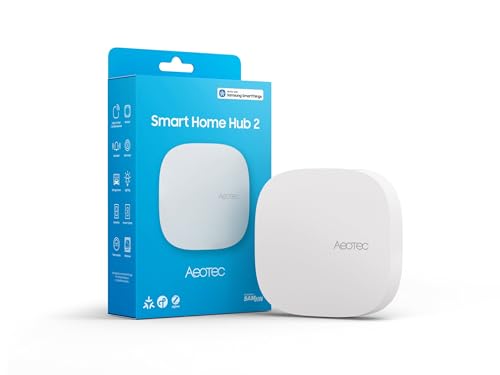
The Aeotec Smart Home Hub2 – V4 stands out for anyone wanting a seamless smart home experience, particularly if you already use SmartThings. This hub functions as a SmartThings Hub and a Zigbee and Matter Gateway, connecting thousands of compatible devices including lighting, sensors, and thermostats. You’ll enjoy multi-platform voice control through Alexa and Google Assistant, allowing you to manage your home effortlessly. Setup is a breeze via Wi-Fi or wired Ethernet, making it perfect for any living space. Plus, you can create custom routines for enhanced security and energy savings, even offline when the internet’s down.
Best For: Those looking for an easy-to-use smart home hub that integrates seamlessly with SmartThings and supports a wide range of smart devices.
Pros:
- Supports Matter and Zigbee standards, allowing connectivity with thousands of compatible devices.
- Multi-platform voice control through Alexa and Google Assistant for convenient management of your smart home.
- Custom automation routines can be created for security and energy efficiency, with many features functioning offline.
Cons:
- No Z-Wave support, limiting compatibility with some smart devices.
- Dependent on Wi-Fi or wired Ethernet for setup, which may not suit all users.
- Limited advanced features compared to some more specialized smart home hubs.
Tapo Smart Hub with Built-in Chime (H100)

If you’re seeking a reliable solution to streamline your smart home experience, the Tapo Smart Hub with Built-in Chime (H100) is an excellent choice. This hub connects up to 64 smart devices using 2.4GHz Wi-Fi, ensuring efficient performance. With its sub-1G low-power wireless protocol, you’ll enjoy a long-range connection of up to 30 meters and reduced signal interference. It enhances battery life of connected devices by up to ten times. Plus, you can integrate security features like motion sensors and activate a high-decibel siren for alerts. Simplify your smart home setup with Tapo’s seamless control and automation capabilities.
Best For: Those looking to enhance their smart home connectivity and security with a reliable hub that supports a wide range of devices.
Pros:
- Supports up to 64 smart devices for extensive home automation.
- Long-range connectivity of up to 30 meters with reduced signal interference.
- Extends battery life of connected devices by up to ten times, enhancing efficiency.
Cons:
- Requires 2.4GHz Wi-Fi, limiting compatibility with some devices.
- Cannot directly connect to smart plugs or lighting, needing additional setup.
- Limited integration with specific smart home products may restrict functionality.
eufy Smart Display E10, Smart Home Hub

For families seeking a seamless and user-friendly way to manage their smart home, the eufy Smart Display E10 stands out as an ideal solution. This 8-inch hub is compatible with various devices, making it easy to integrate into your existing setup. You’ll receive instant alerts for doorbell rings or movement, with live feeds lighting up and providing voice notifications. Enjoy the convenience of monitoring four video streams simultaneously, while historical events are automatically saved for quick playback. Its intuitive touchscreen design guarantees that everyone, from kids to seniors, can easily stay connected and secure in their home.
Best For: Families looking for a user-friendly smart home hub that integrates seamlessly with various devices for enhanced security and convenience.
Pros:
- Instant alerts for doorbell rings, door unlocks, and movement detection enhance home security.
- Simultaneous live monitoring of four video feeds provides a comprehensive view of your property.
- User-friendly touchscreen design makes it accessible for all ages, ensuring everyone can operate it easily.
Cons:
- Limited compatibility with some smart home devices may restrict integration options.
- The 8-inch screen size may not be sufficient for detailed viewing in larger spaces.
- Reliance on Wi-Fi connectivity could pose challenges during outages or slow internet speeds.
Lutron Caseta Smart Lighting Hub (L-BDG2-WH)
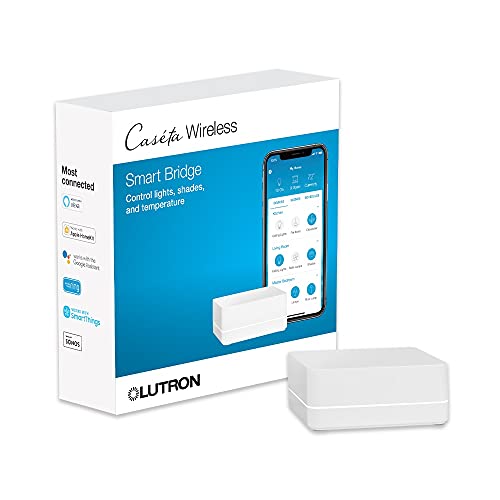
Looking to streamline your smart home experience? The Lutron Caseta Smart Lighting Hub (L-BDG2-WH) is your answer. It supports up to 75 devices and connects seamlessly with top brands like Amazon Alexa, Apple HomeKit, and Google Assistant. With its Clear Connect Technology, you won’t face Wi-Fi interference while controlling your lights and fans. Installation is a breeze—just plug it in and connect to Wi-Fi using the Lutron App. You can personalize your lighting and expand your system as you go. Elevate your home automation with ease and flexibility, making your life simpler every day.
Best For: Homeowners looking to enhance their smart home setup with a reliable and easy-to-use lighting control system.
Pros:
- Supports up to 75 devices, allowing for extensive home automation.
- Seamlessly integrates with popular smart home brands like Amazon Alexa, Apple HomeKit, and Google Assistant.
- Easy installation process with straightforward setup instructions via the Lutron App.
Cons:
- Limited to Caséta devices, which may restrict options for users with other brands.
- Requires Wi-Fi for functionality, which could be a drawback in areas with poor connectivity.
- Initial cost may be higher compared to simpler smart lighting solutions.
Aqara Smart Hub M200, Matter Controller

The Aqara Smart Hub M200 stands out as an ideal choice for tech-savvy homeowners seeking a versatile smart home solution. This multi-protocol hub supports Matter, integrates seamlessly with platforms like Amazon Alexa, Apple HomeKit, and Google Home, and accommodates up to 40 Aqara Zigbee and Thread devices. Its 360° IR blaster enhances connectivity, allowing you to control traditional AC units. With dual-band Wi-Fi and PoE support, you’ll enjoy reliable performance. The built-in speaker offers alerts and custom messages, while local automation guarantees quick responses without relying on cloud access. Elevate your smart home experience with the Aqara Smart Hub M200.
Best For: Tech-savvy homeowners looking for a versatile and reliable smart home hub that supports multiple protocols.
Pros:
- Supports a wide range of platforms: Integrates seamlessly with Amazon Alexa, Apple HomeKit, Google Home, and more.
- Local automation capabilities: Ensures quick and reliable performance without reliance on cloud access.
- Comprehensive control: The 360° IR blaster allows for control of traditional AC units, enhancing connectivity.
Cons:
- Limited third-party device support: Does not work with third-party Zigbee devices.
- Single AC device exposure: Only one air conditioning unit can be connected to Matter.
- Some automations require cloud access: Features like cloud push notifications need a connection to the internet.
Factors to Consider When Choosing a Smart Home Central Automation Hub
When picking a smart home automation hub, you’ll want to take into account several key factors. Think about device compatibility, the communication protocols it supports, and whether you prefer local or cloud control. Security features and ease of setup are also essential to guarantee a smooth experience.
Compatibility With Devices
Choosing the right smart home central automation hub requires you to contemplate compatibility with various devices. Make sure it supports a wide range of protocols like Zigbee, Z-Wave, and Matter for seamless integration. You’ll also want a hub that works with popular ecosystems such as Amazon Alexa, Apple HomeKit, and Google Home, maximizing compatibility with your existing devices. Check how many devices the hub can manage—some support up to 127 or more, giving you room to expand your smart home. It’s essential to verify if the hub connects to both brand-specific and third-party products, creating a versatile setup. Finally, consider features like local control and automation capabilities to enhance performance and privacy.
Communication Protocols Supported
Understanding the communication protocols supported by a smart home hub is essential for guaranteeing seamless integration with your devices. Key protocols like Zigbee, Z-Wave, and Matter offer interoperability among diverse smart devices. Zigbee works well for low-power gadgets such as light bulbs and sensors, while Z-Wave excels in security applications due to its longer range and reliability. Matter, a newer protocol, aims to unify devices across platforms, enhancing compatibility and user experience. Many hubs support multiple protocols simultaneously, allowing you to connect a broader range of devices without brand limitations. Always verify the supported protocols of a smart home hub to guarantee compatibility with your existing devices and facilitate future expansion of your smart home ecosystem.
Local vs. Cloud Control
As you explore smart home automation hubs, considering the choice between local and cloud control is vital for your system’s performance and reliability. Local control hubs process data directly on the device, ensuring faster response times and reliability, especially during internet outages. This approach enhances privacy since your data isn’t transmitted to external servers, minimizing exposure to potential breaches. On the other hand, cloud control relies on external servers, which may introduce latency and requires a stable internet connection for full functionality. Some systems offer a hybrid approach, letting you choose local automation for significant functions and cloud services for features like remote access. Local control also supports offline functionality, ensuring automations run even without internet access, which is critical for security.
Security Features Offered
When evaluating smart home automation hubs, security features play an essential role in protecting your home and personal data. Look for hubs that utilize advanced encryption standards, like WPA3, to safeguard your information from unauthorized access. Built-in alarms or sirens can alert you to intrusions and deter potential threats when paired with motion or door/window sensors. Local storage options are vital, too, as they let you access recorded footage without relying on cloud services, enhancing privacy. Additionally, verify the hub supports real-time alerts for security events, so you’re always informed of potential issues. Two-way audio capabilities also help you communicate with visitors or deter intruders by allowing you to speak directly through the hub.
Ease of Setup
Selecting a smart home automation hub that’s easy to set up can save you time and frustration, allowing you to enjoy your smart home sooner. Look for hubs with plug-and-play installation, minimizing setup time and user involvement. A hub with a user-friendly mobile app can guide you through the installation process with step-by-step instructions and real-time feedback, enhancing your understanding. Choose a hub that supports easy pairing with various smart devices without complicated configurations. Flexible connectivity options, like Wi-Fi, Ethernet, or Power over Ethernet (PoE), accommodate different home environments. Finally, consider hubs featuring “magic pairing” technology that automatically detects devices upon power-up, further streamlining the setup process and making your shift to smart living seamless.
Automation Capabilities
How can the automation capabilities of a smart home hub transform your living space? With advanced automation rules and scenes, you can create a responsive environment that reacts to various triggers, like time or sensor inputs. Many hubs execute automations locally, ensuring quick responses and reliable operation, even during internet outages—essential for security. The right hub integrates with numerous devices and protocols, such as Zigbee, Z-Wave, and Matter, allowing you to build a thorough system across different brands. Some hubs even feature smart IR blasters to control traditional appliances, creating seamless automation. Plus, their scalability lets you expand your smart home gradually without the need to replace your hub, making it a future-friendly choice.
Future-Proofing Options
As you explore options for a smart home central automation hub, it’s essential to take into account future-proofing features that guarantee long-term compatibility and functionality. Look for hubs that support the Matter protocol; this enhances compatibility across various brands and ecosystems. Choose those that receive regular automatic updates to keep pace with new technologies and standards. Hubs integrating multiple communication protocols like Zigbee and Z-Wave can also protect your setup against evolving device compatibility. Evaluate each hub’s capacity to support a growing number of devices, as some can accommodate over 100. Finally, prioritize hubs that focus on local control and automation to enhance performance and reliability during internet outages or disruptions.