As energy prices continue to rise, it’s essential to find ways to cut costs and stay eco-friendly. Smart home energy monitors are an excellent solution for tracking your consumption and optimizing usage. In 2026, the market offers some impressive options that promise both savings and sustainability. Curious about which devices can help you achieve these goals and transform your home into a more efficient space? Let’s explore the top choices available this year.
Emporia Vue 3 Home Energy Monitor
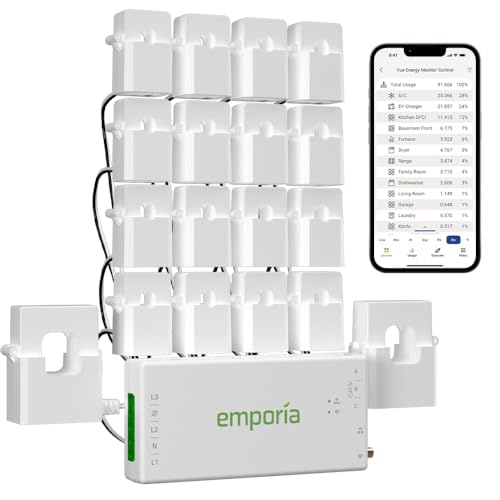
If you’re looking for a reliable way to track your home’s energy usage, the Emporia Vue 3 Home Energy Monitor is an excellent choice. This UL Listed device guarantees safety and reliability while monitoring real-time electricity consumption. Installation is straightforward with clamp-on sensors compatible with various electrical systems. You can manage energy 24/7 through the Emporia Energy App, which provides live data, savings notifications, and customizable settings. With sixteen branch sensors for critical loads and improved design features to reduce panel clutter, you’ll gain detailed insights into your energy use, helping you save money and promote a greener lifestyle.
Best For: Homeowners looking for an effective solution to monitor and manage their energy consumption in real-time.
Pros:
- Provides real-time energy data with high accuracy (±2%).
- User-friendly installation with clamp-on sensors compatible with various electrical systems.
- Offers customizable settings through the Emporia Energy App for effective energy management and cost savings.
Cons:
- Requires a 2.4 GHz WiFi connection for data monitoring.
- Additional sensors may need to be purchased separately for larger systems.
- Data retention limits may restrict access to historical data for longer periods without cloud storage.
Smart Home Energy Monitor with 16x60A Circuit Sensor

For homeowners looking to maximize energy efficiency and savings, the Smart Home Energy Monitor with 16x60A Circuit Sensor stands out with its robust features. This ETL Certified device tracks energy consumption in real-time, helping you save 10%-20% on bills by optimizing appliance usage. With 24/7 monitoring via the Refoss app, you can access detailed electricity usage data for up to three years. Its solar integration feature automates high-energy appliances during surplus, enhancing your solar investment. Plus, personalized alerts notify you of unusual spikes, ensuring efficient management of your energy consumption. It’s an essential tool for eco-conscious homeowners.
Best For: Homeowners looking to enhance energy efficiency and reduce electricity bills through real-time monitoring and smart automation.
Pros:
- Real-time energy tracking enables users to optimize appliance usage and save 10%-20% on energy bills.
- Solar integration automates the use of high-energy appliances during solar surplus, maximizing returns on solar investments.
- Detailed usage data is stored for up to three years, presented in clear charts for easy analysis.
Cons:
- Requires firmware updates via the Refoss app for optimal compatibility and performance.
- Lacks cloud processing options, which may limit remote access to data.
- API support is not available, restricting integration with other smart home systems.
SIEMENS Inhab Smart Home Energy Monitor

The SIEMENS Inhab Smart Home Energy Monitor is ideal for homeowners seeking to optimize their energy usage and reduce costs. With its 16-50Amp circuit level sensors and 2-200Amp main sensors, you can monitor electricity usage in real-time. You’ll appreciate tracking your home’s energy consumption 24/7, covering up to 16 branch circuits. Personalized notifications alert you to energy-saving opportunities and unusual activities, like leaving the oven on. Advanced features include Time of Use Management and Peak Demand Management, ensuring you maximize efficiency. Plus, it’s rigorously tested for safety and compliance, making it a reliable addition to your smart home setup.
Best For: Homeowners looking to optimize their energy usage and reduce electricity costs with real-time monitoring capabilities.
Pros:
- Offers real-time tracking of energy consumption for up to 16 branch circuits.
- Provides personalized notifications for energy-saving opportunities and unusual device usage.
- Supports advanced energy management features like Time of Use and Peak Demand Management.
Cons:
- Installation may require professional assistance for optimal setup.
- May have a higher upfront cost compared to basic energy monitors.
- Compatibility with certain smart devices may be limited.
Emporia Vue 3 Home Energy Monitor
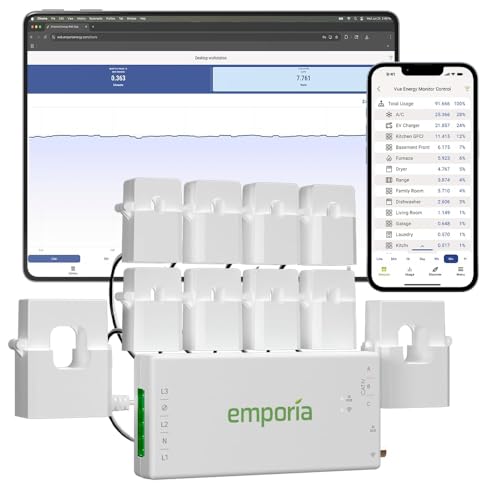
Emporia Vue 3 Home Energy Monitor stands out as an excellent choice for homeowners seeking to take control of their energy usage and costs. This UL Listed device guarantees safety and reliability, protecting against hazards like overheating and short-circuiting. It easily installs in most circuit panels using clamp-on sensors and supports various electrical systems. With the Emporia Energy App, you can automate energy management, receive real-time spending notifications, and configure settings for maximum savings. Plus, you can monitor solar energy and export data anytime, all while enjoying ±2% accuracy. The one-year warranty adds extra peace of mind.
Best For: Homeowners looking to efficiently monitor and manage their energy usage while ensuring safety and reliability.
Pros:
- UL Listed for safety, preventing hazards like overheating and short-circuiting.
- User-friendly installation with clamp-on sensors, compatible with various electrical systems.
- Emporia Energy App provides real-time monitoring, actionable notifications, and automated energy management for potential cost savings.
Cons:
- Requires a 2.4 GHz Wi-Fi connection for functionality, which may limit use in some homes.
- Additional 200A sensor needed for compatibility with certain systems is sold separately.
- Data retention for minute and hour intervals may not be sufficient for long-term analysis compared to some other devices.
Smart Home Energy Monitor with 16 50A Circuit Level Sensors

With 16 50A circuit level sensors, this Smart Home Energy Monitor is perfect for homeowners seeking detailed insights into their energy consumption. It easily installs in your circuit panel, using clamp-on sensors without restrictions on quantity or voltage. Compatible with Home Assistant, this monitor works for single-phase, split-phase, and three-phase systems. Enjoy real-time monitoring through your smartphone app, with data accuracy of 1%. You’ll receive actionable notifications to help reduce your electric bills while supporting your green initiatives. Plus, it comes with a 1-year warranty, ensuring peace of mind with your energy-saving investment.
Best For: Homeowners looking to gain detailed insights into their energy consumption and reduce electric bills while supporting green initiatives.
Pros:
- Real-time monitoring with 1% accuracy allows for precise tracking of energy usage.
- Easy installation with clamp-on sensors, suitable for various electrical systems.
- Offers actionable notifications to help users conserve energy and save on costs.
Cons:
- Requires Home Assistant with MQTT for operation, which may not be familiar to all users.
- Limited to 16 sensors, which might not be sufficient for larger homes or commercial setups.
- Connectivity depends on a stable 2.4GHz WiFi network, which could be a limitation in some environments.
Emporia Vue 3 Home Energy Monitor

For homeowners looking to take control of their energy consumption, the Emporia Vue 3 Home Energy Monitor stands out with its real-time electricity usage monitoring and smart automation features. It installs easily in most circuit panels using clamp-on sensors and supports various electrical systems. With its UL Listed certification, you can trust its safety and reliability. The Emporia Energy App allows you to manage energy consumption, configure settings for peak demand, and gain insights into your spending. Plus, you can add up to sixteen sensors for precise appliance monitoring, ensuring you maximize efficiency and save money.
Best For: Homeowners who want to monitor and manage their energy consumption in real-time for cost savings and efficiency.
Pros:
- UL Listed certification ensures safety and reliability, preventing hazards like overheating.
- Real-time data monitoring with accurate energy data allows for informed decision-making on energy usage.
- Expandable system lets you add up to sixteen sensors for detailed appliance monitoring.
Cons:
- Requires a 2.4 GHz WiFi connection for full functionality, which may not be available in all homes.
- Additional sensors for expanded monitoring are sold separately, potentially increasing overall costs.
- Installation may require some technical knowledge, which could be challenging for some homeowners.
Smart Home Energy Monitor with Live Electricity Usage Tracking
Looking to gain control over your energy consumption? The Smart Home Energy Monitor with Live Electricity Usage Tracking is your answer. Equipped with dual 120A CTs, it offers real-time tracking of voltage, current, power, and total energy consumption. Its easy installation means you can set it up without any complex wiring. Plus, it integrates seamlessly with the Smart Life app, allowing you to analyze your data and automate your energy usage. With features like Dynamic Load Balancing and zero grid export mode, you’ll maximize efficiency and reduce costs, all while keeping your home green. Take charge of your energy today!
Best For: Individuals and families looking to monitor and optimize their home energy consumption efficiently.
Pros:
- Real-time Tracking: Offers accurate monitoring of voltage, current, power, and total energy consumption.
- Easy Installation: Quick setup with pluggable terminals and compact split-core CTs, eliminating complex wiring.
- Smart Integration: Compatible with the Smart Life app for customizable automation and detailed data analysis.
Cons:
- Limited to Single-Phase Systems: May not be suitable for homes with three-phase electrical systems.
- Wi-Fi Dependency: Requires a stable 2.4GHz Wi-Fi connection for optimal performance and data access.
- Requires App Usage: Full functionality is dependent on using the Smart Life app, which may not appeal to everyone.
Sense Energy Monitor – Track Electricity Usage in Real Time
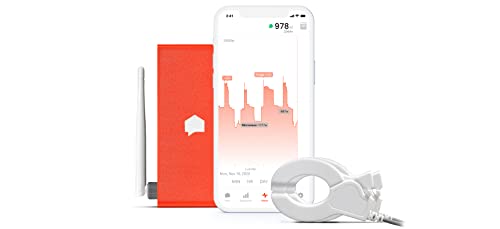
The Sense Energy Monitor is ideal for homeowners enthusiastic to track electricity usage in real time and make informed decisions about their energy consumption. This monitor meets strict ETL/Intertek safety standards, ensuring reliable installation within your electrical panel. You can access energy insights via iOS, Android, or web apps, allowing you to monitor usage anytime, even when family members come home. With custom notifications for critical devices like sump pumps, you’ll avoid potential disasters. By identifying your energy habits, Sense empowers you to enhance efficiency and security, ultimately saving you money while keeping your home environmentally friendly.
Best For: Homeowners who want to actively monitor and manage their electricity usage in real time.
Pros:
- Provides real-time insights into energy consumption, helping users make informed decisions.
- Custom notifications for critical devices enhance safety and prevent potential issues.
- Accessible via iOS, Android, and web apps, allowing for remote monitoring from anywhere.
Cons:
- Currently only available in the United States and Canada, limiting accessibility for international users.
- Requires installation within the electrical panel, which may necessitate professional help.
- Some users may find the initial setup and configuration process complex or time-consuming.
Smart Home Energy Monitor with Bi-Directional Power Tracking and Wi-Fi
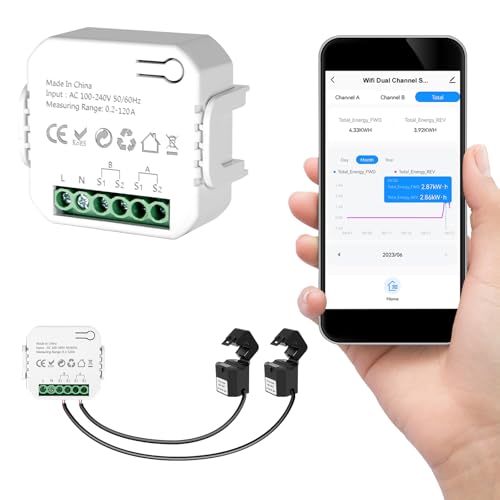
Homeowners seeking to optimize their energy consumption will find the Smart Home Energy Monitor with Bi-Directional Power Tracking and Wi-Fi an invaluable tool. This monitor features 2 x 120A CT sensors, allowing you to track real-time electricity usage of major appliances like air conditioners and water heaters. With bi-directional monitoring, you can manage both energy consumption and generation, making it perfect for homes with solar systems. Installation is a breeze, requiring only a clamp on the power line and a 2.4GHz Wi-Fi connection. Plus, it’s compatible with popular apps like Tuya and Smart Life for easy management.
Best For: Homeowners looking to optimize energy consumption and manage electricity usage effectively.
Pros:
- Accurate Monitoring: Provides precise tracking of electricity usage across major appliances with 2 x 120A CT sensors.
- Bi-Directional Tracking: Allows monitoring of both energy consumption and generation, ideal for homes with solar setups.
- Easy Installation: User-friendly setup process with clamp sensors and 2.4GHz Wi-Fi connectivity, compatible with popular management apps.
Cons:
- Wi-Fi Dependency: Requires a stable 2.4GHz Wi-Fi connection for real-time monitoring and app integration.
- Limited to 120A: May not be suitable for homes with higher electrical demands that exceed the 120A limit per sensor.
- App Compatibility: While it works with Tuya and Smart Life apps, compatibility with other smart home systems may be limited.
Emporia Energy Monitoring Smart Plug (4 Pack)

For those enthusiastic to streamline their energy usage and cut costs, the Emporia Energy Monitoring Smart Plug (4 Pack) is an excellent choice. These WiFi-enabled plugs let you control lights, fans, and other appliances remotely via the Emporia App. You can monitor energy usage to eliminate wasteful standby power and save on electricity bills. Plus, the built-in scheduling feature allows you to automate your devices, like setting your coffee maker to brew at 7 AM. With compatibility for Alexa and Google Home, managing your home energy has never been easier. Enjoy real-time control anytime, anywhere, with this smart plug set!
Best For: Individuals looking to enhance their energy efficiency and automate their home appliances for cost savings.
Pros:
- Energy Monitoring: Tracks energy usage to help reduce unnecessary electricity costs.
- Smart Scheduling: Automates appliance operation, increasing convenience and efficiency.
- Voice Control Compatibility: Works seamlessly with Alexa and Google Home for hands-free management.
Cons:
- Limited Load Capacity: Maximum continuous load is only 10A, which may not support higher power devices.
- WiFi Restriction: Requires a 2.4GHz connection, limiting compatibility with some modern routers.
- Dependent on App: Full functionality relies on the Emporia App, which may not appeal to all users.
Factors to Consider When Choosing a Smart Home Energy Monitor
When you’re choosing a smart home energy monitor, it’s essential to take into account several key factors. Think about how easy it is to install, how accurately it tracks energy usage, and whether it’s compatible with your existing systems. Also, look for features that enhance energy management and make certain you can access real-time data for better monitoring.
Installation Ease
Choosing a smart home energy monitor can be a straightforward process if you focus on installation ease. Look for monitors with clamp-on sensors that attach quickly to existing circuit panels, avoiding complex wiring. Make sure the device is compatible with your home’s electrical system—whether it’s single-phase, split-phase, or three-phase—to prevent installation headaches. Some models offer flexible installation options, which are particularly helpful in tight spaces, allowing access only to busbars. Devices with pluggable terminals simplify the setup, eliminating intricate wiring configurations. Finally, check for installation guides or app support, as these resources can greatly enhance your experience and make the process even smoother. With the right choice, you’ll be up and running in no time!
Monitoring Accuracy
Installation ease sets the stage for effective energy monitoring, but the real game-changer is monitoring accuracy. Accurate monitoring is vital for managing your energy usage effectively. Look for smart home energy monitors that offer precision levels of ±2% to 1% in data collection. Higher accuracy ratings, like the standard Class 1, guarantee reliable measurements for both energy generation and consumption, especially in bi-directional power tracking systems. Real-time tracking of voltage, current, and power factor gives you a thorough view of your energy usage, enabling informed decisions. Additionally, some monitors retain historical data for various periods, helping you identify usage patterns. If you have solar panels, accurate monitoring is necessary for managing surplus energy effectively. Choose wisely!
Compatibility With Systems
To guarantee you get the most out of your smart home energy monitor, it’s important to take into account its compatibility with your home’s electrical system. First, check whether it supports your setup—single-phase, split-phase, or three-phase. You’ll also want to make sure it accommodates clamp-on sensors for easier installation without major rewiring. Flexibility in sensor types is vital too, as some circuits may need specific capacities like 50A or 60A. Additionally, confirm that the monitor can integrate seamlessly with your existing home automation systems or apps, allowing for centralized monitoring and control. If you have solar power, look for models that support solar integration to help optimize your energy generation and consumption.
Energy Management Features
As you explore smart home energy monitors, focusing on energy management features can greatly enhance your energy efficiency. Look for monitors that enable real-time monitoring and automate energy usage to help prevent costly repairs while conserving electricity. Devices with time-of-use configurations and peak demand management let you optimize consumption based on usage patterns and energy rates. If you have solar panels, consider systems that support solar integration and net metering for efficient use of renewable energy and potential savings. Personalized notifications for energy-saving opportunities and alerts for unusual consumption patterns can help you identify malfunctions early. Finally, verify compatibility with your smart home automation system to centralize control and streamline energy management across multiple devices.
Real-Time Data Access
With energy management features in place, real-time data access becomes an essential component when choosing a smart home energy monitor. This capability lets you continuously track your energy consumption, revealing insights into your usage patterns and highlighting potential savings. Most monitors need a stable 2.4 GHz Wi-Fi connection for seamless data reporting through mobile apps or web interfaces. Keep in mind that data retention varies; some models provide 1-second updates for a limited time, while others store hourly data indefinitely in the cloud. Accuracy is also important, with many devices boasting a ±2% margin, ensuring reliable tracking. Real-time monitoring often includes features that alert you to unusual energy spikes, helping you address inefficiencies promptly.
Alerts and Notifications
When you’re choosing a smart home energy monitor, alerts and notifications play an essential role in managing your energy usage effectively. Look for customizable alerts that notify you of abnormal energy patterns, helping you spot potential malfunctions or inefficiencies in your appliances. Many devices can send notifications when your energy consumption exceeds set thresholds, allowing you to adjust your habits and save on costs. Alerts about solar energy production can inform you about excess generation, so you can optimize usage during peak solar hours. Additionally, reminders for energy-saving opportunities, like running high-energy appliances at off-peak times, can help minimize expenses. Personalized notifications for critical devices guarantee you’re alerted if something’s left on, promoting safety and conservation.
Cost and Warranty Options
Choosing a smart home energy monitor involves weighing several important factors, and cost is often at the forefront. The initial price of the device can vary greatly based on its features and capabilities, so you’ll want to find one that fits your budget. Don’t forget to evaluate warranty options, as many monitors come with a standard one to two-year warranty, giving you peace of mind. A longer warranty might indicate the manufacturer’s confidence in the product’s durability. Some monitors also offer extended warranties for an additional fee, which could be worth it for long-term use. Remember, effective monitors can help you save 10%-20% on your electricity bills, helping justify that upfront cost.