When it comes to maximizing your solar investment, choosing the right smart solar energy tracking system can make a significant difference. These systems adapt to the sun’s movement, enhancing energy output and efficiency. With various options available, from single-axis to advanced dual-axis trackers, understanding what suits your setup is essential. Let’s explore the top systems on the market and what factors you should consider before making a decision.
LAFVIN Solar Tracking Starter Kit Project DIY Smart Tracker System

The LAFVIN Solar Tracking Starter Kit is perfect for students and hobbyists keen to immerse themselves in the world of renewable energy and electronics. This DIY smart tracker system teaches you how to convert light energy into electrical energy, making it a fantastic educational tool. With a detailed user manual, you’ll find step-by-step assembly instructions and all necessary components included. You can engage in programming using the graphical test code provided, allowing you to experiment and broaden your understanding. It’s designed specifically for those interested in STEM, helping you grasp essential solar energy principles while having fun with hands-on projects.
Best For: Students and hobbyists interested in hands-on learning about renewable energy and electronics.
Pros:
- Provides a comprehensive learning experience with step-by-step assembly instructions.
- Encourages experimentation with graphical programming, enhancing engagement.
- All necessary components are included, making it user-friendly for beginners.
Cons:
- May require additional tools for assembly that are not included in the kit.
- Could be challenging for complete beginners without prior knowledge of electronics.
- Limited to basic solar tracking projects, which may not satisfy advanced users.
Dual-Axis Solar Tracker Controller Kit for Solar Panel Efficiency
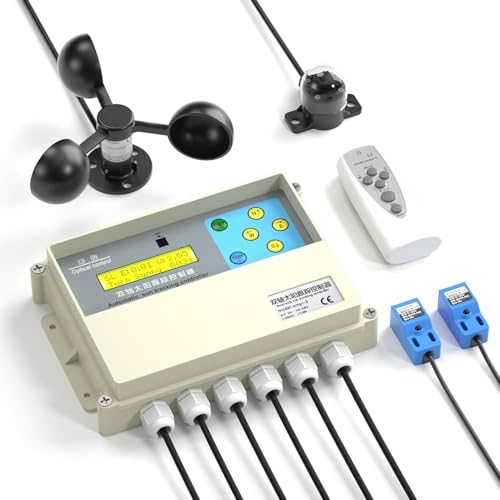
For those seeking to maximize solar panel efficiency in off-grid settings, the Dual-Axis Solar Tracker Controller Kit stands out as an essential tool. This kit auto-tracks the sun’s movement in both east-west and north-south directions, ensuring your panels are always aligned for maximum power. With its built-in wind sensor, it automatically adjusts or locks the position during high winds, protecting your investment. The easy setup includes a sunlight sensor, controller, and clear LCD menu for quick installation. Perfect for RVs, farms, and DIY solar arrays, it offers global compatibility with switchable sensor orientation for different hemispheres.
Best For: Those looking to enhance solar panel performance in off-grid situations, such as RV owners, farmers, and DIY solar enthusiasts.
Pros:
- Boosts solar panel efficiency by automatically tracking the sun’s movement.
- Built-in wind sensor protects panels from damage during high winds.
- Easy installation with a clear LCD menu and comprehensive wiring guide.
Cons:
- Requires initial setup which may be complex for some users.
- May not be suitable for areas with minimal sunlight exposure.
- The reliance on sensors means potential issues in extreme weather conditions.
ECO-WORTHY Solar Panel Single Axis Tracking System

Looking to maximize your solar energy production? The ECO-WORTHY Solar Panel Single Axis Tracking System is your answer. This system enhances energy efficiency by adjusting your panels to follow the sun, increasing power generation by at least 30% compared to fixed mounts. It accommodates various panel sizes and features a robust design with high wind resistance. Plus, with a 270° angular adjustment, it guarantees peak sunlight absorption throughout the day. Just remember to remove the panels during high winds to maintain safety. Invest in this tracking system and watch your solar energy output soar!
Best For: Homeowners and businesses looking to enhance solar energy efficiency and maximize power generation from their solar panels.
Pros:
- Increases power generation by at least 30% compared to traditional fixed mounts.
- Accommodates various solar panel sizes and allows for customized installation.
- Features a robust design that withstands high winds and offers a 270° angular adjustment for optimal sunlight tracking.
Cons:
- Requires manual removal of panels in high winds for safety.
- Initial installation may be more complex compared to fixed mounting systems.
- Potentially higher upfront investment compared to traditional mounting solutions.
Dual Axis Solar Tracker Controller with Remote Control

Equipped with high-precision sensors, the Dual Axis Solar Tracker Controller with Remote Control is an ideal choice for solar energy enthusiasts seeking maximum efficiency from their solar panels. This advanced system automatically tracks sunlight, ensuring prime positioning throughout the day. It levels during windy conditions and returns to its original position on cloudy days or at night. Designed for both northern and southern hemispheres, it features an intuitive LCD screen and a concise operating panel, allowing you to easily adjust parameters remotely. With a combo kit for straightforward installation, you’ll enjoy enhanced energy production and a great return on your solar investment.
Best For: Solar energy enthusiasts and homeowners looking to maximize the efficiency of their solar panel systems.
Pros:
- High-precision sensors enable real-time sunlight tracking for optimal energy production.
- Automatic leveling during windy conditions protects the system from damage.
- User-friendly interface with remote control simplifies parameter adjustments.
Cons:
- Requires installation of limit switches in all four directions, which may add complexity.
- The manual is designed primarily for the northern hemisphere, requiring adjustments for southern hemisphere use.
- Brushless DC motor may require more maintenance compared to traditional motors.
ECO-WORTHY Solar Panel Dual Axis Tracking System

The ECO-WORTHY Solar Panel Dual Axis Tracking System stands out as an excellent choice for homeowners and farmers wanting to maximize their solar energy output. It boosts power generation by 40% and supports various panel configurations. With intelligent light detection and 270° tracking, it optimizes your solar panels’ orientation to enhance energy conversion. Designed for stability, it automatically adjusts to withstand winds up to 17.2 m/s and allows manual adjustments for snow removal. Plus, it saves space with a minimal installation footprint, making it perfect for smaller areas. Enjoy dedicated customer support for any assistance you might need!
Best For: Homeowners and farmers seeking to maximize their solar energy output in limited spaces.
Pros:
- Increases power generation by 40% compared to stationary systems.
- Features intelligent light detection and 270° tracking for optimal solar panel orientation.
- Compact installation footprint, saving 90% space compared to traditional brackets.
Cons:
- May require more complex installation compared to fixed systems.
- Initial investment can be higher due to the tracking technology.
- Performance may depend on local weather conditions and sunlight availability.
Sun Automatic Tracking Controller for Solar Tracking System

For those seeking an efficient way to maximize solar energy capture, the Sun Automatic Tracking Controller stands out with its dual-axis tracking capabilities. It automatically tracks the sun in real-time, adjusting for ideal positioning. This controller operates a dual-degree-of-freedom platform, ensuring stability even in windy conditions and centering on cloudy nights. You can use it in both hemispheres by following simple instructions. The adjustable parameters and LCD display make monitoring easy, while the included manual and infrared control offer flexibility. Just remember, your platform should be powered by two brushed DC motors for seamless functionality.
Best For: Individuals and businesses looking to optimize solar energy collection with a reliable and adjustable tracking system.
Pros:
- Automatically tracks the sun in real-time for optimal solar energy capture.
- Dual-axis functionality allows for stable performance in varying weather conditions.
- Adjustable parameters and an LCD display enable easy monitoring and customization.
Cons:
- Requires a platform powered by two brushed DC motors, which may limit compatibility with existing setups.
- Instruction manual primarily tailored for the northern hemisphere, requiring adjustments for southern hemisphere use.
- External limit setting may be necessary, adding complexity to the installation process.
ECO-WORTHY 1200W Solar Tracker System with Dual-Axis Solar Tracking Kit

If you’re looking for an efficient solar solution for off-grid applications, the ECO-WORTHY 1200W Solar Tracker System with Dual-Axis Solar Tracking Kit stands out. This system includes six 195W monocrystalline panels, boasting a remarkable 25% conversion efficiency. With its dual-axis tracker, you can capture up to 39.2% more sunlight compared to fixed systems, delivering an ideal daily output of around 7.68KWh. Installation is a breeze thanks to pre-set controllers and connected wires. Plus, the durable aluminum frame guarantees longevity in outdoor conditions. Enjoy reliable customer support and a hassle-free warranty for any product issues.
Best For: Individuals seeking an efficient and reliable off-grid solar power solution for homes, farms, sheds, or cabins.
Pros:
- High Efficiency: Features upgraded 195W N-type bifacial panels with a 25% conversion efficiency.
- Increased Sunlight Capture: Dual-axis tracking allows for up to 39.2% more sunlight compared to fixed systems.
- Durable Construction: Aluminum frame and 18 busbars ensure longevity and improved current transfer.
Cons:
- Space Requirement: Requires a significant ground space of 111in x 106in and a height of 4.93ft for installation.
- Initial Cost: Higher upfront investment compared to traditional fixed solar panel systems.
- Maintenance Needs: Moving parts in the tracking system may require more maintenance than fixed installations.
Solar Panel Dual Axis Tracking System with App Control

Designed for solar enthusiasts and homeowners seeking efficiency, the Solar Panel Dual Axis Tracking System with App Control maximizes energy capture by intelligently adjusting to the sun’s position. This system features a 25KG Intelligent Photosensitive Light Chaser Tracker, ensuring your solar panels optimize light exposure. With app control, you can manage your setup effortlessly. It supports rigid solar panels up to 1.1m wide and 25kg in weight, making it versatile for various setups. The dual-axis technology enhances movement, increasing energy conversion efficiency by up to 30%. Plus, installation is simple, allowing for easy transport and disassembly when needed.
Best For: Solar enthusiasts and homeowners seeking to maximize energy capture and efficiency from their solar setups.
Pros:
- Fully automatic management of solar panels for optimal light tracking.
- Increases solar energy conversion efficiency by up to 30% with dual-axis tracking.
- Easy installation and disassembly for flexible usage and transportation.
Cons:
- Limited compatibility with only traditional rigid solar panels.
- Requires a smartphone for app control, which may not be suitable for all users.
- Maximum weight limit of 25kg may restrict the use of larger solar panels.
Single Double Axis Tracking Controller Solar Tracker System

The Single Double Axis Tracking Controller Solar Tracker System is ideal for solar energy enthusiasts looking to maximize their energy output. This system features a patented pyramid four-quadrant light sensor and utilizes an MCU to analyze signals, controlling the motor platform efficiently. With automatic tracking during the day and a manual mode for nighttime, it offers flexibility for your needs. The system boasts anti-vibration capabilities, low power consumption, and high-precision adjustments, making installation hassle-free. You’ll enjoy peak sunlight exposure, with tracking occurring every minute and twenty seconds, ensuring you get the most from your solar investment effortlessly.
Best For: Solar energy enthusiasts and homeowners looking to maximize energy output from their solar panels.
Pros:
- Automatic tracking during the day ensures optimal sunlight exposure.
- User-friendly installation with high-precision adjustments and no complex settings required.
- Low power consumption and anti-vibration features enhance durability and efficiency.
Cons:
- May require regular maintenance to ensure optimal performance over time.
- Initial setup may be challenging for users unfamiliar with solar technology.
- Limited functionality during nighttime, relying on manual mode.
DC 12V Small Solar Tracking System

For those looking to maximize energy efficiency in small-scale solar applications, the DC 12V Small Solar Tracking System stands out with its automatic tracking capabilities. This system operates on a DC 12V power supply, consuming less than 0.5W in standby and up to 4W during operation. With a double tracking platform, it supports a load capacity of 8KG and boasts impressive rotation speeds of 9°/S horizontally and 1°/S in pitch. Its built-in limit switch and adjustable horizontal limit screw enhance its functionality, making it perfect for environments that require automated solar panel positioning for ideal energy capture.
Best For: Individuals and small businesses seeking to enhance energy efficiency through automated solar panel positioning in small-scale solar applications.
Pros:
- Automatic tracking ensures optimal solar energy capture throughout the day.
- Low power consumption with less than 0.5W in standby mode enhances energy efficiency.
- Supports up to 8KG, making it versatile for various solar panel setups.
Cons:
- Limited load capacity may not accommodate larger solar panels or setups.
- Requires a DC 12V power supply, which may necessitate additional equipment for some users.
- Mechanical components may require maintenance over time to ensure reliability.
Factors to Consider When Choosing a Smart Solar Energy Tracking System
When choosing a smart solar energy tracking system, you need to evaluate several key factors. These include tracking technology options, power generation efficiency, and how well the system adapts to environmental conditions. You’ll also want to think about installation complexity and compatibility with your existing solar panels.
Tracking Technology Options
Choosing the right tracking technology for your solar energy system can greatly impact efficiency and energy generation. You can choose between single-axis and dual-axis systems. Single-axis trackers follow the sun from east to west, increasing energy generation by 25-30%. On the other hand, dual-axis trackers adjust both horizontally and vertically, enhancing solar energy capture and improving efficiency by up to 40%. To maximize performance, high-precision sensors are essential; they detect sunlight intensity and adjust the panels in real-time. Additionally, intelligent algorithms can further optimize tracking by analyzing data from multiple light sensors, allowing your system to adapt to varying light conditions. Selecting the best tracking technology guarantees you get the most out of your solar investment.
Power Generation Efficiency
As you consider a smart solar energy tracking system, understanding the factors that influence power generation efficiency is essential. These systems can boost your energy output by at least 30% compared to fixed mounts by aligning effectively with the sun’s movement. Dual-axis trackers are particularly effective, following both east-west and north-south movements, maximizing solar exposure throughout the day. Single-axis trackers also enhance energy capture by adjusting to the sun’s elevation changes. Advanced systems with intelligent light detection sensors can dynamically adjust panel angles based on sunlight intensity, ensuring peak energy conversion. Additionally, well-designed trackers extend light capture time, allowing solar panels to maintain ideal angles even in varying weather conditions, ultimately improving your overall system output.
Environmental Adaptability Features
To guarantee your smart solar energy tracking system performs at its best, you need to take into account its environmental adaptability features. Look for systems with robust weather resistance, guaranteeing operation during high winds and extreme temperatures. This protects your solar panel investment. Models that automatically level during strong winds prevent mechanical damage and require no manual intervention. High-precision light sensors optimize panel orientation, enhancing energy capture even on cloudy days. Additionally, choose trackers designed for seasonal adjustments, allowing flexibility in angle settings to maximize sunlight exposure year-round. Finally, ensure the system operates effectively in both northern and southern hemispheres, making it universally applicable regardless of your geographic location.
Installation Complexity and Requirements
When selecting a smart solar energy tracking system, understanding installation complexity is essential for ensuring a smooth setup. Some systems require only basic skills and tools, while others might demand advanced technical expertise. Fortunately, many tracking systems come with user-friendly manuals and pre-connected components, making them accessible for those with limited experience. Consider the physical space needed for installation; dual-axis systems typically require more ground area than single-axis systems due to their larger components. It’s also vital to review weather resistance and durability, especially in harsher environments, as these factors can affect long-term reliability. Evaluating these requirements will help you choose a system that fits your needs and capabilities.
Compatibility With Solar Panels
Installing a smart solar energy tracking system involves more than just understanding the setup process; compatibility with your solar panels is a key factor to contemplate. First, check the dimensions and weight of your panels since most systems have specific size restrictions. Dual-axis trackers generally offer more flexibility in panel placement compared to single-axis options. It’s also essential to guarantee the tracking system matches your solar panels’ power rating, as some systems cater to specific wattage ranges to prevent overloads. Additionally, consider systems that accommodate various panel types, like rigid or bifacial panels, to enhance versatility. Finally, make sure the tracking system can handle the total number of panels you plan to install, as limits may apply.
Control Mechanisms and Interfaces
Understanding the control mechanisms and interfaces of smart solar energy tracking systems is essential for optimizing your solar setup. High-precision sensors track sunlight in real time, ensuring your panels stay aligned throughout the day. Many systems come with user-friendly LCD displays, allowing you to monitor and adjust settings without complicated setups. Remote control capabilities enhance convenience, letting you manage tracking from afar. Advanced systems utilize intelligent algorithms, automatically adjusting based on sunlight intensity from various angles to boost energy conversion efficiency. Plus, manual override options let you adjust panel positions during bad weather or for maintenance, providing flexibility when you need it most. Choosing the right controls and interfaces can greatly enhance your solar investment.
Durability and Weather Resistance
Choosing a smart solar energy tracking system that can withstand harsh weather is vital for maximizing your investment. Look for systems designed to endure high wind speeds, ideally exceeding 17.2 m/s, to guarantee stability during storms. Robust construction materials that resist corrosion will enhance the tracker’s longevity in outdoor environments. It’s important that the tracker features automatic leveling mechanisms during high winds and the ability to lock its position, protecting your solar panels from potential damage. Additionally, make sure the system operates effectively under various environmental conditions, including temperature fluctuations and precipitation. Prioritize trackers with safety features like wind resistance ratings and guidelines for panel removal during extreme weather to assure reliability and protect your investment.
Maintenance and Support Services
When investing in a smart solar energy tracking system, considering the maintenance and support services available can greatly impact your system’s long-term performance. Look for systems that offer robust customer support and maintenance options to guarantee efficient operation and quick assistance when issues arise. Extensive user manuals and installation guides make setup and troubleshooting easier, minimizing downtime. Evaluate the warranty and after-sales support to protect your investment and assure reliability. Additionally, systems with online resources like tutorials or troubleshooting videos can simplify maintenance tasks. Finally, check if the manufacturer provides ongoing technical support or updates, as this can be essential for adapting to evolving technology and optimizing performance over time.