Choosing the right solar charge controller for off grid systems affects how much energy your batteries store, how efficiently your panels perform, and how safely your setup runs.
Below, we’ve grouped 10 of the best options for different battery sizes, panel arrays, and budgets so you can match the controller to your system with confidence.
Best 10 Solar Charge Controller for Off Grid Picks for 2026
Premium Bluetooth MPPT
Victron SmartSolar MPPT 100V 30A 12/24V

- Fast MPPT tracking for shaded conditions
- VictronConnect app with live data and history
- Synchronized charging for larger systems
Best For: Off-grid users who want smart monitoring and high-efficiency charging
High-Current Auto-Sensing MPPT

- Auto-detects 12V through 96V systems
- 120A output with LCD status display
- Supports AGM, GEL, flooded, and LiFePO4 batteries
Best For: Large off-grid systems that need wide voltage support and high current
Compact PWM RV Pick
Renogy Wanderer 10A PWM Controller

- Compact size for RV and marine installs
- 4-stage charging for multiple battery types
- LCD, USB port, and load control modes
Best For: Small off-grid RV or marine systems needing a simple compact controller
Smart Budget MPPT
Victron SmartSolar MPPT 75V 15A

- Bluetooth app control with real-time data
- MPPT charging performs well in partial shade
- Automatic load disconnect for battery protection
Best For: Smaller off-grid systems that want smart monitoring and MPPT efficiency
Premium MPPT for Harsh Conditions

- 98% conversion rate and 99% tracking efficiency
- Supports Gel, AGM, Flooded, and Lithium batteries
- App monitoring available with BT-2 add-on
Best For: Off-grid systems that need efficient charging and cold-weather durability.
Simple PWM for Mixed Battery Banks

- Backlit LCD shows PV current and battery voltage
- Supports many battery types, including lithium options
- Jumpstart mode for overly discharged lithium batteries
Best For: Users who want a straightforward PWM controller for RV or off-grid systems.
Compact 12V MPPT with USB Charging

- True MPPT design for 12V-only systems
- 22W USB-C and 18W USB ports built in
- 8-layer protection and LCD monitoring
Best For: Small 12V off-grid systems that need both charging and USB power.
Budget-Friendly 10A PWM Pick
Renogy Wanderer 10A PWM Solar Charge Controller
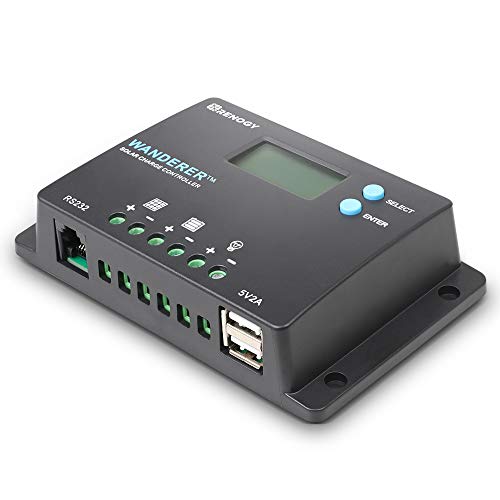
- 4-stage PWM charging for 12V/24V systems
- Works with AGM, Gel, Flooded, and Lithium batteries
- LCD display plus manual, auto, and timed load modes
Best For: Small RV, marine, and DIY off-grid systems
High-Efficiency Bluetooth MPPT Choice
LiTime 30A MPPT Solar Charge Controller

- 99% tracking technology with up to 98% conversion efficiency
- Built-in Bluetooth and LCD screen for monitoring
- Supports LiFePO4 plus sealed, gel, and lead-acid batteries
Best For: Off-grid users who want MPPT efficiency and app monitoring
Feature-Rich 40A App-Controlled MPPT
Dyness 40A MPPT Solar Charge Controller

- 40A MPPT design for up to 600W at 12V or 1200W at 24V
- Bluetooth app control with long operating history tracking
- Supports lithium, AGM, gel, flooded, and user-defined batteries
Best For: Larger off-grid systems needing app control and higher capacity
Premium Bluetooth MPPT – Victron SmartSolar MPPT 100V 30A 12/24V
Victron Energy SmartSolar MPPT 100V 30 amp 12/24-Volt Solar Charge Controller (Bluetooth)
Check Price On AmazonIf you want a solar charge controller for off grid systems that prioritizes efficiency and control, the Victron SmartSolar MPPT 100V 30A is built for serious setups. Its fast MPPT tracking helps recover more power from panels, including when shade is a factor, while the VictronConnect app adds real-time monitoring and easy configuration.
Best For: Off-grid users who want app-based monitoring, strong MPPT performance, and the option to scale a system with synchronized controllers.
Pros:
- Fast MPPT tracking helps maximize power output, even with partial shade.
- VictronConnect app provides real-time data, 30-day history, settings, firmware updates, and alarms.
- Multiple controllers can synchronize for system-wide charging optimization.
- Integrated load output can disconnect loads automatically when battery voltage drops too low.
Cons:
- Only supports 12/24V systems, so it is not for higher-voltage battery banks.
- Premium feature set may be more than basic off-grid builds need.
This is a strong choice if you value visibility and charging performance in an off-grid installation. It is especially appealing when you want both smart app control and flexible system behavior in one controller.
High-Current Auto-Sensing MPPT – POWLAND 120A MPPT 12V-96V
This solar charge controller for off grid setups is aimed at users who need broad battery compatibility and a lot of charging capacity. The POWLAND 120A MPPT controller automatically senses 12V through 96V systems and adds an LCD dashboard for checking PV input, charging stage, and warnings at a glance.
Best For: Large off-grid solar systems, RV setups, and mobile power builds that need high amperage and wide voltage support.
Pros:
- Auto-senses 12V/24V/36V/48V/60V/72V/84V/96V systems.
- 120A capacity and up to 230V max PV input support larger arrays.
- LCD display shows PV voltage/current, charge stage, and diagnostics.
- Works with AGM, GEL, flooded lead-acid, and LiFePO4 batteries.
Cons:
- Larger, higher-capacity controller may be unnecessary for small builds.
- Feature set is practical, but not as app-connected as Bluetooth models.
If your off-grid project is expanding beyond a simple starter system, this controller offers the voltage range and output capacity to match. It is a practical fit when you want one unit that can handle many battery-bank configurations.
Compact PWM RV Pick – Renogy Wanderer 10A PWM Controller
For a smaller solar charge controller for off grid use, the Renogy Wanderer 10A keeps things simple and compact. It supports 12V/24V systems, uses a 4-stage charging profile, and includes an LCD with error codes plus a USB charging port for everyday convenience.
Best For: Small RV, marine, and DIY off-grid builds that need a compact PWM controller with basic monitoring.
Pros:
- Compact size fits easily in RV electrical cabinets and marine panels.
- 4-stage charging supports AGM, Gel, flooded, and lithium batteries.
- Includes load control modes and protection features like overcharge and short-circuit protection.
- Backlit LCD, error codes, and 5V/2A USB output add useful day-to-day functionality.
Cons:
- PWM design is less advanced than MPPT controllers for harvesting solar power.
- 10A rating limits it to smaller solar setups.
This is a sensible pick if you want a straightforward controller for modest off-grid loads. It trades advanced MPPT features for simplicity, compactness, and practical controls.
Smart Budget MPPT – Victron SmartSolar MPPT 75V 15A
The Victron SmartSolar MPPT 75V 15A is a compact solar charge controller for off grid setups that still want smart monitoring and efficient charging. It uses the same Bluetooth-connected Victron ecosystem features as larger models, with MPPT tracking, app-based configuration, and automatic load disconnect support.
Best For: Smaller 12V/24V off-grid systems where Bluetooth monitoring and reliable MPPT performance matter more than high amperage.
Pros:
- MPPT charging helps maximize output, including in partial shade.
- VictronConnect app provides real-time data, performance history, and easy setup.
- Built-in load output can disconnect loads when battery voltage gets too low.
- Certified to UL1741 and designed for 12/24V battery systems.
Cons:
- 15A output is suited to smaller systems, not larger arrays.
- Minimal LED-style display means most interaction happens through the app.
If you want Victron’s smart features in a smaller format, this controller is easy to justify. It suits compact off-grid systems that benefit from efficient charging and app-based oversight without extra bulk.
Premium MPPT for Harsh Conditions – Renogy Rover 40A 12V/24V MPPT
If you need a solar charge controller for off grid power that can squeeze more energy from your panels, the Renogy Rover 40A is built around high-efficiency MPPT charging. It supports 12V/24V auto-detection, works with multiple battery chemistries, and adds protections and low-temperature safeguards that make it a strong fit for remote systems and demanding environments.
Best For: Off-grid users who want higher harvest efficiency, broad battery support, and cold-weather reliability.
Pros:
- MPPT design claims 98% conversion rate and 99% tracking efficiency
- Supports Gel, AGM, Flooded, and Lithium batteries with 12V/24V auto-detection
- Built-in protections include reverse polarity, overload, short-circuit, and reverse current safeguards
- DC Home app support adds real-time data, history, alarms, and settings changes with BT-2
Cons:
- BT-2 connectivity is sold separately
- App-based features require compatible setup and RS485 connection
- May be more controller than needed for very small systems
Overall, this is the most capable option here if your off-grid setup needs efficient charging, flexible battery compatibility, and a controller that is designed to keep working in tougher weather conditions.
Simple PWM for Mixed Battery Banks – BougeRV Li 30A PWM Controller
For a solar charge controller for off grid setups where simplicity matters more than advanced tracking, the BougeRV Li 30A PWM controller offers an easy-to-read display and broad battery support. It handles 12V or 24V systems, includes lithium battery icons and settings, and is geared toward straightforward RV and off-grid wiring.
Best For: RV and off-grid users who want an easy-to-use PWM controller with clear battery compatibility.
Pros:
- Backlit LCD cycles PV current and battery voltage in real time
- Supports multiple battery types including LiFePO4, ternary lithium, LTO, AGM, GEL, and flooded batteries
- Includes a jumpstart function for overly discharged lithium batteries
- Rated for up to 450W on 12V systems and 900W on 24V systems
Cons:
- PWM design is less advanced than MPPT for harvest efficiency
- Max PV input voltage is 55V
- Requires correct wiring order and setup for safe operation
This is a practical budget-minded choice if you want a controller that is easy to read, simple to wire, and flexible enough for several common battery types.
Compact 12V MPPT with USB Charging – 10A MPPT 12V USB-C Controller
If you want a compact solar charge controller for off grid trips and small 12V systems, this 10A MPPT model adds direct USB charging on top of solar battery management. It is designed only for 12V setups, supports common 12V battery types, and focuses on simple installation and real-time monitoring in a small footprint.
Best For: Small 12V off-grid builds that also need USB charging for phones and gadgets.
Pros:
- True MPPT design claims up to 30% better harvest than basic PWM controllers
- Built-in 22W USB-C and 18W USB ports for direct device charging
- 8-layer protection covers overcharge, overvoltage, short circuit, reverse polarity, and overheating
- Compatible with Gel, AGM, Sealed Lead-Acid, Flooded, and LiFePO4 batteries
Cons:
- Only compatible with 12V battery systems
- Not compatible with 24V or 36V batteries
- Not for panels with built-in controllers
As a compact controller for light off-grid use, it stands out most for combining MPPT charging with handy USB outputs, making it useful when space and simplicity matter.
Budget-Friendly 10A PWM Pick – Renogy Wanderer 10A PWM Solar Charge Controller
If you need a solar charge controller for off grid use without adding complexity, the Renogy Wanderer 10A is a compact PWM option built for small 12V/24V systems. It supports AGM, Gel, Flooded, and Lithium batteries, and its 4-stage charging helps manage battery charging more carefully than basic controllers.
Best For: Small RV, marine, and DIY off-grid systems that need simple battery protection and load control.
Pros:
- 4-stage charging with Bulk, Boost, Float, and Equalization modes
- Supports 12V/24V systems and multiple battery types, including lithium
- Manual, automatic, and timed load control modes for DC loads
- LCD display with real-time voltage and system status
Cons:
- 10A capacity is best suited to smaller solar setups
- PWM design is less feature-rich than MPPT models
- Bluetooth monitoring requires a separately sold BT-1 module
Overall, this is a practical entry-level controller for compact off-grid installs where reliability, basic monitoring, and wide battery compatibility matter more than maximum harvesting efficiency.
High-Efficiency Bluetooth MPPT Choice – LiTime 30A MPPT Solar Charge Controller
For a solar charge controller for off grid systems where efficiency matters, the LiTime 30A MPPT model stands out with high tracking performance and built-in Bluetooth. It is designed to extract more power from your array, while supporting 12V/24V setups and an easy-to-read LCD interface.
Best For: Off-grid users who want MPPT efficiency, app-based monitoring, and lithium battery support.
Pros:
- 99% tracking technology and up to 98% conversion efficiency
- Built-in Bluetooth for remote status checks without an extra module
- Compatible with LiFePO4 and adjustable for sealed, gel, and lead-acid batteries
- Die-cast aluminum housing for better heat dissipation
Cons:
- Bulkier than smaller 10A controllers
- Requires parameter adjustment for some battery types
- Higher capacity may be more than needed for tiny systems
This is a strong middle-ground choice for users who want a modern MPPT controller with Bluetooth and broad battery compatibility, especially in compact off-grid power banks and RV builds.
Feature-Rich 40A App-Controlled MPPT – Dyness 40A MPPT Solar Charge Controller
If you want a solar charge controller for off grid setups with more control and more headroom, the Dyness 40A MPPT model offers app monitoring, LCD status, and support for larger 12V/24V systems. It is built for users who want to manage charging data and DC loads from a mobile device while keeping strong protection features in place.
Best For: Larger off-grid systems that need app control, higher capacity, and flexible battery compatibility.
Pros:
- 40A MPPT controller supports up to 600W at 12V or 1200W at 24V
- Integrated Bluetooth app control with up to 300 days of history
- Supports lithium, AGM/sealed, gel, flooded, and user-defined batteries
- Includes load control modes, RS485 Modbus, and optional parallel charging
Cons:
- More complex than basic plug-and-play controllers
- Large size may not suit tight installation spaces
- Lithium battery voltage must be selected manually
For off-grid buyers who want a higher-capacity MPPT controller with modern monitoring and broader system control, this Dyness unit is the most feature-packed option in the group.
How We Picked the Best Solar Charge Controller for Off Grid
For a Solar Charge Controller for Off Grid use, the most important factors are charging efficiency, voltage compatibility, current capacity, battery support, and monitoring features. We prioritized controllers that serve common off-grid applications, from small 12V builds to larger 48V and higher-voltage systems. We also looked for clear displays, Bluetooth app control, and proven brand support where available.
Quick Comparison
In general, PWM controllers are best for smaller, lower-cost systems with modest panel arrays and shorter wiring runs. MPPT controllers are better when you want higher harvest from your panels, especially in colder weather, longer cable runs, or mixed light conditions. If you want easy system visibility, Bluetooth-enabled units make daily checks simpler without adding extra meters or accessories.
Key Buying Factors for a Solar Charge Controller for Off Grid
Battery Voltage and System Match
Make sure the controller supports your battery bank voltage, whether that is 12V, 24V, 48V, or a wider auto-detect range. A mismatch can limit charging performance or make the controller unusable.
MPPT Vs. PWM
MPPT controllers usually cost more, but they convert excess panel voltage into usable charging current more efficiently. PWM models are simpler and can be a smart choice for smaller systems where panel voltage closely matches battery voltage.
Amperage Headroom
Select a controller with enough current capacity for your solar array, then add some buffer for future expansion. Running a controller near its limit for long periods is not ideal.
Monitoring and Battery Profiles
Useful features include Bluetooth monitoring, LCD screens, and selectable charging profiles for lithium, AGM, gel, and flooded batteries. These settings help keep charging safer and more accurate.
Input Voltage and Array Design
If your panels are wired in series, check the controller’s maximum PV input voltage carefully. This matters a lot in off-grid systems where cold-weather voltage rise can push arrays past safe limits.
Who Should Buy Which Solar Charge Controller for Off Grid?
If you are building a compact cabin, shed, or backup power setup, a 10A or 15A PWM controller may be enough. For a growing homestead, RV, van, or battery bank with more solar capacity, a 30A to 40A MPPT unit is often the better balance of performance and value. Larger, multi-voltage systems need higher-current controllers with wide input ranges and strong monitoring tools.
If you want the best mix of efficiency, control, and long-term flexibility, choose an MPPT model with app-based monitoring. If your priority is simplicity and lower cost, a basic PWM controller can still be a practical fit for small off-grid solar projects.