Choosing the right charge controller can make or break a home backup solar setup. The best models protect your batteries, improve charging efficiency, and help you get more reliable power when the grid goes down.
Below, we’ve narrowed the field to 10 strong options for different system sizes, battery types, and monitoring preferences so you can match the controller to your backup goals with confidence.
Best 10 Solar Charge Controllers for Home Backup Picks for 2026
Premium Smart Monitoring
Victron SmartSolar MPPT 100V 50A

- Fast MPPT tracking helps maximize panel output.
- VictronConnect app offers real-time data and history.
- Can synchronize multiple controllers for system-wide charging.
Best For: Users who want app-based monitoring and coordinated charging in a backup system.
All-Weather Mid-Range
Renogy Rover 40A MPPT Controller

- 98% conversion and 99% tracking efficiency claims.
- Supports Gel, AGM, Flooded, and Lithium batteries.
- LCD display plus optional app monitoring support.
Best For: Backup systems needing a durable mid-range controller with flexible battery support.
High-Current Wireless Monitoring
ECO-WORTHY 60A MPPT Controller

- 60A output with 12V/24V/36V/48V auto detection.
- Bluetooth and WiFi monitoring with app access.
- Three load control modes for DC equipment.
Best For: Larger backup systems that want wireless monitoring and higher charging current.
Budget High-Capacity
SA100A Intelligent MPPT Controller
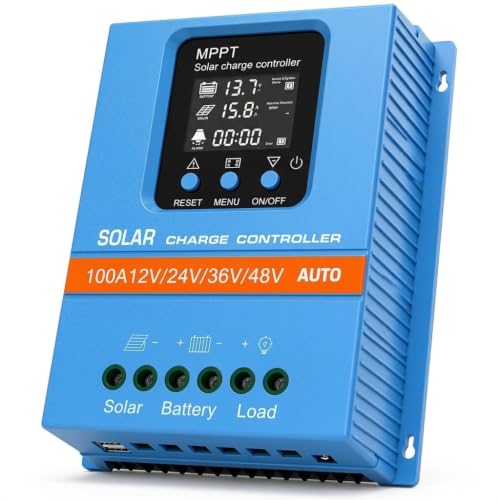
- 100A controller with 12V to 48V auto recognition.
- LCD shows voltage, current, temperature, and errors.
- Supports sealed, GEL, Flooded, and LiFePO4 batteries.
Best For: Backup or off-grid users who want high current and broad voltage compatibility.
Premium Bluetooth MPPT
Victron SmartSolar 75V 15A for 12/24V

- Fast MPPT tracking maximizes available solar power.
- Bluetooth app shows real-time data and 30-day history.
- Intelligent load output can disconnect low-voltage loads.
Best For: Compact 12/24V home backup systems that need app monitoring.
High-Capacity MPPT
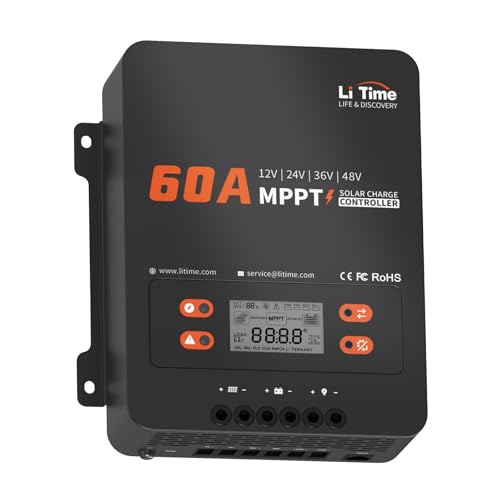
- 60A MPPT supports larger backup solar arrays.
- Handles LiFePO4 and lead-acid batteries.
- LCD display and multiple protections aid setup.
Best For: Larger home backup systems needing high current and flexible voltage.
Budget PWM Option
Renogy Wanderer 10A 12/24V Controller
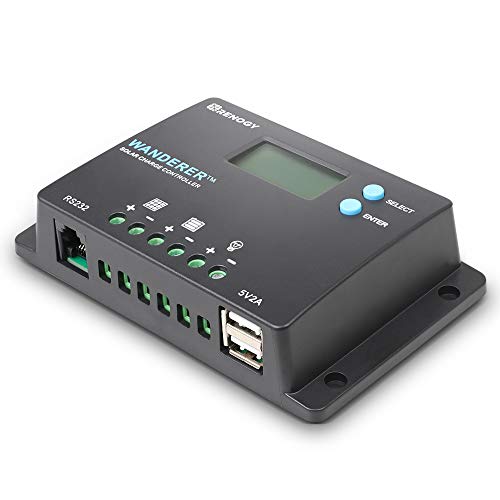
- Simple 12V/24V PWM controller with 4-stage charging.
- Manual, automatic, and timed load modes included.
- Compact design with built-in protection features.
Best For: Small backup setups that need a basic, low-cost controller.
High-Voltage Backup MPPT
Renogy Rover Lite 60A MPPT Controller

- 150V max solar input for larger panel strings
- Supports 12V/24V/36V/48V battery systems
- Includes battery temperature sensor; Bluetooth module sold separately
Best For: Larger home backup systems with higher-voltage solar input needs
Everyday Bluetooth MPPT
LiTime 12V/24V 30A Bluetooth MPPT Controller

- Built-in Bluetooth with LCD and LED indicators
- 99% tracking efficiency with up to 98% conversion efficiency
- Supports LiFePO4 and lead-acid battery types
Best For: Compact home backup systems needing simple Bluetooth monitoring
Premium Smart Monitoring – Victron SmartSolar MPPT 100V 50A
If you’re comparing solar charge controllers for home backup, this Victron SmartSolar MPPT is built for efficient charging and detailed system insight. It uses fast MPPT tracking to squeeze more usable energy from your panels, while the Bluetooth app makes it easier to monitor performance and adjust settings without guesswork.
Best For: Home backup users who want premium app-based monitoring, synchronized charging, and strong battery protection.
Pros:
- Fast MPPT tracking helps maximize power output, including in partial shade.
- VictronConnect app provides real-time data, 30-day history, settings, and firmware updates.
- Can synchronize multiple controllers for coordinated charging and better system optimization.
- Intelligent load output can disconnect loads automatically if battery voltage drops too low.
Cons:
- No built-in display, so app access is the main way to review data.
- Bluetooth/app-based setup may be less convenient if you want a simple standalone controller.
- Limited to 12/24V systems, so it may not fit higher-voltage backup designs.
This is a strong fit if you value control, visibility, and battery-friendly charging in a backup setup. It is especially appealing for users who want a more advanced controller rather than a basic charge regulator.
All-Weather Mid-Range – Renogy Rover 40A MPPT Controller
For buyers shopping solar charge controllers for home backup, this Renogy Rover 40A is a practical MPPT option with strong tracking and broad battery support. Its LCD display, app connectivity option, and all-weather design make it a solid fit for off-grid or backup systems that need dependable everyday control.
Best For: Home backup setups that need a durable, mid-range MPPT controller with battery flexibility.
Pros:
- Claims 98% conversion and 99% tracking efficiency for strong solar harvesting.
- Supports Gel, AGM, Flooded, and Lithium batteries.
- Built for wide temperature operation, from -40°F to 149°F.
- Includes LCD display plus DC Home app support via RS485 with BT-2.
Cons:
- App connectivity requires the BT-2 module, which is sold separately.
- 40A output may be limiting for larger backup arrays.
- One included battery type profile is not enough for users who want highly customized setups.
This controller makes sense if you want a balanced mix of efficiency, protection, and battery compatibility. It is a sensible choice for backup systems that need dependable performance without jumping to a much larger controller.
High-Current Wireless Monitoring – ECO-WORTHY 60A MPPT Controller
If your home backup setup needs a higher-current option, this ECO-WORTHY 60A MPPT controller adds Bluetooth and WiFi monitoring to the mix. It is designed to maximize output in cloudy conditions, detect multiple system voltages automatically, and give you phone-based access to charging data and history.
Best For: Larger backup systems that benefit from 60A output and wireless monitoring.
Pros:
- Up to 99.5% tracking efficiency and 98% peak conversion efficiency.
- Bluetooth and WiFi support let you monitor and adjust settings from a smartphone.
- Automatically detects 12V/24V/36V/48V systems.
- Includes 3 load control modes for different DC load scenarios.
Cons:
- Bluetooth monitoring range is limited to about 33 feet.
- The product note mentions a missing module may require contacting the seller for replacement.
- Plastic construction may feel less rugged than metal-bodied alternatives.
This model is a good fit when you want more output capacity and wireless monitoring in one controller. It stands out for multi-voltage support and flexible load control, which can be useful in a backup power setup.
Budget High-Capacity – SA100A Intelligent MPPT Controller
For shoppers comparing solar charge controllers for home backup, this SA100A is a high-capacity MPPT option with broad voltage support and a straightforward LCD display. It emphasizes automatic system recognition, timing and light-control load functions, and built-in safeguards for off-grid homes and other backup-style installations.
Best For: Users who want a high-amp controller with wide voltage compatibility for backup or off-grid use.
Pros:
- 100A rating with 12V/24V/36V/48V automatic recognition.
- LCD screen shows battery voltage, PV charging/discharging current, temperature, and error codes.
- Supports sealed, GEL, Flooded, and LiFePO4 batteries.
- Includes dual USB ports and load timing/light-control features.
Cons:
- The note describes it with a mixed MPPT/PWM-style execution approach rather than a classic high-end MPPT design.
- No app connectivity is listed, so monitoring is limited to the display.
- The product positioning is broad, which may make it less specialized than premium backup controllers.
This controller offers a lot of capacity and flexibility for the price class, especially if you need broad battery and voltage compatibility. It is a practical choice for backup users who prioritize features and current handling over premium ecosystem integration.
Premium Bluetooth MPPT – Victron SmartSolar 75V 15A for 12/24V
If you want solar charge controllers for home backup that focus on efficiency and visibility, this Victron SmartSolar MPPT is a strong compact option. It uses fast MPPT tracking to maximize available solar input, supports 12/24V systems, and adds Bluetooth monitoring through the VictronConnect app for real-time data and performance history.
Best For: Home backup setups that benefit from app-based monitoring, smart charging, and a compact 12/24V controller.
Pros:
- MPPT tracking helps extract maximum power, including when panels are partially shaded.
- VictronConnect Bluetooth app provides real-time data and 30-day performance history.
- Intelligent load output can disconnect loads automatically if battery voltage gets too low.
- Multiple SmartSolar controllers can synchronize for system-wide energy optimization.
Cons:
- Rated for 15A, so it is better suited to smaller backup arrays.
- Designed for 12/24V systems only.
Overall, this model is a practical pick when you want efficient charging plus easy system visibility in a smaller backup power setup. Its load control and synchronization features add flexibility without making the controller overly complex.
High-Capacity MPPT – LiTime 60A 12V-48V Controller
For solar charge controllers for home backup that need more capacity, this LiTime 60A MPPT is built to handle larger battery banks and higher PV input. It supports 12V, 24V, and 48V configurations, includes an LCD interface for system status, and offers built-in protections plus active cooling for heavier daily use.
Best For: Larger home backup battery systems that need a high-current MPPT controller with flexible voltage support.
Pros:
- 60A capacity and max 200V PV input support larger solar setups.
- 99% tracking efficiency and up to 96% peak conversion efficiency.
- Works with LiFePO4 and lead-acid batteries across multiple system voltages.
- LCD screen, LED indicators, and multiple protections help with setup and monitoring.
Cons:
- No built-in Bluetooth.
- Larger and heavier than smaller controller options.
This is the strongest fit here if your backup power plan centers on a larger battery bank and you want room to grow. The combination of voltage flexibility, high input capacity, and cooling hardware makes it better suited to more demanding installations.
Budget PWM Option – Renogy Wanderer 10A 12/24V Controller
If you are comparing solar charge controllers for home backup on a tighter budget or with a small battery bank, the Renogy Wanderer 10A is a simple PWM choice. It supports 12V/24V systems, uses a 4-stage charging process, and includes basic load control plus built-in protection features for small off-grid loads.
Best For: Small backup or auxiliary solar setups that need a compact, straightforward controller.
Pros:
- Simple 12V/24V PWM design with 4-stage charging.
- Manual, automatic, and timed load control modes add flexibility.
- Built-in protections include overcharge, overload, short-circuit, and reverse polarity.
- Compact size and low self-consumption suit small installations.
Cons:
- 10A rating limits it to smaller solar arrays.
- PWM is less efficient than MPPT for maximizing panel output.
- Best suited to basic systems rather than larger home backup builds.
For modest backup applications, this controller keeps things affordable and uncomplicated. It is not the most powerful choice, but it covers the essentials well when you only need reliable charging for a small system.
Compact Bluetooth MPPT – Redodo 24V 40A Bluetooth MPPT Controller
If you’re comparing solar charge controllers for home backup, this Redodo MPPT is a strong fit for smaller 12V or 24V setups that still need smart monitoring. It offers up to 99% tracking efficiency, built-in Bluetooth, and LCD/LED status display, so you can keep an eye on charging without adding extra hardware.
Best For: Small home backup, RV, and off-grid builds that benefit from Bluetooth monitoring and a straightforward 12V/24V MPPT controller.
Pros:
- Built-in Bluetooth for remote monitoring plus RJ12/RS485 connection support
- 99% tracking efficiency and up to 98% peak conversion efficiency
- Compatible with LiFePO4 by default and adjustable for sealed, gel, and flooded batteries
- Aluminum alloy shell with built-in protections for reverse connection, overpower, overvoltage, short-circuit, and over-temperature
Cons:
- Limited to 12V/24V systems, so it is not the choice for higher-voltage battery banks
- 600W/12V and 1200W/24V PV input may be too small for larger backup arrays
Overall, this is a practical pick if your home backup system is compact and you want easy app-based monitoring built into the controller. It balances efficiency, safety features, and simple operation without pushing into oversized-system territory.
High-Voltage Backup MPPT – Renogy Rover Lite 60A MPPT Controller
For buyers shopping solar charge controllers for home backup with a bigger array in mind, the Renogy Rover Lite 60A stands out for its 150V maximum solar input and wide battery support. It handles 12V, 24V, 36V, and 48V systems, making it a flexible option when you want room to scale your setup without cluttering it with extra wiring.
Best For: Larger DIY home backup systems that need a 60A MPPT controller with high PV input and multi-voltage support.
Pros:
- 150V maximum solar input supports larger series panel configurations
- Works with 12V, 24V, 36V, and 48V battery systems
- Includes a battery temperature sensor and mounting screws
- LCD display, easy-to-labeled ports, and optional Bluetooth module support
Cons:
- Bluetooth monitoring requires a separately purchased module
- Compatible only with Renogy Bluetooth module(s) sold separately
This controller makes sense when your backup build is growing beyond small-starter size and you want a cleaner, higher-input MPPT layout. Its temperature range, certification profile, and included sensor also make it appealing for more serious residential off-grid use.
Everyday Bluetooth MPPT – LiTime 12V/24V 30A Bluetooth MPPT Controller
If you need solar charge controllers for home backup and want a balanced, easy-to-use option, the LiTime 30A MPPT is designed for straightforward 12V or 24V systems. It combines built-in Bluetooth, LCD controls, and high tracking efficiency, making it a practical choice for monitoring a smaller backup array without unnecessary complexity.
Best For: Everyday 12V/24V home backup setups that want built-in Bluetooth and dependable MPPT performance.
Pros:
- Built-in Bluetooth for remote control and usage info
- 99% tracking efficiency and up to 98% peak conversion efficiency
- Works with LiFePO4, sealed, gel, and flooded lead-acid batteries
- Die-cast aluminum body helps with heat dissipation and includes multiple protection features
Cons:
- Limited to 12V/24V systems rather than higher-voltage banks
- 450W/12V and 900W/24V PV input may be modest for larger home backup arrays
For a compact home backup build, this controller covers the essentials well: efficient charging, easy monitoring, and broad battery compatibility. It’s a sensible middle-ground option if you want Bluetooth built in but don’t need a larger 60A controller.
How We Picked the Best Solar Charge Controllers for Home Backup
We focused on Solar Charge Controllers for Home Backup that offer dependable battery protection, appropriate input and output ratings, and the features most homeowners actually use. That includes MPPT efficiency for larger or higher-voltage arrays, clear battery compatibility, useful displays, and Bluetooth or app support where it adds real value.
We also considered whether each controller fits common backup use cases, from small essential-load systems to larger whole-home battery banks. The goal is to help you choose a controller that matches your array size, battery chemistry, and long-term expansion plans.
Quick Comparison: What the Main Types Mean
MPPT controllers are the better choice for most home backup systems because they harvest more energy, especially with longer cable runs or colder weather. PWM controllers are simpler and can work well for smaller, lower-cost systems with closely matched panel and battery voltages.
Among the MPPT options, higher input voltage models give you more flexibility in panel wiring, while lower-amp units are often enough for compact backup kits. Smart features like Bluetooth, WiFi, and LCD screens are helpful, but they should come after core electrical fit and battery compatibility.
Key Buying Factors for Solar Charge Controllers for Home Backup
Battery voltage: Make sure the controller supports your bank, whether that is 12V, 24V, 36V, or 48V. For home backup, 24V and 48V systems often make more sense as loads and storage needs grow.
Charge technology: MPPT is usually worth the extra cost if you want better efficiency and more flexible panel design. PWM is fine for smaller, simpler setups with a tight budget.
Solar input limits: Check both maximum PV voltage and controller amp rating. Your panel string configuration must stay within those limits, especially in cold weather when open-circuit voltage rises.
Battery compatibility: Confirm support for lead-acid, AGM, gel, flooded, or lithium batteries. Home backup systems often benefit from controllers with adjustable charging profiles and temperature compensation.
Monitoring and installation: Bluetooth, WiFi, and LCD displays make system checks easier, but clean wiring, proper breakers or fusing, and ventilation matter just as much for safe operation.
Who Should Buy What
If you are building a small emergency backup kit, a lower-amp model or PWM controller can keep costs down. If you want better efficiency, quieter operation, and room to expand, choose an MPPT controller with higher PV input tolerance.
For lithium battery banks and larger backup systems, prioritize controllers with adjustable charging parameters, strong monitoring options, and enough headroom for future panel additions. In most cases, the best Solar Charge Controllers for Home Backup are the ones that match your battery chemistry and array design first, then add smart features second.