Cold weather changes how solar systems behave, and the right controller can make a big difference in charging stability and battery health. For winter setups, the best options balance efficiency, temperature compensation, and dependable protection features.
This roundup focuses on practical choices for cabins, RVs, boats, off-grid sheds, and backup power systems that need reliable solar charge controllers for winter use.
Best 10 Solar Charge Controllers for Winter Use Picks for 2026
Premium Bluetooth MPPT
Victron SmartSolar 75V 15A 12/24V

- MPPT helps maximize output in weak sunlight.
- Performs well with partial shade on panels.
- Bluetooth app shows live data and history.
Best For: Off-grid systems that need efficient winter charging and monitoring
Waterproof Budget Pick

- 100% waterproof for rain, snow, and dust.
- Zero battery consumption at night.
- Simple LED status and multiple safety protections.
Best For: Small outdoor 12V systems that need weatherproof reliability
High-Output Bluetooth MPPT

- MPPT helps extract more power in low light.
- Useful for partial shade and winter sun.
- Bluetooth app offers live monitoring and settings.
Best For: Larger RV or off-grid systems that need higher winter charging capacity
Compact PWM Controller
- Low self-consumption helps conserve battery power.
- 4-stage charging supports several battery types.
- Temperature compensation suits changing conditions.
Best For: Small RV, marine, or off-grid systems on a budget
Compact MPPT Pick
SUNAPEX 12V 10A MPPT for LiFePO4/AGM/Gel
- Zero battery drain when idle
- Smart 4-stage charging for 12V batteries
- LCD, LED, USB, and Type-C outputs
Best For: Small 12V systems where low parasitic draw and simple monitoring are priorities
Bluetooth Value Controller
ECO-WORTHY 30A PWM with App Monitoring

- Supports 12V and 24V systems
- Bluetooth app monitoring with LCD display
- Multiple protection functions and dual USB
Best For: Users who want app monitoring and broader system compatibility
Weather-Ready MPPT Choice
SOLPERK 12V 10A Waterproof MPPT

- IP67 waterproof design
- MPPT charging for 12V systems
- Works with multiple battery chemistries
Best For: Portable 12V setups that need weather resistance and efficient charging
Quick-Install Winter Backup Pick
12V 20A PWM Controller with LCD
- Supports 12V LiFePO4, AGM, and Gel batteries
- LCD shows voltage and charge level clearly
- Built-in USB-C and USB charging ports
Best For: 12V users who want simple installation and basic monitoring
Weatherproof Budget Choice
SOLPERK 10A Waterproof PWM Controller

- IP67 waterproof for outdoor use
- Auto-detects 12V/24V systems
- SAE plug-and-play installation
Best For: Small outdoor systems that need weather resistance
High-Capacity Tracking Pick
100A MPPT Solar Controller with LCD

- Supports 12V to 48V systems
- Detailed LCD shows voltage, current, and temperature
- Multiple protection features and operating modes
Best For: Large multi-voltage systems needing detailed monitoring
Premium Bluetooth MPPT – Victron SmartSolar 75V 15A 12/24V
If you want solar charge controllers for winter use that can squeeze the most from weak or partial sunlight, this Victron SmartSolar MPPT is built for the job. Its fast tracking and intelligent charge algorithm help maximize output when panels are shaded or conditions are less than ideal, while Bluetooth app access makes it easy to check performance and adjust settings.
Best For: Off-grid setups that need efficient charging in low-light and partially shaded conditions.
Pros:
- MPPT tracking is designed to maximize power output from available sunlight.
- Works well when solar panels are partially covered in shade.
- VictronConnect app provides real-time data and 30-day performance history.
- Can synchronize with other SmartSolar MPPT controllers for system-wide optimization.
Cons:
- 15A output may be limiting for larger arrays.
- More advanced than a basic controller, so it may be overkill for simple builds.
For winter charging, the main advantage here is efficiency: it is specifically built to harvest usable energy from limited sunlight and keep battery charging optimized. If your setup values monitoring, tuning, and better performance in less-than-perfect conditions, this is a strong premium pick.
Waterproof Budget Pick – SOLPERK 8A 12V IP67
For simple solar charge controllers for winter use, this SOLPERK unit stands out because it is fully waterproof and built to handle rain, snow, and dust. It is a practical match for small 12V systems where weather protection and low standby drain matter more than advanced tracking features.
Best For: Small 12V outdoor systems that need weatherproof, low-maintenance charging.
Pros:
- 100% waterproof seal helps it handle rain, snow, and dust.
- Zero power consumption at night avoids battery drain when sunlight is gone.
- Built-in safety protections cover reverse current, overheating, short circuit, and more.
- Simple LED indicators make charging status easy to read.
Cons:
- 8A output is best for smaller systems only.
- Limited to 12V solar panels and 12V batteries.
This is a straightforward choice if you want reliable outdoor protection without extra complexity. It is less about high-end performance and more about keeping a small winter setup safe, efficient, and easy to use.
High-Output Bluetooth MPPT – Victron SmartSolar 100V 30A
Victron Energy SmartSolar MPPT 100V 30 amp 12/24-Volt Solar Charge Controller (Bluetooth)
Check Price On AmazonIf you need solar charge controllers for winter use on a larger array, this Victron SmartSolar MPPT gives you the same low-light efficiency benefits in a higher-output format. It is designed to convert available sunlight into usable energy, work well in shade, and provide app-based monitoring so you can keep tabs on performance during short winter days.
Best For: Larger off-grid or RV systems that need stronger charging capacity in poor light.
Pros:
- MPPT design helps maximize power output from available sunlight.
- Handles partial shade effectively, which is useful in winter conditions.
- VictronConnect support adds real-time data, history, and configuration access.
- 30A output suits more demanding systems than smaller controllers.
Cons:
- Larger and heavier than compact low-amp controllers.
- More controller than needed for very small solar setups.
The big advantage here is capacity without giving up the MPPT efficiency that helps in dim weather. If your winter system needs more charging headroom and you want Bluetooth visibility, this model is a strong step up.
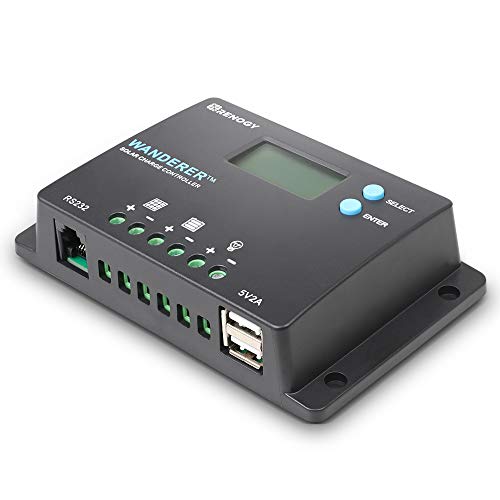
Compact PWM Controller – Renogy Wanderer 10A 12/24V
This Renogy Wanderer is a practical option if you want solar charge controllers for winter use in a small RV, marine, or off-grid setup. Its low self-consumption, temperature compensation, and 4-stage charging help it manage batteries carefully when daylight is limited and every watt counts.
Best For: Small 12V/24V systems that need simple, efficient battery management.
Pros:
- 4-stage charging supports AGM, Gel, Flooded, and Lithium batteries.
- Temperature compensation helps charging stay better tuned in changing conditions.
- Ultra-low self-consumption reduces wasted battery power.
- LCD display and USB port add everyday convenience.
Cons:
- PWM design is less advanced than MPPT for maximizing weak sunlight.
- 10A output is suited to smaller solar systems.
This is a solid value pick if you need a compact controller with useful protection and battery support, not a feature-heavy monitor. For small winter systems, it offers a dependable balance of simplicity, efficiency, and control.
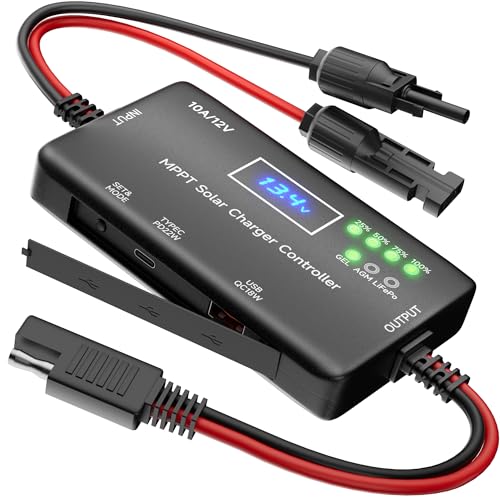
Compact MPPT Pick – SUNAPEX 12V 10A MPPT for LiFePO4/AGM/Gel
If you want solar charge controllers for winter use in a small 12V setup, this SUNAPEX MPPT model is built for straightforward charging and low standby loss. Its zero battery drain design and smart 4-stage charging can be appealing when winter sun is limited and every bit of harvested power matters.
Best For: 12V battery systems using LiFePO4, AGM, Gel, or lead-acid batteries where compact size and low parasitic draw matter.
Pros:
- Zero battery drain when the sun is not available
- Smart 4-stage charging helps support battery health
- LCD and LED indicators make status checks simple
- USB and Type-C outputs add handy device charging
Cons:
- Only works with 12V batteries, not 24V or 36V packs
- Not compatible with panels that already have built-in controllers
- Requires correct polarity during installation
For a compact winter-ready controller, this one focuses on efficient 12V charging and easy monitoring rather than high amperage. It is a practical fit if your system is small, portable, and you want a controller that avoids draining the battery between sunny periods.
Bluetooth Value Controller – ECO-WORTHY 30A PWM with App Monitoring
Among solar charge controllers for winter use, this ECO-WORTHY unit stands out if you want higher current capacity and app-based monitoring. It supports 12V and 24V systems, offers Bluetooth connectivity, and includes multiple protection features that help keep a small off-grid setup running more safely through colder months.
Best For: Users who want a 30A controller for 12V/24V systems with Bluetooth monitoring and basic load handling.
Pros:
- Works with both 12V and 24V systems
- Bluetooth app monitoring with up to 98 feet range in open field conditions
- Dual USB outputs for charging small devices
- Multiple protections include short-circuit, open-circuit, reverse, and overload
Cons:
- Uses PWM rather than MPPT charging
- Can heat up during operation and needs a ventilated installation area
- Load current is listed at 10A, which may be limiting for some setups
This is a sensible pick if you value convenience features more than maximum charging efficiency. For winter use, the Bluetooth monitoring and safety protections make it easier to keep tabs on battery behavior without adding complexity.
Weather-Ready MPPT Choice – SOLPERK 12V 10A Waterproof MPPT
If you are comparing solar charge controllers for winter use, this SOLPERK model is built around efficient 12V charging and a waterproof design. Its MPPT charging is described as 30% more efficient than PWM controllers, which can be useful when winter sunlight is weaker and charging windows are shorter.
Best For: Portable or small 12V solar setups that need waterproof construction and efficient charging.
Pros:
- MPPT charging is designed to be more efficient than PWM
- IP67 waterproof construction suits harsher conditions
- Compatible with AGM, lead-acid, gel, flooded, deep cycle, and LiFePO4 batteries
- Simple status checks with three indicator lights
Cons:
- Only designed for 12V battery systems
- Does not include Bluetooth or app-based monitoring
- Basic indicator-based feedback rather than a full display
This controller makes sense if weather resistance is a top concern and you want efficient charging in a compact package. For winter use, the waterproof rating and MPPT design are the main selling points, especially in portable or outdoor setups.
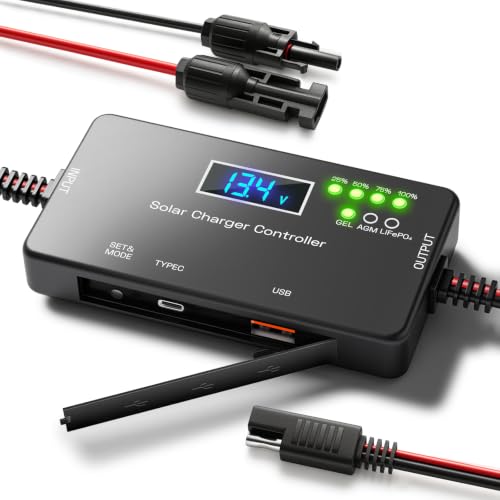
Quick-Install Winter Backup Pick – 12V 20A PWM Controller with LCD
For solar charge controllers for winter use, this 12V 20A PWM unit is a practical fit if you want simple setup, battery protection, and easy status checks in a cold-season RV, boat, or shed system. It supports 12V lithium, AGM, and gel batteries, handles panels up to 300W, and includes an LCD that shows voltage and charge level at a glance.
Best For: 12V off-grid users who want an easy-to-install controller with basic display and built-in USB charging.
Pros:
- Compatible with 12V LiFePO4, AGM, and Gel batteries.
- LCD display shows real-time voltage and 25%/50%/75%/100% battery level.
- 6-in-1 protection includes overcharge, reverse polarity, short-circuit, and over-temperature protection.
- Built-in 22W Type-C and 18W USB ports add convenient device charging.
Cons:
- Not compatible with 24V or 36V systems.
- PWM design is less advanced than MPPT for maximizing harvest.
- Best suited to modest 12V setups rather than larger arrays.
This is a straightforward winter-ready controller for users who value dependable protection and simple monitoring over advanced tuning. The no-drain nighttime blocking feature is especially useful when power is limited.
Weatherproof Budget Choice – SOLPERK 10A Waterproof PWM Controller
If you need solar charge controllers for winter use in an exposed location, this IP67 waterproof model is built for outdoor conditions and simple plug-and-play setup. It automatically identifies 12V or 24V systems, supports common deep-cycle batteries, and uses a 3-stage PWM charging process to improve charging efficiency.
Best For: RV, boat, and outdoor systems that need a compact waterproof controller with easy wiring.
Pros:
- IP67 waterproof design suits outdoor winter exposure.
- Automatically detects 12V/24V systems and supports AGM, GEL, and flooded batteries.
- 3-stage PWM charging and low standby power help improve efficiency.
- SAE port and pre-drilled holes make installation simple.
Cons:
- 10A output limits it to smaller setups.
- LED indicators are basic compared with full LCD displays.
- Less feature-rich than larger controllers with more advanced monitoring.
This is a solid pick when the main priority is weather resistance and hassle-free installation. It is best for modest systems where outdoor durability matters more than advanced controls.
High-Capacity Tracking Pick – 100A MPPT Solar Controller with LCD
For larger solar charge controllers for winter use, this 100A unit is designed for higher-capacity systems that need broad voltage support and detailed monitoring. It automatically recognizes 12V, 24V, 36V, and 48V systems, offers dual USB ports, and uses MPPT-style tracking to improve energy use in changing conditions.
Best For: Larger off-grid or multi-voltage systems that need flexible charging modes and strong monitoring tools.
Pros:
- Supports 12V/24V/36V/48V systems and multiple battery types, including LiFePO4.
- LCD displays working mode, battery voltage, PV current, discharge current, temperature, and more.
- Comprehensive protection covers over-voltage, over-current, deep discharge, reverse connection, and overheating.
- Multiple operating modes and factory reset support add setup flexibility.
Cons:
- Large 100A capacity may be more controller than smaller systems need.
- Product notes mention it combines MPPT and PWM technologies, so it may not be full MPPT performance.
- More complex than basic controllers if you only want simple plug-and-go operation.
This is the strongest option here for users who want more system visibility and multi-voltage support. It makes sense when winter conditions call for better tracking, broader compatibility, and more detailed diagnostics.
How We Picked the Best Solar Charge Controllers for Winter Use
We prioritized controllers with strong low-temperature performance, solid battery charging profiles, and the right protection features for cold, variable weather. MPPT models were favored for their better harvest in short daylight conditions, while PWM options were included for budget-friendly or simpler systems.
Quick Comparison
For winter solar, MPPT usually offers the best energy capture when sun hours are limited. PWM can still be a smart choice for smaller arrays, matched-voltage setups, and basic 12V systems. Bluetooth, waterproofing, and clear LCD monitoring are especially useful when systems are installed in hard-to-access locations.
Key Buying Factors for Solar Charge Controllers for Winter Use
Charging Efficiency in Low Light
Winter often means weaker sun and shorter charge windows, so a controller that can extract more power from panels is valuable. MPPT models typically outperform PWM here, especially when panel voltage is higher than battery voltage.
Battery Type Support
Make sure the controller supports your battery chemistry, such as LiFePO4, AGM, gel, or lead-acid. Correct charging profiles matter more in cold weather because batteries charge more slowly and are more sensitive to overcharge.
Cold-Weather Protection
Look for features like temperature compensation, low-temperature charging safeguards, and robust casing or waterproof ratings if the controller may face condensation, frost, or damp installations.
System Size and Amperage
Match the controller amperage to your solar array and battery bank with room to spare. Undersizing can limit winter performance, while oversizing can add unnecessary cost without benefit.
Monitoring and Installation
Bluetooth apps and LCD screens make it easier to verify charging status, especially when panels are producing less than expected. For winter cabins, RVs, and boats, easy visibility can help you catch issues early.
Who Should Buy Which Solar Charge Controllers for Winter Use?
If you want the best overall winter performance, choose an MPPT controller with the right voltage headroom and battery support. If your system is small and cost-sensitive, a quality PWM controller can still work well for straightforward 12V setups. Buyers in exposed or mobile environments should give extra weight to waterproof designs and remote monitoring, while those with lithium batteries should confirm cold-charge protections before buying.
In short, the best Solar Charge Controllers for Winter Use are the ones that fit your battery chemistry, match your array size, and keep charging efficient when daylight is scarce.