Cleaning tall, wide, or hard-to-reach windows is one of the few household jobs where automation can make a meaningful difference. The best window cleaning robots for large homes combine dependable suction, controlled movement, water dispensing, and safety systems that help them work across expansive glass surfaces.
This roundup compares 10 models with different navigation systems, spray designs, stations, and cleaning features. Use the guide below to narrow your choices based on window size, height, surface type, and how much hands-on supervision you prefer.
Best 10 Window Cleaning Robots for Large Homes Picks for 2026
Best All-Around Coverage

- TruEdge edge scrubbing and four-side frame detection
- WIN-SLAM 4.0 route planning with multiple modes
- Portable station and up to 110 minutes of cordless use
Best For: Large homes with varied glass windows and frequent room-to-room cleaning
Best Dual-Stage Cleaning

- Wet-lift round pad and dry-polish square pad
- 6500 Pa suction with constant 55N pressure
- 30-minute UPS adhesion and 220 kg safety rope
Best For: Users prioritizing edge coverage and a polished, streak-reduced finish
Best for Extended Coverage

- Up to 807 square feet per tank fill
- TruEdge 2.0 uses four edge brushes
- 10,000 Pa suction with six cleaning modes
Best For: Large homes with extensive glass and fewer-refill cleaning sessions
Best Value for High Windows

- 6400 Pa variable suction with 30-minute UPS backup
- Dual spray and round design for broad surface coverage
- Handles windows, skylights, mirrors, and tile walls
Best For: Homes with high windows, skylights, and other smooth surfaces
Best High-Suction Value
Double Helix Window Cleaning Robot

- 4800–6400 Pa variable-frequency suction
- Side-spray atomization and an 85 ml water tank
- Air-pressure sensor and AI edge detection
Best For: Buyers prioritizing suction and automatic spraying
Best for Manual Control
TOSIMA WA9C Pro Window Cleaning Robot

- Four-nozzle dual spray system for even moisture
- Six cleaning modes with remote-controlled manual operation
- Drop sensor, pressure monitoring, and 25-minute backup battery
Best For: High windows, mirrors, and users wanting precise control
Compact Everyday Pick
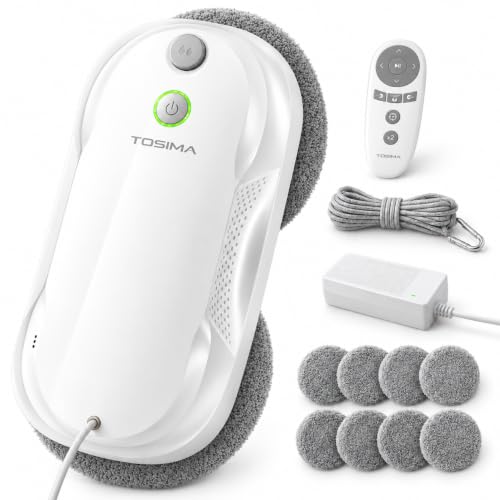
- 6400Pa adaptive suction with dual-spray cleaning
- Remote control and intelligent navigation
- Backup battery supports up to 25 minutes during outages
Best For: Routine glass cleaning when compact storage and simple controls are priorities
Flexible Large-Window Option

- 85 ml visible tank with dual ultrasonic spray nozzles
- S-shaped navigation for large and small windows
- Remote control supports manual and overhead cleaning
Best For: Homes with mixed window sizes and sunroom glass
Best All-Around Coverage – ECOVACS WINBOT W2S Omni
For shoppers comparing window cleaning robots for large homes, the ECOVACS WINBOT W2S Omni stands out for its organized navigation, edge-focused cleaning, and portable station. Its 80 mL tank, 110-minute battery life, and dual power modes are practical for moving between multiple rooms and larger glass surfaces.
Best For: Large homes with multiple framed, frameless, or tilted flat-glass windows.
Pros:
- TruEdge technology and frame detection help improve coverage near edges and corners.
- WIN-SLAM 4.0 plans organized routes and offers multiple cleaning modes.
- Portable OMNI Station combines charging, controls, cable management, storage, and safety functions.
- Supports cordless cleaning for up to 110 minutes or extended AC-powered sessions.
Cons:
- The 80 mL tank may still require refills during especially extensive cleaning jobs.
- Designed for indoor use and compatible glass surfaces, rather than general exterior surfaces.
The W2S Omni is a strong fit when convenience across a large home matters as much as cleaning performance. Its station and flexible power options reduce setup between windows, while the edge system addresses one of the common limitations of robotic window cleaners.
Best Dual-Stage Cleaning – HUTT 10 Premium Round-Square
The HUTT 10 Premium is a compelling option among window cleaning robots for large homes because it combines wet lifting with dry polishing. Its 80 mL tank, smart mapping, strong suction, and power-outage protection support repeated cleaning across windows, mirrors, and other glass surfaces.
Best For: Households that want separate wet-cleaning and dry-polishing stages with strong safety features.
Pros:
- Round-square dual-pad design targets edges, corners, frames, and broad glass areas.
- Up to 6500 Pa suction and constant 55N pressure support stable, forceful cleaning.
- NAVI 7.0 mapping and 14 sensors help plan paths and monitor edges and pressure.
- UPS protection maintains adhesion for up to 30 minutes during a power interruption.
Cons:
- The manufacturer recommends purified water, and cleaning liquid is not included.
- Pad moisture and dirty drive tracks can affect traction and navigation.
- Its 80 mL tank is smaller than some options designed for longer coverage per refill.
Choose the HUTT 10 Premium if finish quality and edge reach are priorities. The dual-stage approach is more involved than a simple one-pad system, but it gives large-home owners a useful way to handle both dirt removal and final polishing.
Best for Extended Coverage – ECOVACS WINBOT W2S PRO Omni
For large homes with many windows, the ECOVACS WINBOT W2S PRO Omni is designed to reduce interruptions. Its enlarged 4.1 fl oz tank is rated for up to 807 square feet per fill, while TruEdge 2.0, WIN-SLAM 4.0, and 10,000 Pa suction support edge-to-edge cleaning and secure movement.
Best For: Large glass areas where fewer refills and strong edge cleaning are important.
Pros:
- TruEdge 2.0 uses four felt-bristle edge brushes to reach frames and corners.
- The enlarged tank supports up to 807 square feet of coverage per fill.
- WIN-SLAM 4.0 detects frames and obstacles and offers six cleaning modes.
- The portable OMNI Station integrates battery power, cable management, controls, storage, and anti-drop protection.
Cons:
- The supplied specifications list a 68 dB noise level, so it is not silent.
- Its station and accessories require storage space between cleaning sessions.
The W2S PRO Omni is the most targeted choice here for minimizing refill stops across a large property. Its combination of high suction, a larger tank, and dedicated edge brushes makes it especially suitable for extensive glass-cleaning routines.
Best Value for High Windows – X6 High-Window Robot
The X6 is a practical pick for shoppers seeking window cleaning robots for large homes without limiting use to standard panes. Its slim round shape, 6400 Pa variable suction, dual spray nozzles, and remote-controlled navigation are suited to high windows, floor-to-ceiling glass, skylights, mirrors, and tile walls.
Best For: Homes with high, narrow, or varied smooth surfaces where ladder use is a concern.
Pros:
- 6400 Pa variable suction, edge detection, and a UPS function help support secure operation.
- Dual spray nozzles wet the glass evenly, while the round body is designed to cover 95% of the area.
- Works on glass, mirrors, skylights, and tile walls, including narrow window frames.
- Includes a safety cable, remote, mops, water bottle, and a 12-month warranty.
Cons:
- Very dirty windows may require two cleaning passes.
- Using too much water or dirty pads can cause smears and reduce traction.
- The corded design requires access to a power source during cleaning.
The X6 makes the most sense for homes with hard-to-reach glass and mixed smooth surfaces. It offers broad compatibility and straightforward remote operation, but owners should follow the pad and moisture guidance to get a clean, streak-reduced result.
Best Overall – ECOVACS WINBOT W3 OMNI
For large homes with expansive windows, glass doors, or high-rise panes, the ECOVACS WINBOT W3 OMNI is the most hands-off option in this roundup. Its self-cleaning station, wide-angle triple spray system, and smart navigation are designed for routine cleaning across larger glass surfaces.
Best For: Large homes, broad glass panels, glass doors, and shoppers prioritizing automated maintenance.
Pros:
- Automatic station washes the mop pads after use.
- Win-SLAM 5.0 offers obstacle avoidance and Fast, Intensive, and Zone modes.
- TruEdge technology helps clean along edges and into corners.
- Triple nozzles provide wide-angle spray coverage for large windows.
Cons:
- Its 12.22 kg listed weight makes it less portable than compact alternatives.
- The feature-rich station may be more than needed for occasional spot cleaning.
The W3 OMNI stands out for reducing both cleaning effort and mop maintenance. It is a strong fit when you have many windows to cover and want the most automated workflow available among these options.
Best High-Suction Value – Double Helix Window Cleaning Robot
For shoppers comparing window cleaning robots for large homes, the Double Helix model focuses on strong variable suction and automatic spraying. Its visible 85 ml tank and side atomization are intended to provide consistent coverage while the robot works across glass.
Best For: Users who want strong suction, automatic water spraying, and a relatively lightweight window-cleaning robot.
Pros:
- Variable 4800–6400 Pa suction is designed to adjust to dirt levels.
- Bidirectional ultrasonic atomization sprays water from the sides.
- 85 ml tank sprays twice per movement to reduce refill frequency.
- Air-pressure sensing and AI edge detection support anti-drop operation.
Cons:
- The supplied surface recommendation lists bamboo rather than glass, so verify suitability for your windows.
- Button control is less flexible than app or remote control.
- The listed dimensions appear inconsistent with a typical window robot, so confirm sizing before purchase.
This model emphasizes suction power and water coverage rather than advanced navigation or a cleaning station. It may suit buyers who value simple operation and strong adhesion, provided the product specifications meet their particular window setup.
Best for Manual Control – TOSIMA WA9C Pro Window Cleaning Robot
The TOSIMA WA9C Pro is a practical choice for large homes where you want systematic coverage but also the ability to direct the robot yourself. Its four-nozzle spray system, six cleaning modes, remote control, and safety features make it useful for high windows, mirrors, and glass doors.
Best For: Homeowners who want remote control, multiple path patterns, and a complete accessory kit for varied glass surfaces.
Pros:
- Four nozzles provide even spray coverage across the glass.
- Six cleaning modes include N-, Z-, and manual paths for flexible coverage.
- 2600–3200 Pa suction, air-pressure monitoring, and a drop sensor support stability.
- Backup battery protection keeps the robot attached for up to 25 minutes after power loss.
Cons:
- It requires a safety rope anchored to a reliable object for overhead work.
- The 25-minute battery duration is intended for power-loss protection, not extended cordless cleaning.
- Remote control requires more hands-on involvement than a fully automated station-based system.
The WA9C Pro balances automation with direct control. It is especially appealing when different windows need different cleaning patterns or when you want to target stubborn spots manually.
Compact Everyday Pick – Tosima W5
For shoppers comparing window cleaning robots for large homes, the Tosima W5 offers adaptive suction, automatic spraying, and intelligent navigation in a compact package. Its remote control and backup battery add convenience when cleaning smooth glass surfaces, including frameless windows.
Best For: Homeowners who want a lightweight robot for routine glass cleaning and easy storage.
Pros:
- Adaptive suction reaches up to 6400Pa and adjusts to the surface.
- Dual-spray cleaning helps loosen fingerprints, dust, and stains.
- Triple safety system includes a safety rope, edge-sensing air pressure sensor, and up to 25 minutes of backup battery power.
- Remote control and intelligent navigation simplify operation.
Cons:
- The compact 6-inch cleaning path may require more passes across numerous large windows.
- It is designed for smooth surfaces and glass windows rather than broad outdoor surface types.
The W5 is a practical choice when manageable size and straightforward controls matter. For a large-home cleaning routine, its safety features are useful, though the narrower cleaning path may make extensive window coverage more time-consuming.
Flexible Large-Window Option – Tosima X1
The Tosima X1 is a flexible choice among window cleaning robots for large homes, with an 85 ml visible tank, dual ultrasonic spray nozzles, and automatic S-shaped navigation. It can handle large and small glass surfaces, while the remote allows manual direction changes for overhead cleaning.
Best For: Households needing one robot for varied window sizes, sunroom glass, and regular indoor cleaning.
Pros:
- Dual nozzles spray in the direction of travel to help reduce smearing.
- Visible 85 ml water tank makes the remaining water easy to monitor.
- Automatic top-to-bottom S-shaped cleaning works on windows from 30×30 cm and larger.
- Backup battery keeps the robot attached for about 25 minutes during a power outage.
Cons:
- At 65 dB, it may be noticeable during operation.
- The supplied notes specify indoor use and a working temperature range of 0°C to 40°C.
The X1 balances coverage flexibility and usability well. Its visible tank and manual controls are particularly helpful in a large home with mixed window dimensions, although users should plan around its indoor operating guidance and corded power source.
Advanced High-Rise Cleaner – HUTT S55 Pro
For extensive glass areas, the HUTT S55 Pro combines 6500Pa adaptive suction, HydroJet pump spraying, and SLAM 4.0 navigation. Its floating pads, visible water tank, and automatic return function make it a strong contender for window cleaning robots for large homes and high-rise windows.
Best For: Users prioritizing systematic navigation, edge control, and deeper cleaning across high or hard-to-reach glass.
Pros:
- SLAM 4.0 supports Z-path cleaning, edge recognition, repeat cleaning, spot mode, and automatic return.
- Up to 6500Pa adaptive suction helps maintain adhesion across different angles.
- HydroJet pump spray and microfiber pads are designed to dissolve and remove common stains.
- Multi-layer safety protection includes pressure compensation, suction adjustment, a safety rope, and backup battery power.
Cons:
- The 80 ml tank is smaller than the Tosima X1’s 85 ml tank.
- Operation depends on the included cleaning pads and a secure safety-rope setup.
The S55 Pro is the most feature-focused option in this group. Its navigation and floating-pad design can help streamline larger cleaning jobs, while the multiple safety measures add reassurance for high-rise or difficult-to-reach windows.
How We Picked the Best Window Cleaning Robots for Large Homes
We focused on features that matter when a robot must clean many windows rather than just an occasional pane. Our comparison considers suction strength, movement and navigation, spray or water-delivery systems, pad design, cord and tether safety, battery or station convenience, and support for large or high windows.
Claims such as maximum suction are useful for comparison, but they do not guarantee performance on every surface. Glass texture, dust, moisture, frame design, and pad condition all affect results. A robot should also be viewed as a maintenance tool, not a completely unattended replacement for careful cleaning.
Quick Comparison
- Best overall convenience: Look for a model with a multifunction station, automated washing or drying, and reliable navigation.
- Best for high windows: Prioritize strong, adaptive suction, a long safety tether, and clear loss-of-power alerts.
- Best for large glass areas: Choose efficient route planning, a larger water tank, and pads that can be changed quickly.
- Best for controlled cleaning: Multiple modes and adjustable spray levels help accommodate lightly dusty or heavily soiled glass.
- Best for portability: A compact robot with a portable station is easier to move between floors and rooms.
Key Buying Factors for Window Cleaning Robots for Large Homes
Suction and Safety
Strong suction is essential, especially for exterior panes and upper-floor windows. Confirm that the robot includes a physical safety rope, backup power or anti-drop protection, and audible or app alerts when suction is interrupted. Never skip the tether on elevated glass.
Navigation and Coverage
Smart mapping can reduce missed areas and unnecessary overlap across large windows. SLAM-style navigation, edge detection, and automatic route planning are especially useful when cleaning multiple panes. Check whether the unit can handle frameless glass, narrow edges, or windows divided by mullions.
Spray System and Pad Maintenance
Automatic spray reduces manual work, but tanks and nozzles need regular cleaning. Dual-nozzle, ultrasonic, or pump-based systems may distribute moisture more evenly. Reusable pads should be easy to remove, wash, and replace; dirty pads can spread grime instead of removing it.
Window Compatibility
Measure your windows and review the manufacturer’s minimum and maximum dimensions. Confirm compatibility with double glazing, tinted glass, textured surfaces, screens, stickers, and heavily framed windows. Most robots perform best on smooth, reasonably clean glass.
Who Should Buy Which Window Cleaning Robots for Large Homes?
Choose a station-equipped ECOVACS model if you want the simplest workflow for a large home and value automated maintenance. Consider a HUTT or Tosima model if you want strong suction, specialized navigation, or a practical balance of portability and features. A compact X6, Double Helix, or WA9C Pro-style option may suit buyers who want basic automated cleaning without a large station.
Whichever model you choose, plan to pre-clean loose grit, use clean pads, keep the safety line secured, and supervise the first few runs. The right robot can reduce ladder work and routine effort, but careful setup remains important for streak-free, safe results.