An energy recovery ventilator for home use helps bring in fresh outdoor air while reducing energy loss, making it a smart upgrade for tighter houses.
Below, we focus on models that balance airflow, efficiency, filtration, and practical installation options so you can choose with confidence.
Best 10 Energy Recovery Ventilator for Home Picks for 2026
Whole-Home ERV Pick
Broan B160E75RS 133 CFM Wall/Ceiling ERV
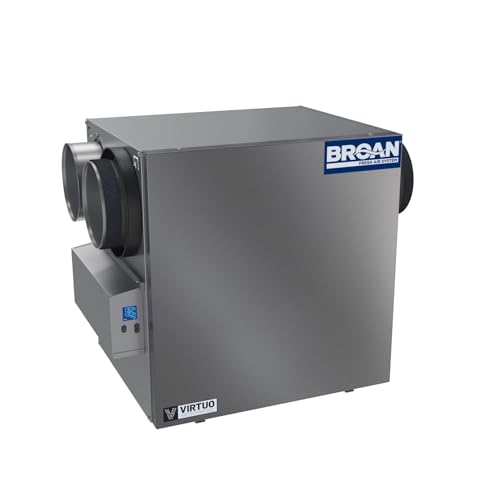
- Up to 133 CFM for home ventilation
- Wall or ceiling mounted with side ports
- LCD screen and galvanized steel build
Best For: Homeowners wanting a mounted ERV with built-in controls
Reliable HRV Option
Fantech VHR 150 3-Speed Heat Recovery Unit

- Up to 159 CFM at 0.4" PS
- Three-speed control with low-voltage compatibility
- Washable electrostatic filters
Best For: Homes needing strong airflow and easy filter maintenance
Smart Balanced Choice
Panasonic Intelli-Balance Elite Plus+ 120 CFM ERV

- SmartFlow ECM motors for stable airflow
- 30 to 120 CFM customizable range
- Dual MERV 13 filters and flexible mounting
Best For: Buyers wanting a smart ERV with filtration and flexible install options
Single-Room Retrofit Pick
VENTS-US TwinFresh Comfo 30 CFM Ductless ERV

- Ductless through-the-wall installation
- Up to 30 CFM for rooms up to 500 sq. ft.
- Recovers up to 88% of heat or cooling
Best For: Retrofits and single rooms that need ventilation without ductwork
Premium SmartFlow ERV
Panasonic Intelli-Balance Elite 110 CFM
- SmartFlow ECM motors auto-adjust airflow
- 30–110 CFM supports multiple pressure setups
- Includes dual MERV 13 filters
Best For: Homes needing flexible, quiet ERV performance
Quiet Balanced Ventilation

- Balanced air exchange with capillary core
- Low-noise design with centrifugal fan
- High 255 CFM airflow capacity
Best For: Buyers wanting simple, quiet balanced ventilation
Auto-Balancing Wall ERV

- Auto-balancing VIRTUO technology
- 206 CFM capacity for larger homes
- Wall or ceiling mounting options
Best For: Homes needing higher-capacity auto-balancing ventilation
Compact ERV With Control Panel
Awoco 6" Vent ERV System with Control Panel
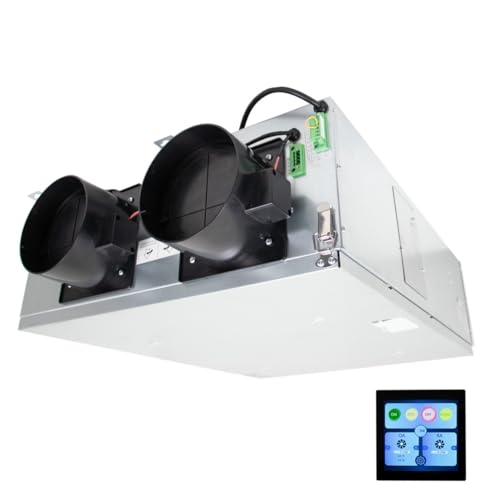
- Balanced airflow with heat and moisture retention
- Touchscreen panel, timer knob, and humidity sensor
- Washable filter plus included 6-inch adapters
Best For: Small to mid-size homes needing simple ERV control
High-Airflow Whole-House ERV
VENTS-US Frigate ERV 120s Whole-House Ventilator

- Up to 162 CFM for whole-house air exchange
- Anti-frost protection for cold-weather use
- Enthalpy core plus washable MERV 6 filters
Best For: Cold-climate homes needing higher-capacity ventilation
Simple 100 CFM Attic ERV
Awoco 6" Vent ERV System, 100 CFM

- Balanced ventilation with heat and moisture retention
- Humidity sensor, timer knob, and defrost cycling dampers
- Washable 20 PPI filter with bracket installation
Best For: Attic installs where simple humidity-aware ventilation matters
Whole-Home ERV Pick – Broan B160E75RS 133 CFM Wall/Ceiling ERV
If you want an energy recovery ventilator for home use that can be mounted on the wall or ceiling, the Broan B160E75RS is built as a more permanent whole-home ventilation option. It delivers up to 133 CFM and uses side ports, an LCD screen, and a galvanized steel build for a straightforward install in a residential setup.
Best For: Homeowners looking for a wall- or ceiling-mounted ERV with integrated controls and a durable metal housing.
Pros:
- Up to 133 CFM for home ventilation needs
- Wall or ceiling mounted with side ports
- LCD screen for on-unit visibility
- Galvanized steel construction
Cons:
- Heavier unit at 44 pounds
- Requires 120V power and 163 watts
- No finish may be less appealing in visible installs
For buyers comparing a practical energy recovery ventilator for home installations, this Broan model stands out for its mounting flexibility and built-in display. It is best suited to users who want a more centralized ventilation solution rather than a small single-room unit.
Reliable HRV Option – Fantech VHR 150 3-Speed Heat Recovery Unit
Fantech VHR 150 Heat Recovery Ventilator (HRV) Supply Fan Shutdown Defrost 3 Speed Unit
Check Price On AmazonThe Fantech VHR 150 is a heat recovery ventilator for home ventilation setups that need balanced airflow and simple control. It supports up to 159 CFM at 0.4″ PS, uses a three-speed ventilation control, and includes washable electrostatic filters for routine maintenance.
Best For: Homes needing an HRV with strong airflow, remote-control compatibility, and simple filter maintenance.
Pros:
- Airflow up to 159 CFM at 0.4″ PS
- Three-speed ventilation control
- Compatible with low-voltage controls and external dry contacts
- Washable electrostatic filters
Cons:
- HRV, not an ERV, so it is less focused on moisture transfer
- Larger unit with a 45-pound weight
- May need compatible controls for full functionality
This model is a strong fit if you are shopping for an energy recovery ventilator for home use but are also considering a heat recovery alternative with similar whole-house capability. Its practical control options and washable filters make it appealing for users who want a straightforward ventilation system.
Smart Balanced Choice – Panasonic Intelli-Balance Elite Plus+ 120 CFM ERV
The Panasonic Intelli-Balance Elite Plus+ is a feature-rich energy recovery ventilator for home installations that need flexible airflow and better air filtration. With SmartFlow ECM motors, a 30 to 120 CFM range, MERV 13 filters, and a hygroscopic transfer core treatment, it is designed to balance ventilation performance with indoor air quality.
Best For: Buyers who want a smart, flexible ERV with strong filtration and multiple installation options.
Pros:
- SmartFlow ECM motors adjust for airflow and quiet operation
- Customizable 30 to 120 CFM airflow range
- Dual MERV 13 filters included
- Ceiling, wall, or floor mounting with plug-in or hardwired options
Cons:
- More complex than a basic single-room ventilator
- Accessories like Wi-Fi module are optional
- May be more system than needed for smaller spaces
If you want an energy recovery ventilator for home use with modern controls and filtration, this Panasonic model is a compelling all-around choice. Its broad airflow range and flexible mounting make it suitable for a variety of residential layouts.
Single-Room Retrofit Pick – VENTS-US TwinFresh Comfo 30 CFM Ductless ERV
The VENTS-US TwinFresh Comfo is a ductless energy recovery ventilator for home rooms where traditional ductwork is not practical. It offers up to 30 CFM for spaces up to 500 sq. ft., recovers up to 88% of heat or cooling, and includes a humidity sensor, remote control, and MERV 5 filters.
Best For: Bedrooms, basements, home offices, and retrofits that need room-by-room fresh air without ductwork.
Pros:
- Ductless through-the-wall design for 6 to 20 inch walls
- Up to 30 CFM for rooms up to 500 sq. ft.
- Recovers up to 88% of heat or cooling
- Quiet operation as low as 0.2 sones with remote control
Cons:
- Designed for single rooms rather than a full central system
- Lower airflow than whole-home units
- MERV 5 filtration is basic compared with higher-grade options
For shoppers who need an energy recovery ventilator for home projects without running ducts, this VENTS-US unit is a practical retrofit-friendly solution. It is especially useful where targeted ventilation, quiet operation, and simple installation matter more than central whole-house airflow.
Premium SmartFlow ERV – Panasonic Intelli-Balance Elite 110 CFM
If you want an energy recovery ventilator for home use that can adapt to changing conditions, the Panasonic Intelli-Balance Elite is built around automatic airflow control and balanced ventilation. Its SmartFlow ECM motors adjust output to help maintain performance quietly, while the hygroscopic core helps exchange heat and moisture for a more comfortable indoor environment.
Best For: Homes that want flexible installation, quiet operation, and smart airflow control with high-efficiency filtration.
Pros:
- Customizable airflow from 30 to 110 CFM for balanced, positive, or negative pressure setups
- Dual MERV 13 filters included for incoming and outgoing air
- SmartFlow ECM dual brushless motors automatically adjust for varying pressure conditions
- Ceiling, wall, or floor mounting options with plug-in or hardwired installation
Cons:
- More complex than a basic ventilation fan thanks to smart controls and multiple setup options
- May be more than needed if you only want simple fixed-speed ventilation
- Wi-Fi module and some controls are included or optional, which may add setup decisions
Overall, this Panasonic ERV stands out for homeowners who value control, filtration, and installation flexibility. Its combination of variable airflow and energy recovery makes it a strong fit for whole-home ventilation planning.
Quiet Balanced Ventilation – NET.Pro 255 CFM ERV
The NET.Pro energy recovery ventilator for home ventilation is aimed at buyers who want balanced air exchange with straightforward operation. It uses a capillary core to transfer heat between incoming and outgoing air, while the low-noise motor and centrifugal fan design are meant to support quiet, efficient ventilation.
Best For: Homeowners who want a quiet, code-compliant balanced ventilation solution with simple controls.
Pros:
- Balanced ventilation exchanges heat between incoming and outgoing exhaust air
- Capillary core helps clean air during heat exchange
- Low-noise motors and centrifugal fan are designed for quiet operation
- High air flow capacity at 255 CFM for broader ventilation needs
Cons:
- Button control is basic compared with smarter control systems
- No advanced filtration rating is listed in the supplied details
- Large 255 CFM capacity may be more than smaller homes need
This model makes sense if you want a practical ERV focused on balanced airflow and low operating noise. It looks best suited to homeowners who prioritize capacity and simplicity over extra features.
Auto-Balancing Wall ERV – Broan B210E75RS AI 206 CFM
For shoppers looking for an energy recovery ventilator for home installation on a wall or ceiling, the Broan B210E75RS emphasizes automation and capacity. Its VIRTUO technology includes auto-balancing and an integrated LCD screen, while the ERV core is designed to handle indoor ventilation with a brushless motor and side-port layout.
Best For: Homes that need a higher-capacity ERV with wall or ceiling mounting and auto-balancing features.
Pros:
- VIRTUO technology with auto-balancing and integrated LCD screen
- Wall or ceiling mounting for installation flexibility
- 206 CFM airflow capacity for larger ventilation demands
- Brushless motor and included MERV 8 filter
Cons:
- 270-watt wattage is higher than some smaller residential units
- Only basic push-button control is listed in the notes
- Heavier, larger unit may require more planning for installation
This Broan ERV is a solid fit if you want automated balancing and a higher airflow rating in a home-friendly format. It pairs practical mounting options with the features needed for more demanding ventilation setups.
Compact ERV With Control Panel – Awoco 6" Vent ERV System with Control Panel
If you want an energy recovery ventilator for home use that focuses on balanced airflow and straightforward controls, this Awoco 6-inch ERV is built for that job. It brings in outside air, exhausts stale indoor air, and includes a touch screen control panel plus adjustable airflow knobs for both outside air and return air.
Best For: Homeowners who want a compact ERV with humidity control, washable filters, and simple on-unit adjustments.
Pros:
- Balanced air exchange helps retain heat and manage indoor moisture.
- Touch screen control panel plus timer knob for 5 to 60 minutes per hour.
- Washable 20 PPI filter and built-in humidity sensor.
- Includes two 6-inch vent adapters, brackets, and a plug-in power cord.
Cons:
- Requires 6-inch insulated ducting for exhaust and outside air.
- Rated at 100 CFM maximum, so it may suit smaller spaces better than large homes.
- Its 50 dB rating may be noticeable in quiet areas.
This model stands out if you want an ERV with practical controls and maintenance-friendly filters in a compact package. The built-in humidity features and defrost/recirculation dampers make it especially appealing for year-round use.
High-Airflow Whole-House ERV – VENTS-US Frigate ERV 120s Whole-House Ventilator
The VENTS-US Frigate ERV 120s is an energy recovery ventilator for home ventilation when you need stronger airflow and cold-weather protection. It is designed for whole-house air exchange, with an enthalpy core that transfers heat and moisture, plus an electronic anti-frost system for freezing conditions.
Best For: Homes in colder climates that want higher airflow, washable filtration, and continuous balanced ventilation.
Pros:
- Up to 162 CFM maximum net airflow for whole-house ventilation.
- Electronic anti-frost protection helps safeguard performance in freezing weather.
- Enthalpy core transfers both heat and moisture to stabilize temperature and humidity.
- Washable MERV 6 filters and simple three-speed control.
Cons:
- Uses 5-inch duct connections, so installation must match that setup.
- At 1.9 sones, it may still be audible in quiet spaces.
- Its steel-cased, ceiling-mounted design may require more planning than a simpler unit.
This is a strong pick if your priority is higher-capacity ventilation with cold-climate protection. Its mix of airflow, filtration, and heat/moisture recovery makes it a practical whole-home ERV option.
Simple 100 CFM Attic ERV – Awoco 6" Vent ERV System, 100 CFM
This Awoco energy recovery ventilator for home use is a straightforward 6-inch ERV that focuses on balanced ventilation, washable filtration, and basic speed adjustment. It exhausts stale indoor air while bringing in outside air, and it also includes built-in dampers, a humidity sensor, and a timer knob for run-time control.
Best For: Homeowners who want a practical attic-mounted ERV with humidity sensing and low-maintenance filters.
Pros:
- Balanced air exchange helps improve indoor air quality and retain existing heat.
- Adjustable airflow knobs allow up to 100 CFM.
- Built-in humidity sensor, defrost cycling dampers, and timer knob.
- Washable 20 PPI filter and included brackets simplify upkeep and installation.
Cons:
- Requires 6-inch insulated ducting for exhaust and outside air.
- It offers 2 speed levels rather than a wide speed range.
- At 50 dB, it is not the quietest choice for noise-sensitive spaces.
For buyers who want the core ERV benefits without extra complexity, this model keeps the feature set focused and practical. It is a sensible fit for attic installations where balanced ventilation and humidity control matter more than premium controls.
How We Picked the Best Energy Recovery Ventilator for Home
We prioritized balanced ventilation performance, sensible airflow ranges, filtration quality, freeze or defrost protection, control options, and installation flexibility. For an Energy Recovery Ventilator for Home use, the right fit depends on house size, ducting, and whether you want whole-home or room-by-room fresh air support.
Quick Comparison
Use higher-CFM units for larger homes or stronger whole-house ventilation needs. Midrange models suit average homes, while ductless or lower-CFM options are better for smaller spaces, additions, and targeted fresh-air zones. Features like smart controls, MERV-rated filtration, and wall- or ceiling-mount designs can make day-to-day use easier.
Key Buying Factors for an Energy Recovery Ventilator for Home
Airflow and Home Size
Match CFM to the home’s square footage, occupancy, and airtightness. Too little airflow limits air exchange; too much can create unnecessary noise or energy use.
Energy Recovery Type
ERVs transfer both heat and some moisture, which is often helpful in humid or dry climates. If your priority is recovering sensible heat only, compare HRV alternatives carefully.
Filtration and Air Quality
Look for filtration that supports your indoor air goals, especially if you deal with dust, pollen, or wildfire smoke. Better filtration can improve comfort, but it should be balanced with airflow and maintenance needs.
Controls, Defrost, and Noise
Useful controls include speed settings, timers, remote access, and automatic balancing features. In colder climates, defrost protection matters. If the unit will run often in living areas, quieter operation is a major plus.
Installation Style
Whole-house ducted systems typically deliver the most even ventilation, while ductless or compact wall-mounted models can be simpler for smaller homes, renovations, or specific rooms.
Who Should Buy Which Energy Recovery Ventilator for Home?
Choose a higher-CFM whole-home unit if you want broad ventilation coverage for a larger, tighter house. Pick a midrange model if you need dependable everyday fresh air without oversizing. Go with a ductless or compact option if you want easier installation for an apartment, addition, or localized ventilation project. If indoor air quality is your top concern, favor models with stronger filtration and more control over fan speed and scheduling.
For most buyers, the best Energy Recovery Ventilator for Home use is the one that matches airflow needs, climate, and installation constraints—not the one with the most features on paper.