Manual grain mills give you a simple way to turn wheat, corn, oats, rice, and other dry grains into fresh flour without electricity. The right model can also support food storage, off-grid cooking, and small-batch baking.
We compared 10 popular hand-operated mills for construction, capacity, grind control, ease of use, and everyday practicality. Use the guide below to match a mill to your baking habits, preparedness plans, and available counter space.
Best 10 Manual Grain Mills Picks for 2026
Classic Cast-Iron Workhorse
Victoria High-Hopper Grain Mill

- 2,400-gram hopper
- Adjustable cast-iron grinding
- Clamps to 1/2–2-inch tables
Best For: Versatile home grinding and larger batches
Lifetime-Built Premium Mill
Country Living Hand Grain Mill

- Aircraft-aluminum construction
- Cracked grain to cake flour
- Lifetime warranty
Best For: Durability-focused bakers and long-term use
Large-Capacity Flour Maker

- Six-cup hopper
- 12-inch momentum flywheel
- Motorization-ready design
Best For: Large batches of dry grain and baking flour
Compact Tabletop Classic
Victoria Low-Hopper Grain Mill

- 1,200-gram capacity
- Adjustable cast-iron discs
- Low-profile clamp-on design
Best For: Occasional home grinding in a compact setup
Compact Versatility
Kitchen Crop Hand Crank Grain Mill
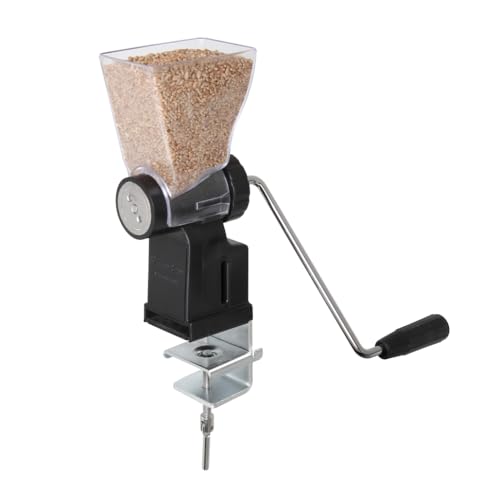
- Stainless steel burrs handle many dry, non-oily grains and seeds.
- Adjusts from coarse cracked grains to fine flour.
- Lightweight clamp-on design with optional motor compatibility.
Best For: Small-batch grinding and compact kitchen storage
Traditional Heavy-Duty Pick

- Cast iron construction with food-safe tin plating.
- Adjustable for flour, masa, cracked grains, coffee, and spices.
- 1.9-quart hopper and complete mounting kit included.
Best For: Traditional home milling and corn-based recipes
Large-Capacity Workhorse
VEVOR Manual Grain Mill with Flywheel

- Two-liter hopper supports larger grinding sessions.
- Three fineness settings cover coarse, medium, and fine textures.
- Heavy carbon steel body and wide base promote stable operation.
Best For: Higher-volume home grinding and stationary use
Traditional Choice
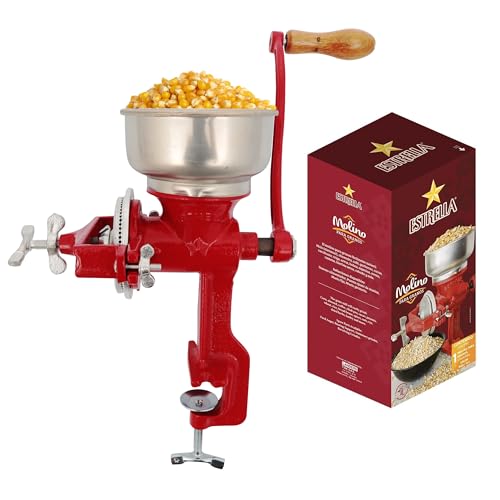
- Traditional hand-crank design for masa and tortillas
- Cast iron body with adjustable grinding settings
- Clamps to countertops up to 1.5 inches
Best For: Traditional Mexican and Latin American home cooking
High-Capacity Workhorse
White Heavy-Duty Hand Grain Mill

- 1.3 kg listed capacity with an extra-large hopper
- Adjustable grinding for coarse meal to fine processing
- Manual stainless steel mill for dry ingredients
Best For: High-volume home, camping, and preparedness grinding
Compact Cast-Iron Pick

- 7.5-pound iron construction
- Table clamp, crank, hopper, and body included
- Designed for corn, wheat, oats, and brewing grains
Best For: Straightforward home grain and brewing-grain milling
Classic Cast-Iron Workhorse – Victoria High-Hopper Grain Mill
For shoppers comparing manual grain mills, the Victoria High-Hopper model offers a sturdy cast-iron build, a 2,400-gram capacity, and adjustable grinding for coarse-to-fine results. It clamps to tables 1/2 to 2 inches thick and includes a non-slip protector for more stable operation.
Best For: Home users who want a versatile clamp-on mill for grains, corn, coffee, seeds, nuts, spices, and other dry or prepared ingredients.
Pros:
- Heavy-duty cast-iron construction with double tin plating.
- High hopper holds up to 2,400 grams.
- Adjustable screw supports different grinding textures.
- Wooden-handle crank and non-slip surface protector improve handling.
Cons:
- Cannot produce a superfine texture.
- Will not grind whole wheat into a fine powder.
- Limited 90-day warranty.
This is a practical, multipurpose manual grain mill for traditional table-mounted grinding. Choose it when durable cast iron and a larger hopper matter more than ultra-fine flour production.
Lifetime-Built Premium Mill – Country Living Hand Grain Mill
Among manual grain mills, the Country Living Hand Grain Mill stands out for its solid aircraft-aluminum construction, industrial-grade ball bearings, and broad adjustment range. It is designed to move from cracked grain to cake flour and comes with a lifetime warranty.
Best For: Serious home bakers and self-sufficiency-minded users who want a durable, adjustable mill with long-term warranty coverage.
Pros:
- Made from solid cast aircraft aluminum.
- Double-sealed industrial-grade ball bearings.
- Adjusts from cracked grain to cake flour.
- Includes a lifetime warranty.
Cons:
- At 16 pounds, it is relatively heavy.
- Two-pound capacity is smaller than some high-capacity alternatives.
- Supplied specifications do not identify included mounting accessories.
With its strong construction and wide adjustment range, this mill is aimed at buyers prioritizing durability and flour flexibility. Its weight is worth considering if you need to move or store the mill frequently.
Large-Capacity Flour Maker – Lehman’s Power Grain Mill
This Lehman’s model is one of the more substantial manual grain mills, combining a six-cup hopper with a 12-inch flywheel that adds momentum during hand grinding. Its stainless steel burrs are designed to process free-flowing dry grains into pastry flour, and the mill can also be motorized.
Best For: Batch-oriented users grinding wheat, corn, rye, rice, quinoa, and small beans for bread and baked goods.
Pros:
- Large six-cup hopper supports bigger batches.
- 12-inch iron V-belt flywheel helps make hand grinding easier.
- Stainless steel burrs have an electrolytic-polished surface.
- Four pre-drilled base holes allow bolting, and the mill can be motorized.
Cons:
- At 26 pounds, it is notably heavy.
- Its large footprint may require dedicated counter or bench space.
- Designed for free-flowing dry ingredients rather than a broad range of wet or prepared foods.
The Lehman’s mill is a strong fit when capacity and easier manual operation take priority. Its size and weight make it better suited to a permanent setup than occasional, portable use.
Compact Tabletop Classic – Victoria Low-Hopper Grain Mill
For buyers seeking compact manual grain mills, the Victoria Low-Hopper model provides adjustable cast-iron grinding in a lower-profile format. It clamps to tables 1/2 to 2 inches thick, includes a rubber protector, and handles grains, corn, coffee, seeds, nuts, spices, and more.
Best For: Home cooks who want a versatile, lower-hopper mill for occasional table-mounted grinding and ingredient preparation.
Pros:
- Durable cast-iron construction with erosion-resistant discs.
- Adjustable screw changes the grinding coarseness.
- Low-hopper design has a compact 1,200-gram capacity.
- Non-slip protector helps protect tables during use.
Cons:
- Cannot grind to a superfine texture.
- Will not turn whole wheat into a fine powder.
- 90-day limited warranty is relatively short.
This model makes sense for users who value a traditional cast-iron grinder without choosing the high-hopper version. It is versatile, but shoppers needing very fine flour should consider a different mill design.
Compact Versatility – Kitchen Crop Hand Crank Grain Mill
Kitchen Crop Hand Crank Grain Mill Wheat Flour Grinder, Stainless Steel Metal Burrs (The Grain Mill)
Check Price On AmazonFor shoppers comparing manual grain mills, the Kitchen Crop offers a compact way to grind dry, non-oily grains and seeds in small batches. Its stainless steel burrs and adjustable dial cover textures from cracked grain to fine flour, while the included hand crank can be paired with an optional motor.
Best For: Small-batch home grinding and shoppers who want a lightweight mill with flexible operation.
Pros:
- Grinds wheat, rice, oats, barley, rye, corn, beans, spices, and other non-oily ingredients.
- Adjustable settings range from coarse cereal and cracked grains to fine bread-quality flour.
- Compact 2.9-pound design includes a clamp for counters or tables up to 2 inches thick.
- Includes a five-year manufacturer warranty and accepts an optional electric drive motor.
Cons:
- The optional electric motor is sold separately.
- Its two-cup hopper is better suited to small batches than high-volume milling.
This is a practical choice when storage space and portability matter. The clamp-on design and broad ingredient range make it versatile, but its small-batch capacity may be limiting for frequent bulk grinding.
Traditional Heavy-Duty Pick – Corona Manual Grain Mill
Among manual grain mills, the Corona stands out for its traditional cast iron construction and broad food-preparation range. It is designed for grinding corn, wheat, rice, coffee, spices, and more, with adjustable textures for flour, masa, tortillas, tamales, and other recipes.
Best For: Home cooks who want a durable, traditional molino for corn, grains, coffee, and spices.
Pros:
- Heavy-duty cast iron body with food-safe, rust-resistant tin plating.
- Adjustable grind supports coarse through fine textures.
- Large 1.9-quart hopper accommodates more material than a small-batch mill.
- Complete kit includes the hopper, handle, grinding plates, clamp, mounting hardware, and stabilizing pad.
Cons:
- At 4.31 kg, it is substantially heavier than compact manual mills.
- The countertop clamp fits surfaces up to 1.45 inches thick, limiting some mounting options.
- Cast iron construction requires cleaning after use and dry storage.
The Corona is a strong fit for buyers who value classic construction and recipe versatility. Its heavier body and included mounting accessories support stable use, while the care requirements are typical of a cast iron grinder.
Large-Capacity Workhorse – VEVOR Manual Grain Mill with Flywheel
For buyers seeking manual grain mills with a larger hopper and sturdy base, the VEVOR combines a flywheel hand-crank design with a powder-coated carbon steel body. It handles grains, corn, spices, nuts, and coffee beans, with three fineness settings and the option to grind repeatedly for a finer result.
Best For: Larger-batch grinding and users who prioritize a stable, high-capacity manual mill.
Pros:
- Two-liter, 0.53-gallon hopper reduces the need for frequent refilling.
- Three settings provide coarse, medium, and fine grinding options.
- Wide base helps reduce vibration during operation.
- Flywheel supports hand-crank use plus belt or motor drive operation; motor is not included.
Cons:
- At 32.2 pounds, it is much heavier and less portable than compact mills.
- The motor is not included for belt or motor-driven operation.
- Finer textures may require grinding the material more than once.
This VEVOR is geared toward shoppers who want capacity and stability rather than easy storage. Its substantial carbon steel frame and large hopper suit repeated preparation, though the weight makes it a less convenient choice for moving between locations.
Traditional Choice – Estrella Cast Iron Molino
The Estrella is a traditional manual grain mill focused on corn-based cooking. Its cast iron body, adjustable grinding settings, and countertop clamp make it a practical option for preparing masa, tortillas, tamales, and other freshly ground recipes without electricity.
Best For: Home cooks who want a traditional Mexican-style molino for corn, nixtamal, masa, and other coarse ingredients.
Pros:
- Cast iron construction is designed for long-term use.
- Handles corn, nixtamal, chickpeas, wheat, rice, coffee beans, spices, and soybeans.
- Clamps to countertops up to 1.5 inches thick.
- Removable parts simplify cleaning and storage.
Cons:
- Its traditional hand-crank design requires manual effort.
- The listed capacity is 5 inches rather than a larger hopper measurement.
- Its specialty-oriented design may be less suitable for high-volume milling.
Choose this manual grain mill if authentic corn preparation and traditional family recipes matter more than maximum throughput. The adjustable settings and broad ingredient compatibility add useful flexibility for home kitchens.
High-Capacity Workhorse – White Heavy-Duty Hand Grain Mill
This heavy-duty manual grain mill is built for users who want a large hopper, adjustable grind, and broad ingredient coverage. Stainless steel grinding discs and a substantial flywheel support manual milling of dry grains, flour ingredients, spices, herbs, and coffee beans.
Best For: Home, camping, survival, or everyday users who need a large-capacity mill for dry ingredients.
Pros:
- Adjustable grinding degree supports coarse meal through finer results.
- Processes dry grains, legumes, spices, herbs, nuts, and coffee beans.
- Extra-large hopper and 1.3 kg listed capacity reduce frequent refilling.
- Stainless steel grinding discs and removable parts support cleaning.
Cons:
- It is large and heavy at 28.6 pounds.
- Only dry materials can be ground; wet, oily, fresh, or sticky ingredients are unsuitable.
- The larger flywheel and crank require dedicated counter or workspace room.
This is the more substantial option for buyers prioritizing capacity and adjustment range. Its size makes it less portable than compact manual grain mills, but the design is better suited to repeated dry-ingredient grinding.
Compact Cast-Iron Pick – XXL Cast Iron Hand Crank Mill
This cast iron manual grain mill keeps the design straightforward: a hand crank, hopper, body, and table clamp for grinding common home and brewing grains. Its 7.5-pound construction offers a balance between solid materials and a relatively compact footprint.
Best For: Home users seeking a simple clamped mill for corn, wheat, oats, and brewing grains.
Pros:
- Heavy-duty iron construction provides a sturdy grinding base.
- Table clamp helps secure the mill during use.
- Suitable for corn, wheat, oats, and brewing grains.
- Compact listed dimensions measure 8 by 5 by 11.5 inches.
Cons:
- The supplied notes provide limited detail about grind adjustment.
- No specific cleaning or material-compatibility guidance is listed.
- Its 7.5-pound weight may still be substantial for frequent relocation.
Consider this model when you want a no-frills manual grain mill with a cast iron body and table-clamp setup. It is a focused choice for basic grain grinding, though the available specifications are less detailed than those of the other options.
How We Picked These Manual Grain Mills
We focused on the factors that matter most when choosing a hand-powered grinder: housing and burr materials, hopper and collection capacity, grind adjustment, crank and flywheel design, mounting stability, cleaning needs, and the types of dry grains each mill can handle. We also considered whether a model is better suited to occasional home use, frequent baking, emergency preparedness, or heavier grinding.
Cast iron and steel construction generally offer durability and stability, while stainless-steel burrs can provide useful resistance to corrosion and easier maintenance. No manual mill is effortless, so handle comfort and a secure work surface were also important considerations.
Quick Comparison
| Best For | What to Prioritize |
|---|---|
| Frequent bread baking | Durable burrs, stable mounting, adjustable flour texture |
| Emergency preparedness | Rugged construction, repairable parts, broad grain compatibility |
| Large batches | High hopper capacity, long handle, substantial flywheel |
| Small kitchens | Compact footprint, manageable hopper, easy storage |
| Multi-grain use | Fine adjustment and manufacturer-approved grain compatibility |
Key Buying Factors for Manual Grain Mills
Construction and Mounting
A heavy cast-iron or steel body is less likely to shift while grinding, but it can be difficult to move. Check how the mill attaches to a counter or table and whether your workspace can accommodate its clamp or mounting hardware.
Capacity and Throughput
A larger hopper reduces refilling during big batches, but capacity does not automatically mean faster grinding. Flywheel size, handle length, burr design, and your own effort all affect output. For occasional flour, a smaller hopper may be easier to store.
Grind Adjustment
Look for a clearly adjustable mechanism if you make both coarse meal and fine flour. Some mills excel at cracking corn or producing rustic meal but may require more effort to reach a fine baking texture.
Grain Compatibility and Care
Confirm that the mill supports the grains you plan to use, including wheat, corn, oats, rice, or beans where applicable. Avoid oily or wet ingredients unless the manufacturer explicitly permits them. Brush away residual flour and follow the care instructions to prevent buildup and corrosion.
Who Should Buy Which Manual Grain Mills?
Choose a heavy-duty cast-iron model if long-term durability, stability, and preparedness are your priorities. A larger-capacity mill makes more sense for frequent bakers or households that process substantial batches. If you mainly want fresh flour for occasional recipes, prioritize a compact design and convenient storage over maximum capacity.
Buyers who want versatility should select a model with dependable fine adjustment and broad dry-grain compatibility. If hand grinding is a backup rather than a daily task, focus on ruggedness, simple maintenance, and replaceable or accessible wear parts. Whichever model you choose, plan for a sturdy mounting surface and realistic batch sizes: manual grinding is reliable, but it requires time and physical effort.